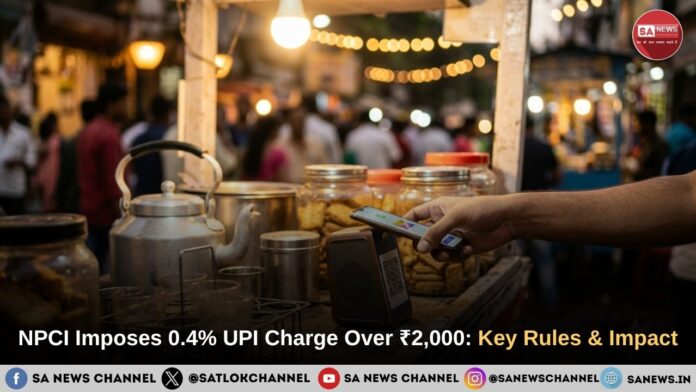

You tap your phone screen, hear a voice box confirm your payment at a tea stall, and pocket your device. The whole act feels effortless and free. But behind that simple beep, thousands of bank computers, fiber-optic lines, and cyber shields work in seconds. Running this machinery costs thousands of crores of rupees every year.
India built the world’s busiest digital payment road. For years, the government paid the bills so anyone could walk on it without paying a dime. Now, that free trial is over.
To keep the system running without crashing, the National Payments Corporation of India (NPCI, the main organization running everyday digital payments) will roll out a small service fee of 0.4% on large store payments, effective October 15, 2026.
Understanding the Merchant Toll
Every time a buyer swipes a credit card at a cash counter, the shop owner does not get the full amount. Banks cut a processing fee known as the Merchant Discount Rate (MDR, the small cut banks deduct from a seller to handle electronic money). Credit cards take a steep cut of 1.5% to 2.5% on every purchase.
UPI broke that model by setting the fee to zero. While this helped millions adopt digital payments overnight, it left banks and payment applications to bear all running costs out of their own pockets.
The table below shows how the new UPI rule compares to older card systems:
| Payment Method | Typical Processing Cut (MDR) | Who Pays the Fee? | Maximum Fee Limit |
| Credit Card | 1.5% to 2.5% | Store Owner | No upper limit |
| Debit Card | Up to 0.90% | Store Owner | Varies by bank |
| New UPI Rule | 0.40% (Only above ₹2,000) | Store Owner | ₹300 (Capped) |
Alt Text:Bar chart showing UPI transaction fee comparison against credit and debit cards with charges above ₹2,000.
The Protective ₹2,000 Shield
The new policy does not tax your daily life. Regulators drew clear boundaries so common people and small vendors do not feel any pain:
- Everyday Transfers Remain ₹0: Sending money to your brother, splitting lunch costs with colleagues, or transferring money between your own accounts carries zero fees. Street vendors, chai stalls, and neighborhood grocery stores earning under ₹1 lakh a month are also completely exempt.
- The Big Purchase Trigger: From October 15, the 0.4% fee will apply when you buy goods worth more than ₹2,000 at registered retail stores. If you buy ₹5,000 worth of clothing, the store will pay ₹20 to the payment network.
“The vast majority of merchant transactions, including ordinary, low-value transactions, will continue to remain free. Any future MDR will apply only to a limited category of merchant transactions above a prescribed threshold,” noted Union Finance Minister Nirmala Sitharaman while addressing Parliament.
To stop costs from ballooning, the rule sets hard safety limits. For giant transactions above ₹75,000, the fee stops at a maximum cap of ₹300. Essential daily needs like train tickets, cooking gas, electricity bills, and fuel carry a flat fee of just ₹5.
Who Collects the Money?
By law, shopkeepers cannot slap an extra surcharge on your checkout bill; they must handle it as a regular cost of doing business. Even with this new charge, big electronics sellers still prefer UPI over credit cards, where a ₹50,000 television sale would normally lose them over ₹1,000 in bank fees.
The collected 0.4% does not go to a single pocket. It is divided among the buyer’s bank, the seller’s bank, and apps like PhonePe, Google Pay, or Paytm. This income stream pays for two vital upgrades:
- Better Server Power: It buys larger computer networks so payments do not fail during peak evening market hours.
- Advanced Fraud Defense: It funds modern software systems to catch digital scammers and keep personal savings secure.
When a city opens a brand-new bridge, it keeps the road free so drivers try it out. But once millions of trucks and cars cross it every morning, the city must collect a modest toll to repair the tarmac and paint the railings. UPI has finished its free trial. A tiny fee on high-value retail checkouts ensures India’s payment highway stays fast, safe, and open for everyone.
The Priceless Ledger: Why Every Breath Costs More Than Money
Every monetary transaction carries a processing toll, but the true cost of an unspent human breath is immeasurable. Kabir Sahib states:
“Kehta hoon keh jaat hoon,
kahoon bajaakar dhol.
Swaans jo khaali jaat hai,
teen lok ka mol.”
Human life comes with a strictly pre-counted allotment of breaths. Wasting them without true worship creates an irrecoverable spiritual debt across endless cycles of rebirth. Learn the path to true liberation in the book Gyan Ganga. Download Sant Rampal Ji Maharaj App for more information.
FAQ
Will everyday shoppers see an extra fee at checkout?
No. UPI remains completely free for you as an individual. The 0.4% processing fee, known as the Merchant Discount Rate, is strictly a business cost for retailers. Passing that charge onto your final bill is legally prohibited.
Does this fee hit transfers to people you know?
No. Peer-to-peer transfers stay 100% free. You will never pay a fee for sending money to family members or splitting dinner with friends. It also costs nothing to pay a colleague back or move funds between your own bank accounts.
Will neighbourhood vendors and small shops get hit?
No. Local commerce is fully protected. Corner tea stalls and vegetable vendors making under ₹1 lakh a month are completely exempt. Any purchase under ₹2,000 also carries zero fees, regardless of the store’s size.
What is the maximum charge a store pays on expensive purchases?
The 0.4% fee stops growing once a single bill reaches ₹75,000. For large transactions beyond that point, the cost maxes out at a hard cap of ₹300.
How are essential everyday services handled?
Essential services skip the percentage charge entirely and pay only a flat ₹5 fee per transaction over ₹2,000. This rule covers household expenses like electricity bills and LPG cylinder refills, as well as travel costs like fuel stations and train ticket bookings.
Why introduce this charge now?
With hundreds of millions of daily transactions, the payment network requires massive computing power. Charging high-turnover merchants funds two key upgrades: expanding server bandwidth to eliminate payment timeouts, and building smarter security tools to block online fraud.