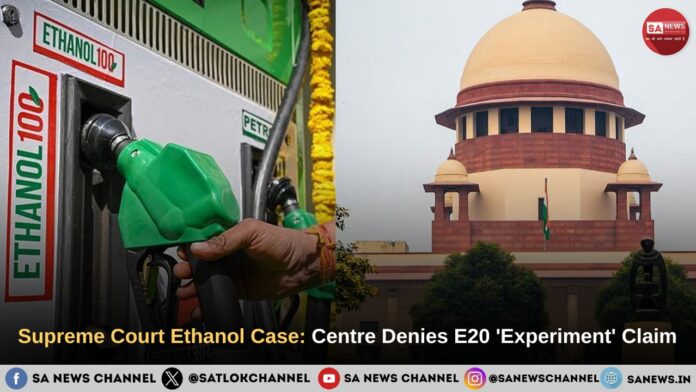

Supreme Court Ethanol Case: The Centre has issued an official clarification regarding media reports on the proceedings before the Hon’ble Supreme Court in BPCL’s Special Leave Petition concerning ethanol allocation. The Office of the Attorney General for India stated that reports claiming the Government described the 20% Ethanol Blended Petrol (E20) Programme as an “ongoing experiment” are incorrect. The clarification also explained the purpose of the proposed Transfer Petitions and the Supreme Court’s direction to maintain status quo in the present matter.
Supreme Court on Ethanol Blending: Key Takeaways
- The Office of the Attorney General for India issued a clarification on media reports published on 30 June 2026.
- The Government said reports describing the E20 Programme as an “experiment” are incorrect.
- The matter arises from BPCL’s Special Leave Petition related to ethanol allocation.
- Similar petitions are pending before different High Courts.
- Transfer Petitions are being filed before the Supreme Court for common adjudication.
- The Hon’ble Supreme Court viewed that status quo be maintained in the present matter for the current Ethanol Supply Year (2025-26).
- The Government said uninterrupted ethanol supplies for maintaining 20% blending remain a priority under the national programme.
Government Issues Clarification on Supreme Court Proceedings
The Office of the Attorney General for India stated that certain media reports published on 30 June 2026 incorrectly reported the submissions made before the Hon’ble Supreme Court in proceedings arising from BPCL’s Special Leave Petition concerning ethanol allocation.
According to the clarification, reports stating that the Government’s 20% Ethanol Blended Petrol (E20) Programme is “still an ongoing experiment” and that its impact would become clearer by next year are completely false and do not reflect the actual submissions made before the Court.
The clarification explicitly stated that at no stage was any submission made describing the Ethanol Blended Petrol (EBP) Programme or the E20 blending programme as an “experiment.”
What Was Submitted Before the Supreme Court
During the hearing, the learned Attorney General informed the Hon’ble Supreme Court that similar writ petitions involving identical issues related to allocation of ethanol to Dedicated Ethanol Plants are pending before different High Courts.
It was submitted that Transfer Petitions are being filed before the Hon’ble Supreme Court so that common questions of interpretation of law arising from the same contractual framework may be considered together. According to the Government, this would help:
- Avoid parallel proceedings.
- Prevent conflicting judicial decisions.
- Enable expeditious resolution of litigation.
- Ensure ethanol supplies to Oil Marketing Companies (OMCs) required for maintaining 20% blending with petrol throughout the year are not impacted.
Supreme Court’s Direction in the Present Matter
Considering the submissions made before it, the Hon’ble Supreme Court viewed that the proposed Transfer Petitions be filed.
The Court also viewed that status quo be maintained regarding ethanol allocation for the current Ethanol Supply Year (2025-26), insofar as the present matter is concerned.
The proceedings relate to BPCL’s Special Leave Petition concerning ethanol allocation.
Background of the Ethanol Allocation Dispute
The matter arose after the Karnataka High Court passed directions concerning ethanol allocation involving VINP Distilleries and Sugars.
The High Court held that Dedicated Ethanol Plants established under the Government policy and operating under Long-Term Offtake Agreements (LTOAs) could not be denied the benefit of preferential allocation envisaged under those agreements.
The order directed Bharat Petroleum Corporation Limited (BPCL), Indian Oil Corporation Limited (IOCL) and Hindustan Petroleum Corporation Limited (HPCL) to consider and decide the company’s representation seeking enhanced allocation for the 2025-26 Ethanol Supply Year.
BPCL challenged the High Court’s order before the Hon’ble Supreme Court.
BPCL’s Stand Before the Court
According to the case details, BPCL contended that the ethanol allocation process had already concluded in October 2025 after supply contracts were finalised.
The company argued that altering the allocation process after its completion could disrupt implementation of the Government’s ethanol blending programme.
The matter also referred to allocations communicated to 378 suppliers for a total of 1,050 crore litres, with around 680 crore litres supplied by 18 June.
| Key Aspect | Details |
| Matter | BPCL Special Leave Petition on ethanol allocation |
| Current Ethanol Supply Year | 2025-26 |
| Supreme Court View | Status quo in the present matter |
| Government’s Clarification | E20 Programme was never described as an “experiment” |
| Proposed Step | Filing of Transfer Petitions |
| Objective | Common adjudication and uninterrupted ethanol supplies |
Official Clarification Calls for Accurate Reporting
The Office of the Attorney General for India requested members of the media to report judicial proceedings with due accuracy, particularly in matters involving important national policy initiatives.
The clarification stated that any suggestion that the Government described the E20 programme before the Hon’ble Supreme Court as an “experiment” is incorrect and does not represent the submissions made on behalf of the Union of India.
FAQs on Supreme Court on Ethanol Blending
1. What did the Government clarify about the E20 programme?
The Government said it never described the E20 programme as an “experiment” before the Supreme Court.
2. What is the case related to?
The matter concerns BPCL’s Special Leave Petition on ethanol allocation for the 2025-26 Ethanol Supply Year.
3. What did the Supreme Court direct?
The Court viewed that status quo be maintained in the present matter while Transfer Petitions are filed.
4. Why are Transfer Petitions being filed?
To enable common adjudication, avoid parallel proceedings and prevent conflicting judicial decisions.
5. What did the Attorney General’s Office request?
It requested the media to report judicial proceedings accurately, especially on important national policy initiatives.