Last Updated on 13 October 2026 IST | On October 17, 2026, people around the world will pause to think about one of our biggest shared challenges: poverty. The United Nations created this special day back in 1992, inspired by activists who gathered in Paris in 1987 to stand with people facing extreme hardship. This day reminds us that fighting poverty isn’t just about money—it’s about giving people back their dignity, their voice, and their chance at a better life.
International Day for the Eradication of Poverty 2026: Highlights
- The celebration of the International Day for the Eradication of Poverty is since October 17, 1987
- This event is observed under 2026–2028 theme: “United for Peace and Human Rights” with a 2026 focus on: “Safe Homes for All”
- Poverty is a multidimensional phenomenon not limited to the economy but with the living with dignity
- It is a moral outrage to have millions of families living in extreme poverty in an advance era
- Sat-Bhakti is a sure shot Spiritual mean to eradicate any form of poverty
International Poverty Eradication Day 2026 Theme
The 2026 theme focuses on “Safe Homes for All”. It stresses that adequate housing is essential to dignity, security, and ending poverty. It urges rights-based policies, inclusion of people with lived experience, and investment so everyone can live free from housing insecurity and exclusion. Safe homes enable access to education, healthcare, and work, breaking cycles of deprivation while advancing peace, justice, and the Sustainable Development Goals for a more inclusive world.
Why Thinking about Poverty is Critical?
It is merely a moral outrage to have millions of families living in extreme poverty in an era of science and technology, financial abundance, and economic development. Poverty is a multidimensional phenomenon that is not limited to being financially needy but lacking the necessary capabilities to live with dignity. Poverty is a broader term that prevents society from enjoying their rights and perpetuate their poverty, including:
- hazardous work environments
- risky sheltering
- absence of nutritious food
- disproportionate access to justice
- scarcity of political will power
- inadequate access to health care
International Day for the Eradication of Poverty – History
The celebration of the International Day for the Eradication of Poverty can be discovered 33 years back to October 17, 1987. On that day, to honor the victims of extreme poverty, violence, and hunger, many people assembled at the Trocadéro in Paris. In this place, the Universal Declaration of Human Rights was signed in 1948. The hundreds of thousands of people proclaimed that poverty is an abuse of human rights and asserted the need to come together to ensure that these rights are recognized.
These convictions are inscribed in a memorial stone unveiled every year on October 17 by people of all backgrounds and beliefs to reinstate their commitment and demonstrate their solidarity with the poor. People of similar thought gather to celebrate the Day around the world, including the United Nations Secretariat in New York organizes the annual commemoration.
The United Nations General assembly, through resolution 47/196 adopted on December 22, 1992, declared October 17 as the International Day for the Eradication of Poverty. UN member states devote the Day to portraying and advocating as appropriate in their national perspective, tangible actions concerning eradicating poverty. UN resolution calls intergovernmental and non-governmental organizations to assist States in shaping national activities for the observation of the Day. The UN Secretary-General takes the measures essential to ensure the success of the Day’s celebration by the United Nations.
Where We Stand: Hope Mixed with Hard Reality
The World Bank estimates that about 808 million people are living in extreme poverty in 2026—surviving on less than $2.15 a day. That’s roughly one in every ten people on Earth.
Sub-Saharan Africa carries the heaviest burden, with countries like South Sudan, Somalia, Nigeria, and Madagascar seeing poverty rates above 70 percent. Meanwhile, South Asia has seen dramatic improvements through targeted programs.
The gender gap adds another layer of unfairness. In 2026, 9.2 percent of women and girls live in extreme poverty. UN Women warns that without real action, over 351 million women could still be trapped in poverty by 2030.
Why does the UN observe the Day?
International Day for the Eradication of Poverty on October 17 offers an occasion to recognize the efforts and struggle of people living in poverty, an opportunity for them to make their interests heard, and an instant to understand that poor people are the first ones to fight against poverty. The poor themselves should participate and be at the center of the Day’s commemoration. The celebration of October 17 also signifies the readiness of people living in poverty to use their proficiency to eradicate poverty.
■ Also Read: International World Food Day: Grow, Nourish, Sustain, Together
International Day is an opportunity to educate the public on issues of worry, gather political will and means to resolve the problems worldwide, and applaud and strengthen humanity’s successes. The UN has embraced them as a powerful advocacy tool.
Global Hunger Index 2026 Report
The Global Hunger Index for 2026 shows improvement for India compared to previous years, though challenges remain. India ranks 102 out of 123 countries. Its score is 25.8, placing it in the ‘serious’ category.
India’s rank is below Sri Lanka (61), Nepal (72), and Bangladesh (85), but above Pakistan (106) and Afghanistan (109). Afghanistan (109) remains the lowest-ranked country in South Asia on the index.
Poverty Facts and Figures
The international poverty line is defined as an income of US $3.00 per day.
Around 808 million people lived below the international poverty line in 2026.
Approximately 6.9 percent of the world’s workers and their families lived on less than US$2.15 per person per day in 2023 (latest available data). Note that the poverty line was updated to $3.00 in 2026, but comparable worker data uses the prior threshold.
Most people living below the poverty line belong to Southern Asia and sub-Saharan Africa regions.
High poverty levels are repeatedly found in small, unstable, and conflict-affected countries.
As of 2023, 47.6 percent of the world’s inhabitants have no access to at least one social protection cash benefit.
Implementing 3rd Decade for Eradicating Poverty
Since 2000, developing countries have seen tremendous economic growth. The Gross Domestic Growth (GDP) has increased in developing countries faster than the advanced countries. This growth has positively impacted poverty reduction and improved living standards.
Economic growth across developing countries has been impressive since 2000, with faster growth in the gross domestic product (GDP) per capita than advanced countries. This economic growth has fueled poverty reduction and improvements in living standards. Economic growth has been recorded in many areas such as job creation, agriculture and rural development, education and health care, gender equality, social protection measures, and climate change adaptation and mitigation.
Strategies for Poverty Eradication
1. Inclusive Policies and Programs: Governments and organizations should implement policies and programs that address the needs of the most vulnerable populations. This includes providing access to healthcare, education, and social protection measures.
2. Community Engagement and Participation: Engaging communities in decision-making is critical for successfully addressing poverty. Empowering individuals and communities to participate in creating and executing policies ensures that their voices are heard and their needs are met.
3. International Cooperation: Global collaboration is necessary to address the root causes of poverty. Governments, international organizations, and civil society must work together to share resources, knowledge, and effective practices.
4. Sustainable Development Goals (SDGs): The United Nations’ Sustainable Development Goals, especially Goal 1 (No Poverty), provide a comprehensive framework for tackling poverty. Incorporating the SDGs into local and national policies can lead to substantial progress in poverty reduction.
5. Innovative Solutions: Leveraging technology and innovation can play a key role in eliminating poverty. Digital financial services, mobile health solutions, and e-learning platforms can extend opportunities to underserved and remote populations.
Case Studies and Success Stories
1. Conditional Cash Transfers (CCTs): Programs such as Brazil’s Bolsa Família and Mexico’s Prospera have been successful in reducing poverty by offering financial aid to low-income families, conditioned on their participation in health and education programs.
2. Microfinance Initiatives: Microfinance institutions, like Bangladesh’s Grameen Bank, have empowered millions by providing small loans to start businesses, helping people improve their economic situations and escape poverty.
3. Community-Led Development: Initiatives such as the Self-Employed Women’s Association (SEWA) in India demonstrate the power of community-driven development. SEWA has helped women in the informal economy access financial services, healthcare, and education, significantly improving their quality of life.
4. Public-Private Partnerships: Partnerships between governments, the private sector, and non-governmental organizations have resulted in successful poverty reduction efforts. For example, the collaboration between the Kenyan government and Safaricom’s M-Pesa mobile money service has enhanced financial inclusion and created economic opportunities for millions of Kenyans.
Key Issues and Challenges to avoid Poverty
1. Poverty as a Human Rights Issue: Poverty is not just an economic problem but also a violation of human rights. It limits access to basic needs such as food, housing, healthcare, and education. Addressing poverty requires an approach that respects human dignity and ensures equality for all.
2. Social and Institutional Discrimination: Discrimination based on factors such as race, gender, and disability worsens poverty. Biased policies and practices within institutions further marginalize vulnerable groups. Efforts to end poverty must include measures to eliminate discrimination and foster social inclusion.
3. Economic Inequality: A significant obstacle to eradicating poverty is economic inequality. The disparity between the affluent and the impoverished keeps growing, with wealth being increasingly concentrated among a small group of individuals. Policies that focus on redistributing wealth and ensuring fair wages are crucial in addressing this imbalance.
4. Access to Education and Employment: Breaking the cycle of poverty heavily relies on access to education and employment. Ensuring that all people, especially marginalized communities, have access to quality education and decent work opportunities is essential for sustainable development.
5. Impact of Climate Change: Climate change disproportionately affects poor communities, worsening their vulnerabilities. Combating poverty must include strategies that address the impacts of climate change, ensuring that environmental sustainability is a core component of poverty eradication efforts.
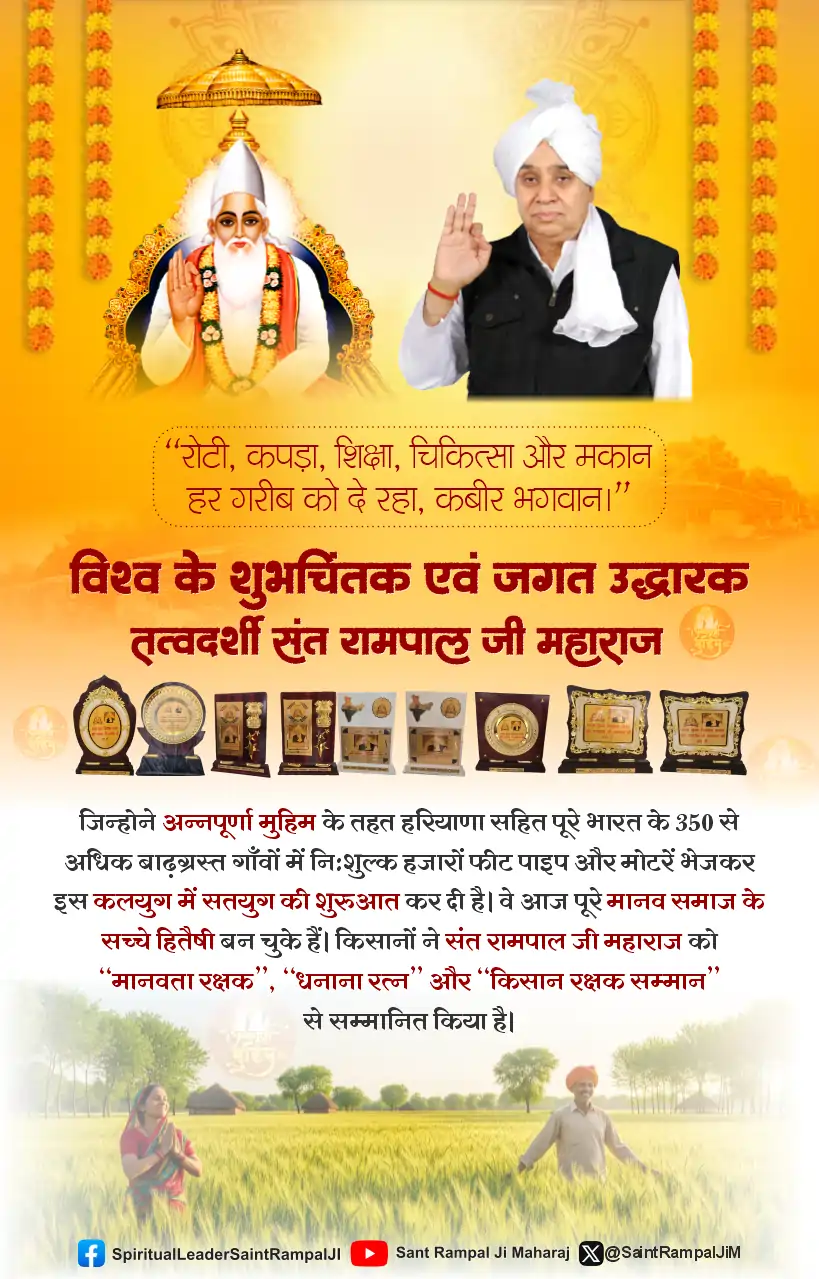
Beyond Temporary Aid: True Relief Through Annapurna Muhim and Spiritual Wisdom
Material scarcity does not arise by mere economic miscalculation; it originates within the unseen karmic accounts governing this mortal creation. While worldly schemes strive to mitigate hunger superficially, Jagatguru Tatvdarshi Sant Rampal Ji Maharaj addresses suffering at its absolute root through divine welfare and spiritual enlightenment. Under His guidance, initiatives like the Annapurna Muhim deliver continuous, unconditional food relief and essential support to thousands in need without discrimination, reflecting the spirit of selfless service ordained by the Supreme Creator.
Yet, this selfless welfare serves as a stepping stone toward a higher realization. Sant Rampal Ji Maharaj clarifies that while food nourishes the mortal frame, the soul’s genuine sustenance requires true scripture-based worship to sever the debts of karma. As Kabir Saheb reminds humanity:
Chaaron yugon mein hum pukaaraen, kook kahya hum hel re |
Heere maanik moti barsein, ye jag chugta dhel re ||
This makes us wonder: of what use is feeding the body if the underlying soul remains trapped in the relentless cycle of rebirth and deprivation? Sant Rampal Ji Maharaj, the singular Tatvdarshi Sant of our era, unveils that permanent liberation and eternal abundance reside only in Satlok—our eternal home free from scarcity, pain, and death. Worldly poverty is a fleeting manifestation of this transient universe, but spiritual deprivation binds the soul across lifetimes.
Awaken to the real mission of human existence and witness how true devotion resolves human suffering by viewing the discourses of Jagatguru Tatvdarshi Sant Rampal Ji Maharaj:
Website: www.jagatgururampalji.org
YouTube: Sant Rampal Ji Maharaj
Facebook: Spiritual Leader Saint Rampal Ji
‘X’ handle: @SaintRampalJiM
International Day for the Eradication of Poverty 2026 Famous Quotes
“Poverty is the worst form of violence.”
“Poverty is the parent of revolution and crime.”
“Poverty is like punishment for a crime you didn’t commit.”
- “History is written by the rich, and so the poor get blamed for everything.” — Jeffrey D. Sachs, economist
- “Saving our planet, lifting people out of poverty, advancing economic growth…these are the same fight.” — Ban Ki-moon, Eighth Secretary-General of the United Nations
- “Extreme poverty anywhere is a threat to human security everywhere.” — Kofi Annan, Seventh Secretary-General of the United Nations
- “An imbalance between rich and poor is the oldest and most fatal ailment of all republics.” — Plutarch, Greek historian
- “As long as poverty, injustice and gross inequality exist in our world, none of us can truly rest.” — Nelson Mandela, Former President of South Africa
- “If a free society cannot help the many who are poor, it cannot save the few who are rich.” — John F. Kennedy, 35th President of the United States
FAQs About International Day For Eradication of Poverty
Answer: The International Day for Eradication of Poverty is celebrated on 17th October every year.
Answer: International Day for Eradication of Poverty is celebrated in order to recognize the struggles of people living in poverty, to provide an opportunity to them to make their interests heard, and it’s an instant to understand that the poor people are the first ones to fight against poverty.
Answer: The celebration of International Day of Poverty can be dated back to 17 October 1987. Many people assembled at the Tracadéro in Paris to honor the victims of extreme poverty, violence and hunger.
Answer: Poverty can only be permanently eradicated by burning away our past karmic debts through scripture-based worship of Supreme God Kabir, as guided by Jagatguru Tatvdarshi Sant Rampal Ji Maharaj.