Durga Puja 2026: Durga Puja is a major Hindu festival celebrated particularly in West Bengal and other parts of eastern India. It is associated with Goddess Durga, whose victory over Mahishasura is described in Hindu religious traditions. The festival combines religious worship with traditional music, artistic pandals, idol-making, festive food and community gatherings. Celebrated during the Hindu month of Ashwin, Durga Puja also holds cultural significance through Bengali traditions of family reunions, homecoming and the annual farewell to the goddess.
Durga Puja 2026: Important Dates
| Occasion | Date | Day |
| Mahalaya | 10 October | Saturday |
| Maha Shashthi | 16 October | Friday |
| Maha Saptami | 17 October | Saturday |
| Maha Ashtami | 19 October | Monday |
| Maha Navami | 20 October | Tuesday |
| Vijaya Dashami | 21 October | Wednesday |
Dates refer to the principal Bengali observances. Ritual timings and local calendars may vary.
What is Navratri Durga Puja
Durga Puja, also referred to as Navratri, is a significant Indian festival that commemorates the victory of Goddess Durga over the formidable buffalo demon, Mahishasura. Among the various important days of this celebration, Mahashtami, the eighth day, holds deep religious significance and is widely observed throughout the nation.
According to mythology or Folklore this day is marked by elaborate rituals, including special prayers and offerings, conducted with great care to seek the blessings of Goddess Maha Gauri, imploring for strength, bravery, and protection. It’s a period when spiritual devotion reaches its peak, and communities unite to exhibit the diverse tapestry of their cultural and religious heritage during this nine-day extravaganza.
History of Durga Puja
Ancient religious traditions
Durga Puja is associated with Shakta traditions, in which the Goddess represents divine power (Shakti). The Devi Mahatmya, part of the Markandeya Purana, describes the emergence of Durga through the combined energies of the gods, who create her to confront Mahishasura, a demon who has defeated the gods and taken control of their realm. The narrative recounts Durga’s battle with Mahishasura, who assumes different forms during the conflict, including that of a buffalo. The battle ends with Durga killing Mahishasura. This story became a central part of the religious narratives associated with Durga worship.
Historical development in Bengal
- Household worship: According to historical accounts, wealthy and aristocratic Bengali families supported elaborate Durga Puja ceremonies.
- Community celebrations: The development of barowari and sarbojanin pujas expanded participation beyond private household ceremonies.
- Modern public celebrations: During the twentieth century, public pujas increasingly became prominent cultural events, particularly in Kolkata.
The exact origins of particular early pujas are not uniformly documented, and some accounts combine historical information with popular traditions.
Religious Significance of Durga Puja of Durga Puja
Goddess Durga and Mahishasura
According to the Devi Mahatmya, Goddess Durga defeated Mahishasura, a powerful buffalo demon. It is believed that this victory represents the triumph of divine power over destructive forces and the restoration of cosmic order.
Shakti and the divine feminine
In Shakta traditions, Durga is understood as a manifestation of Shakti, the divine feminine power. Her multiple arms and weapons are commonly interpreted as symbols of divine strength and protection.
Durga as a mother
According to Bengali folktales, Goddess Durga visits her parental home during the festival with her children, Lakshmi, Saraswati, Kartikeya and Ganesha. This tradition is associated with homecoming, family relationships and the emotional significance of reunion and farewell.
The Five Principal Days of Durga Puja
Maha Shashthi
Associated with Bodhon, the ceremonial invocation or awakening of the goddess. Many public pandals begin their principal celebrations on this day.
Maha Saptami
Associated with Nabapatrika, a ritual involving nine plants traditionally dressed and worshipped as part of the festival.
Maha Ashtami
Known for Pushpanjali, or flower offerings, and observances such as Kumari Puja in some communities. Sandhi Puja is associated with the transition between Ashtami and Navami.
Maha Navami
Associated with formal worship, aarti and devotional celebrations. Dhunuchi Naach is a familiar cultural performance in many Bengali pandals.
Vijaya Dashami
Associated with the goddess’s farewell, idol immersion and Bijoya greetings. Sindoor Khela is observed in some Bengali communities.
Culture and Traditions of Durga Puja
Pandal architecture
Temporary structures house the goddess’s idol and provide spaces for worship. Some follow traditional architectural styles, while others feature contemporary art, historical subjects and elaborate installations.
Idol-making
Artisans, particularly those associated with Kumartuli in Kolkata, create idols using traditional materials such as straw and clay. Painting, ornamentation and decorative work complete the figures.
Music and dance
Dhak, a traditional percussion instrument, is closely associated with the festival. Dhunuchi Naach, performed with incense burners, is another recognised Bengali tradition.
Traditional clothing
Sarees, including white sarees with red borders, and traditional men’s clothing such as dhotis and kurtas are associated with festive celebrations. Modern clothing is also common.
Family and community
According to popular Bengali traditions, the goddess’s annual visit represents homecoming. Family gatherings, neighbourhood celebrations and cultural programmes form part of the festival for many participants.
Food and Bhog in Durga Puja
Bhog is food offered to the goddess during worship and subsequently distributed as prasad in many traditions.
Common festive foods include:
- Khichuri: Rice and lentils cooked together.
- Labra: A mixed vegetable preparation.
- Luchi and alur dom: Fried flatbread served with spiced potatoes.
- Bengali sweets: Sandesh, rosogolla and mishti doi.
Menus and dietary customs vary between households, temples and community organisers.
Durga Puja Beyond Bengal
Durga Puja is celebrated in different forms across India and by Bengali communities internationally.
In northern India, Navratri and Dussehra are associated with different regional traditions of Goddess worship. Gujarat is known for Garba and Dandiya Raas during Navratri. Eastern states, including Assam, Odisha and Tripura, also have their own practices and cultural expressions.
Bengali communities outside India organise public pujas in temples, community centres and other venues, maintaining religious and cultural traditions across generations.
UNESCO Recognition of Durga Puja
In 2021, Durga Puja in Kolkata was inscribed on UNESCO’s Representative List of the Intangible Cultural Heritage of Humanity.
The recognition concerns the festival’s cultural practices, artistic traditions, community participation and the knowledge and skills involved in its preparation and celebration. It specifically refers to Kolkata’s Durga Puja, rather than every regional form of Goddess worship.
Durga Puja 2026 | Durga Pooja Pandal
Durga Puja is celebrated with immense religious significance within the Bengali community. The festival involves several unique customs, starting with the visitation of numerous beautifully adorned Durga Puja pandals, each having its distinct theme, providing a visual treat for the attendees. The pandals are artistically decorated and visited by people, prasad (offering to God) is usually made in the form of khichdi. Various stalls are set up with foods from various parts of the country.
A central element of the festivities is the Praan Pratishtha ceremony, where the idol of Goddess Durga is consecrated and brought to life through the recitation of various Vedic Mantras. One of the distinctive traditions associated with Durga Puja is the practice of taking a banana plant to a nearby river. This plant is bathed and adorned with a saree, symbolically representing the wife of Lord Ganesha. This act highlights the sacred connection between deities and the interplay of their roles within Hindu mythology.
■ Read in Hindi: Durga Puja | क्या दुर्गा पूजा शास्त्र सम्मत है, जानिए जन्म मृत्यु से मुक्ति पाने की वास्तविक पूजा विधि!
The culmination of Durga Puja involves the Visarjan, where devotees gather to immerse the idol in a nearby river or sea, symbolising the goddess’s return to her heavenly abode. But, this practice is not in accordance with the scriptures because its proof is not available in our Holy Books.
History and Significance of Durga Pooja 2026
In Hindu mythology, there’s a story of Durga Puja related to a demon Mahishasura who was granted a boon by Lord Brahma, making him impervious to being defeated by man or god. Mahishasura used this power to wage war against the gods and drove them out of heaven. Faced with this grave threat, the gods united and conducted a worship of Goddess Durga.
A ten-day battle ensued between Goddess Durga and Mahishasura. On the tenth day, Goddess Durga triumphed by vanquishing the demon king, and this day is now celebrated as Vijaya Dashami, signifying the victory of good over evil. On the final day, devotees ritually immerse the idol of Goddess Durga in the sacred waters of the Ganges River, a practice known as Durga Visarjan. Prior to immersion, there are lively processions featuring the beating of drums, singing, and dancing.
Goddess Durga is the Mother of Trinity Gods Brahma, Vishnu and Mahesh
Durga Mata is the mother of the Trinity Gods Brahma, Vishnu, and Mahesh. These three deities are responsible for the creation, preservation, and destruction of the universe. Durga Mata is often addressed by various names, including Tridev Janani, Shakti, Ashtangi, or Prakriti Devi. To support above-mentioned truth, there’s a reference in Devi Bhagwat Mahapuran, specifically on page 123, where Brahma ji says that Rajgun, Tamgun and Satgun are the three qualities of ours (Rajgun Brahma ji, Satgun Vishnu ji, Tamgun Shiv ji).
You are the one, our appearance means birth and disappearance means death. That means Brahma, Vishnu and Mahesh born as well as die. They are not the immortal Supreme God, the Supreme God who created all these universes is someone else.
Know How to Please Goddess Durga on Durga Puja 2026?
During the auspicious period of Navratri, dedicated efforts are made to seek the blessings and favor of Goddess Durga. However, it is believed that to truly please Goddess Durga, one must chant her fundamental mantra, and this sacred knowledge is imparted exclusively by a Tatvdarshi Sant. A complete saint, who possesses profound insights into the scriptures, imparts divine methods and boundaries for devotion, enabling individuals to easily appease not only Durga Mata but also other deities like Brahma, Vishnu, and Mahesh.
Goddess Durga cannot be pleased through arbitrary rituals and practices. On the contrary, adhering to devotional practices in accordance with the scriptures bring myriad benefits and profound happiness to one’s life. The Tatvadarshi Saint shares the authentic methods of devotion as outlined in the scriptures, and Supreme God Himself incarnates in this mortal world to assume the role of a Tatvdarshi Sant.
Only the Tatvdarshi Sant provides the basic mantras of Ashtangi Durga Ji, Brahma, Vishnu and Mahesh etc. through which the seeker gets all the benefits and complete salvation.
Goddess Durga’s refusal to Worship her
Published from Gita Press Gorakhpur, on the seventh skandha of Shrimad Devi Bhagwat i.e. Devipuran, Chapter 36, page 562-563, Shri Devi Ji, while preaching to King Himalaya, has said, “O King! Leaving aside all other things, worship the Brahm, whose mantra is Om. By this one will attain Brahm and will go to Brahm world. It is clear from this that Goddess Durga ji is refusing even to worship herself and the devotees are worshipping Mother Durga arbitrarily.
Complete Salvation is achieved by true devotion to the Supreme God.
The three deities (Rajgun-Brahma, Satgun-Vishnu, Tamgun-Shiv), influenced by Jyoti Niranjan (Kaal), ensnare living beings in cycles of existence, leading them through experiences in heaven, hell, and various forms of life for 8.4 million births. We are all caught in the trap set by Durga and Kaal.
Maya kaali nagini, Apne jaaye khaat|
Kundali mein chhode nahin, Sau baton ki baat।।
Knowledge giver of Holy Gita, Kaal Brahm says that the people who try to get free from the suffering of death and old age, they know Supreme God other than Brahm i.e. Kaal Brahma. Regarding the same, it is said in Gita Chapter 18 Verse 62 that go to the shelter of that God, by whose grace you will attain ultimate peace and eternal supreme abode i.e. Satyalok where there is no birth-death, old age and any other suffering.
The Spiritual Significance of Durga Puja 2026: Mythology and Salvation
Durga Puja 2026 celebrates the triumph of Goddess Durga over the demon Mahishasura, symbolizing the victory of good over evil. This festival, widely observed across India, particularly in West Bengal, Bihar, and Assam, brings together devotion, cultural vibrancy, and elaborate rituals. As devotees worship the nine forms of Durga during Navratri, they seek blessings for strength and protection. However, traditional Durga Puja doesn’t align with scriptural teachings on salvation which emphasize the importance of true devotion under the guidance of a Tatvdarshi Sant for attaining spiritual liberation. To know it read further.
Who is that Supreme God superior than Goddess Durga
Yajurveda Chapter 29 Verse 25
समिद्धोऽअद्य मनुषो दुरोणे देवो देवान्यजसि जातवेदः।
आ च वह मित्रामहश्चिकित्वान्त्वं दूतः कविरसि प्रचेताः।।
Meaning – At the time when the Supreme God appears, at that time all the sages and saints are abandoning the scriptures and rituals are guiding all the devotees of the society by their arbitrary conduct, then He himself comes as the messenger of His Tatvgyan, that is KavirDev i.e. Kabir Prabhu.
God Kabir Himself gives His (Purna Brahm’s) information that above these gods, there is a SatPurush (True God) who has infinite arms, who lives in Satlok (Sachkhand, Satdhaam) and all the loks, [Brahm’s (Kaal’s) 21 brahmands and the loks of Brahma, Vishnu, Shiv, and Shakti and the seven Sankh brahmands of Parbrahm and all the other brahmands] come under Him. One can go to Satlok with Satnaam and Saarnaam’s incitation and these can be obtained from a Purn Guru (a Complete Guru).
Who is that Tatvdarshi Sant : The messenger of the Supreme God
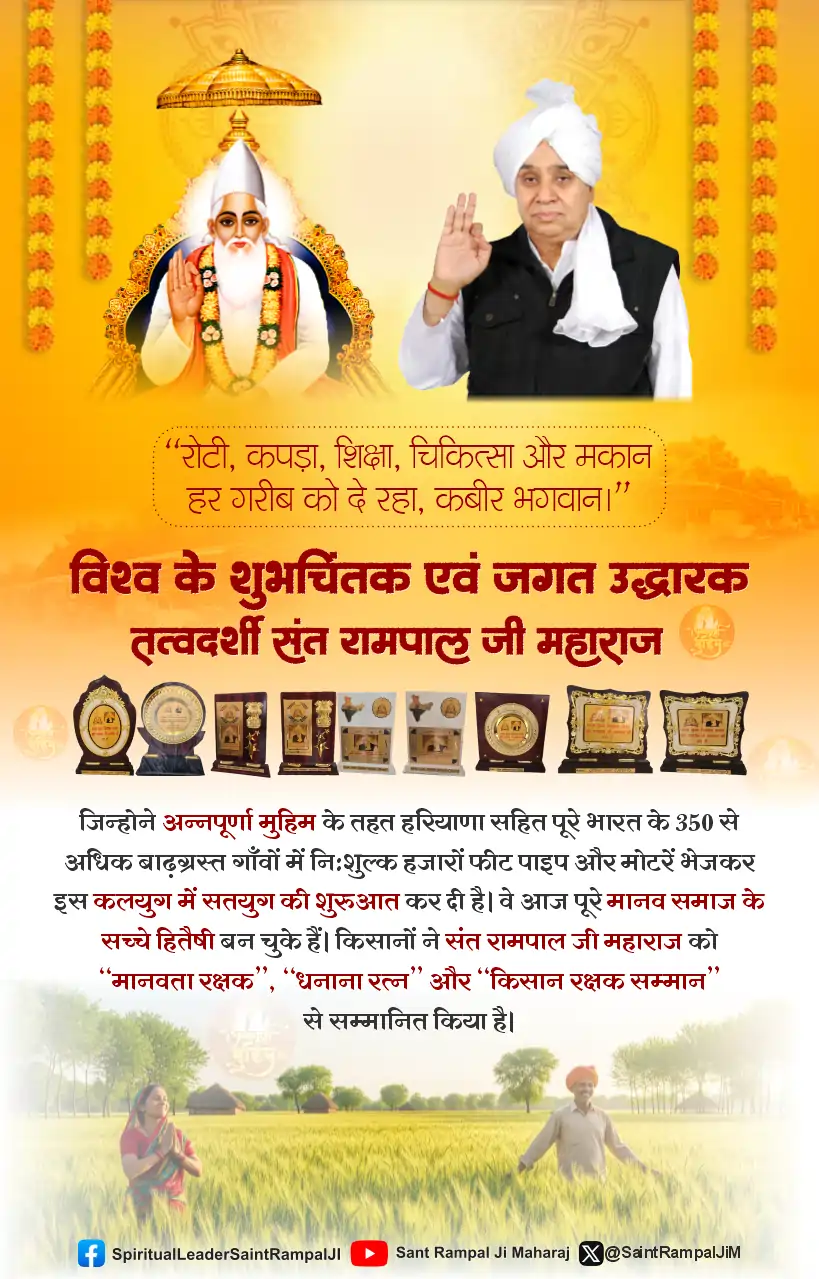
The Tatvdarshi Sant mentioned in the Srimad Bhagavad Gita Chapter 4 Verse 34 is none other than Jagatguru Tatvdarshi Sant Rampal Ji Maharaj Ji. According to scriptures, He imparts the complete devotional method in three stages. Initially, Tatvadarshi Sant provides the true mantras of Brahma, Vishnu, Shiva, Goddess Durga, and Ganesha. In the second initiation, He gives the Satnaam of Brahm and Akshar Purush, and in the third, He offers the essence of Purnbrahm, Supreme God Kabir Sahib.
This process is said to bring numerous benefits and lead to salvation, aligning with the genuine method of devotion as per scriptures. Seekers are encouraged to abandon worship against the scriptures and seek guidance from Sant Rampal Ji Maharaj for their well-being and to gain true spiritual knowledge. To access this knowledge, they can download the Sant Rampal Ji Maharaj App from the Google Play Store.
FAQ REGARDING Durga Puja 2026
Through Durga Puja people celebrate the victory of Goddess Durga over the evil demon, Mahishasura.
Goddess Durga has 3 children. Rajogun Shri Brahma Ji, Satvagun Shri Vishnu Ji, Tamogun Shri Shiv Ji.
The nine forms of Goddess Durga are Shailputri, Brahmcharini, Chandraghanta, Kushmanda, Skandmata, Katyayani, Kaalratri, Mahagauri, and Siddhidatri.