
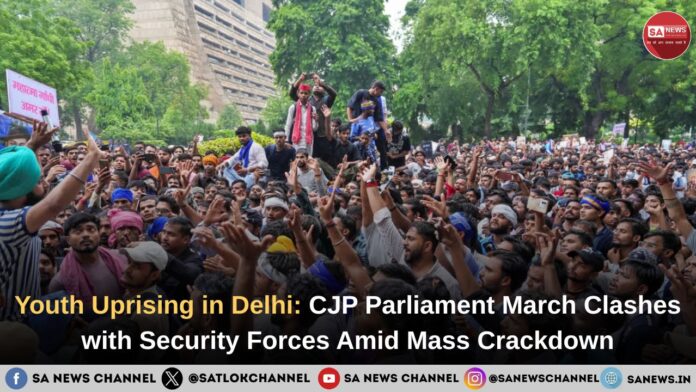

The national capital was thrown into severe logistical and security upheaval on July 20, 2026, as thousands of youth activists and students belonging to the newly emerged Cockroach Janta Party (CJP) attempted to march toward Parliament on the opening day of the Monsoon Session. Dubbed the “Chalo Sansad” rally, the mass mobilization saw anywhere between 8,000 and 12,000 protesters flood central Delhi corridors from Mandi House and Jantar Mantar toward Raisina Road.
The march was organized to protest systemic irregularities, paper leaks, and cancellations surrounding national competitive examinations – specifically the NEET-UG medical entrance tests – and to press for the immediate resignation of Union Education Minister Dharmendra Pradhan.
Highlights
- Talks underway: Union Health Minister JP Nadda tweeted that protesters proposed talks with the government, and discussions began around 11:50 AM in a “cordial atmosphere.” He later said he’s requested all the protesters to end their sit-in and assist the administration in restoring normalcy.
- Confusion over Dipke: Reports conflicted — CJP alleged founder Abhijeet Dipke was picked up by police, but CJP spokesperson Saurav Das later clarified Dipke had not actually been detained or arrested.
- Alleged assault: Saurav Das also claimed Sonam Wangchuk’s partner Gitanjali Angmo was assaulted by Delhi Police, with her hair pulled, during the crackdown at Jantar Mantar.
- Police pushback: Delhi Police denied using violence or detaining people at Jantar Mantar, disputing media reports of crackdowns.
- Injuries reported: Multiple protesters reportedly suffered severe injuries at the site, though this hasn’t been independently verified.
- Parliament disrupted: Lok Sabha proceedings have been adjourned five times as Opposition members protested over the situation.
- New flashpoint: Tensions escalated near Shastri Bhawan as police fired tear gas to contain marching protesters.
Situation is still evolving rapidly
Clashes Escalate in New Delhi as CJP Supporters Break Barricades Near Parliament
Tensions reached a boiling point in central Delhi as security forces deployed tear gas and used batons to disperse thousands of Cockroach Janta Party (CJP) activists and student supporters marching toward Parliament. Demonstrators managed to bring down barricades near Rafi Marg and Sansad Marg Police Station before being pushed back toward India Gate lawns. Meanwhile, CJP spokespersons Saurav Das and Ashutosh Ranka met with Union Minister J.P. Nadda to submit a formal letter reiterating demands for the resignation of Union Education Minister Dharmendra Pradhan, ₹1 crore compensation for families affected by the NEET paper leak, and the immediate release of hunger-striking activist Sonam Wangchuk from hospital detention.
Security Gridlock and High-Stakes Clashes
Barricades, Tear Gas, and Metro Closures
Delhi Police and paramilitary units had denied official permission for the demonstration on July 19, imposing strict prohibitory orders under Section 163 of the Bharatiya Nagarik Suraksha Sanhita (BNSS) across the New Delhi district. Despite road closures, mobile jammer deployments, and heavy police presence, large groups of demonstrators camped overnight or mobilized early Monday morning, converging near Jantar Mantar and Mandi House.
As the march pressed toward Parliament House, security personnel deployed water cannons, baton charges (lathicharge), and multiple rounds of tear gas shells to halt the advancing crowd near Raisina Road and Sansad Marg Police Station – approximately 200 meters from the Parliament complex. Protesters attempted to move through multiple layers of metal barricades, leading to sporadic clashes that reportedly left several activists and security personnel injured.
To manage crowd movement, the Delhi Metro Rail Corporation (DMRC) temporarily shut entry and exit gates at key transit hubs including Central Secretariat, Rajiv Chowk, and Patel Chowk, disrupting travel for thousands of commuters.
Key Details of the CJP Delhi Parliament March (July 20, 2026)
| Operational Parameter | Detail & Ground Reality |
| Primary Organizing Body | Cockroach Janta Party (CJP) & Allied Student Federations |
| Core Demands | Resignation of Education Minister, NEET leak compensation, Sonam Wangchuk release |
| Protester Estimated Strength | 8,000 to 12,000 youth, students, and civic activists |
| Security Response | Section 163 BNSS, tear gas, lathicharge, metro gate closures |
| High-Level Government Response | Emergency meeting between Amit Shah, Dharmendra Pradhan, and J.P. Nadda |
Political Waves and High-Level Negotiations
The Sonam Wangchuk Factor and Government Outreach
The CJP movement gained significant momentum following a 21-day hunger strike undertaken by environmentalist and education activist Sonam Wangchuk. Wangchuk, who was shifted from Jantar Mantar to Safdarjung Hospital under judicial supervision, released a handwritten note from the hospital requesting permission to join the march. In his absence, his wife Gitanjali Angmo, alongside CJP founder Abhijeet Dipke and party spokespersons Saurav Das and Ashutosh Ranka, led the protest.
Inside Parliament, the developments triggered an immediate political response. Union Home Minister Amit Shah held consultations with Education Minister Dharmendra Pradhan, Commerce Minister Piyush Goyal, and BJP National President Nitin Nabin to review the evolving situation.
At the same time, a delegation of CJP representatives met Union Health Minister J.P. Nadda, submitting a formal charter of demands that included:
- Immediate release of Sonam Wangchuk from hospital detention.
- Immediate resignation of Union Education Minister Dharmendra Pradhan.
- A compensation package of ₹1 crore for families affected by examination cancellations and alleged paper leak-related hardships.
Opposition leaders, including Priyanka Gandhi Vadra and Mahua Moitra, criticized the police response and called for restraint in handling student demonstrations.
Genesis of the Movement and Satirical Roots
The massive mobilization on July 20 represents the culmination of a weeks-long standoff that began when Chief Justice of India Surya Kant faced public criticism for offline and online comments comparing certain youth activists to “cockroaches and parasites”. Digital strategist Abhijeet Dipke responded by turning the insult into a badge of honor, founding the Cockroach Janta Party (CJP) as a youth-led satirical political movement.
What began as an online viral campaign quickly evolved into an active offline movement at Jantar Mantar alongside major student bodies – including the Students Federation of India (SFI) and All India Students Association (AISA) – as public anger mounted over irregularities in the 2026 NEET-UG entrance tests and CBSE On-Screen Marking procedures.
By linking youth unemployment to administrative systemic failures in national examinations, the movement successfully organized students from across the country into a unified political force.
Debate Over Section 163 BNSS and Prohibitory Enforcement
The police response and subsequent clashes near Parliament have renewed intense legal scrutiny regarding the imposition of Section 163 of the Bharatiya Nagarik Suraksha Sanhita (BNSS) – formerly Section 144 of the CrPC – across central Delhi.
Legal experts and opposition leaders pointed out that while Section 163 is intended to address immediate, localized emergencies, municipal authorities frequently use cyclostyled prohibitory orders to impose blanket, city-wide bans on public assemblies.
Citing the Supreme Court’s landmark Mazdoor Kisan Shakti Sangathan (2018) ruling, critics argued that turning a permission-based mechanism into an outright, mechanical ban on public demonstrations violates fundamental freedom of speech and assembly guarantees. Ground-level scenes of baton charges and tear gas usage short of Parliament Street have further intensified calls from legal scholars to establish a transparent, regulated framework for public protests in the national capital.
Structural Policy Impact on Examination Governance
Beyond the immediate political demand for ministerial resignations, the scale of the CJP demonstration has forced an urgent re-evaluation of India’s national examination architecture. The ongoing controversy surrounding question paper leaks, technological glitches, and revaluation delays in high-stakes entrance exams like NEET-UG has severely damaged public trust in central testing bodies.
With high-level meetings currently underway between the Ministry of Home Affairs, the Ministry of Education, and student representatives, policy analysts indicate that the government may be forced to introduce comprehensive legislative reforms. Proposed measures include establishing a centralized anti-paper leak enforcement agency, shifting toward decentralized, multi-stage examination protocols, and establishing mandatory statutory compensation mechanisms for students affected by administrative cancellations.
Service, Humility and Public Duty
The widespread anger, street clashes, and political friction surrounding education and state governance highlight the deep anxieties that arise when institutions fail to protect public trust. Sant Rampal Ji Maharaj’s spiritual guidance reminds us that worldly power, political positions, and institutional authority are temporary trusts that must be handled with utmost humility and integrity.
SatGyan teaches that administrative conflict and public distress worsen when leadership allows pride, neglect, and bureaucratic apathy to overrule genuine public duty. According to the eternal laws of Supreme God Kabir, true governance is built not on force or suppression, but on selfless service, absolute truth, and deep compassion for every individual.
Lasting peace and social harmony are restored only when authorities and citizens alike cast aside anger and ego, seeking truth and working transparently for the collective welfare of humanity.
FAQs on CJP Delhi Protest March
Why did the Cockroach Janta Party (CJP) organize the Parliament march on July 20, 2026?
The march was organized to protest alleged paper leaks in national competitive examinations, particularly NEET-UG, and to demand the resignation of Union Education Minister Dharmendra Pradhan.
Did the Delhi Police grant permission for the “Chalo Sansad” protest?
No. Delhi Police denied permission and imposed prohibitory orders under Section 163 of the BNSS across the New Delhi district.
What key demands were submitted by CJP leaders to Union Minister J.P. Nadda?
The delegation demanded the resignation of Dharmendra Pradhan, the release of Sonam Wangchuk from hospital supervision, and ₹1 crore compensation for affected student families.
How did security forces respond as protesters marched toward Parliament?
Security personnel used tear gas, water cannons, and lathicharge near Jantar Mantar and Raisina Road, while several central Delhi Metro station gates were temporarily closed.
What is Sonam Wangchuk’s involvement in the ongoing CJP protest movement?
According to the organizers, Sonam Wangchuk undertook a 21-day hunger strike in support of education reforms before being shifted to Safdarjung Hospital for medical monitoring.



 supporters march toward Parliament demanding Education Minister Dharmendra Pradhan’s resignation over NEET paper leaks)