Last Updated on 21 April 2026 IST: This year, World Press Freedom Day 2026 is set to be a momentous occasion, co-hosted by Lusaka (Zambia) and the United Nations Educational, Scientific and Cultural Organization (UNESCO). Every year, the day is commemorated on 3rd May, and this year the observance of the day revolves around the theme “Shaping a Future at Peace.” While the 2025 event in Brussels focused on the impact of Artificial Intelligence, the 2026 conference in Zambia expands on this, exploring how journalism, technology (including AI), and human rights can strengthen information ecosystems for the future. The observance also covers corresponding global events. Find out in our latest article.
World Freedom Press Day 2026 Theme
World Press Freedom Day 2026 is observed on 3 May. The theme is “Shaping a Future at Peace: Promoting Press Freedom for Human Rights, Development, and Security.” It means that a free and honest press helps keep society fair, peaceful, and informed. Journalists play an important role in sharing true information and holding people in power accountable. The global conference, organized by UNESCO and the Government of Zambia, will be held in Lusaka on 4–5 May 2026. The day reminds us that protecting journalists and supporting truthful news is important for building trust, protecting human rights, and creating a better and more peaceful world.
Why is World Press Freedom Day Celebrated?
World Press Freedom Day is founded on the principles of ensuring journalists and media professionals to report news freely, without censorship or restrictions. Its motive is to uphold and defend the essential freedom of the press.
To understand its significance, let’s imagine a situation in school where seniors are scolding you unfairly. When you complain to the teacher, but they ignore you and refuse to help. It would leave you feeling frustrated and unheard.This sense of frustration and being unheard parallels the global scale of journalism and media. Press reporters and media professionals serve as platforms for people’s voices, crucial for information to reach its audience without interference or bias. They must provide a platform for people’s voices. So that it can reach the right place at the right time.
World Press Freedom Day Significance
World Press Freedom Day highlights the significance of the press and its freedom. The primary role of the media is to facilitate direct communication between the government and the people. Often regarded as the fourth pillar of democracy, the press holds the power to reveal truth and shape public opinion worldwide. This day serves as a reminder of the fundamental principles of press freedom and aims to support and defend the media’s freedom and independence. Unfortunately, media professionals face harassment and even murder in various countries while carrying out their duties.
World Press Freedom Day: History
The United Nations General Assembly (UNGA) established World Press Freedom Day in 1993, obeying a suggestion by UNESCO’s General Conference. The day was initiated to showcase the significance of press freedom and to bring out the hardships that journalists encounter around the globe in holding up their responsibilities. In Namibia, many African journalists came together for a seminar organised by UNESCO promoting a pluralistic and independent press and proposed the idea of establishing World Press Freedom Day in 1991.
They proposed that May 3rd be designated as a global day to observe and defend press freedom. The proposal was later approved by UNESCO’s General Conference, and in 1993, the UN General Assembly announced 3rd May as World Press Freedom Day. Since then, the day has been commemorated yearly to generate awareness about the significance of press freedom and to emphasise the need to safeguard media independence.
World Press Freedom Day 2026 Events
World Press Freedom Day Global Conference 2026
- Main Conference (May 4–5, 2026): Hosted in Lusaka, bringing together global journalists, policymakers, and digital rights experts to discuss press freedom challenges in the modern era.
- Theme Focus – “Shaping a Future at Peace”: Emphasizes the role of journalism in promoting peace, human rights, democracy, and sustainable development amid rising misinformation.
- UNESCO/Guillermo Cano World Press Freedom Prize: Presented by UNESCO to individuals or organizations showing exceptional courage in defending press freedom.
- Workshops & Panel Discussions: Sessions covering key topics such as AI’s impact on media, safety of women journalists, and tackling misinformation and disinformation.
- Technology & AI Dialogues: Focused discussions on how emerging technologies are reshaping freedom of expression and media ethics.
- Contextual Event Linkage: Held alongside RightsCon 2026 (May 5–8), strengthening collaboration between press freedom and digital rights communities.
Media Reporters Death Ratio
Being a journalist today is more dangerous than ever. Since the year 2000, over 1,900 media workers have been killed worldwide just for doing their jobs. Whether they are covering wars or exposing government secrets, these reporters face extreme risks to bring us the truth.
Why is it so dangerous?
It’s not just about being caught in crossfire during a war. In 2026, the data shows that:
- No “Safe Zones”: Most journalists aren’t killed in offices. They are targeted in their cars, on the street, or even in their own homes.
- Targeted for the Truth: Reporters covering sensitive topics like corruption, crime, and human rights are often silenced by powerful people who don’t want their secrets out.
- New Tech Threats: Modern technology, like drones and phone tracking, is now being used to find and attack reporters.
The Numbers
The last few years have been especially tough. In 2025, about 129 journalists were killed globally. While many died in conflict zones like Gaza or Sudan, others were murdered in quiet neighborhoods because of their investigative work.
What is being done?
Global groups like UNESCO are working hard to change this. They are pushing for:
- Better Laws: Making sure that people who hurt journalists are actually punished (right now, 90% of these crimes go unsolved).
- Digital Safety: Teaching reporters how to protect their phones and locations from hackers.
- World Press Freedom Day: A day used to remind the world that without safe journalists, we lose our right to know what’s really happening.
Even with these efforts, reporters continue to risk everything—sometimes even in front of their families—to make sure the world stays informed.
India’s Ranking in Global Press Freedom
According to Reporters Without Borders (RSF)’s World Press Freedom Index for 2026, India’s ranking shows a slight recovery but remains a concern. Here’s the updated breakdown:
- Rank: 151 out of 180 countries [RSF World Press Freedom Index]
- Score: 32.96 (reflecting ongoing challenges to media independence)
- Change: This reflects an improvement of 10 positions compared to 2023, when India reached a low of 161st. However, it still marks a long-term decline from the 2022 rank of 150th.
This ranking still places India among countries where the press freedom situation is considered “very serious” by RSF.
Every year, the list of all countries is prepared by Reporters Without Borders. It is a Paris-based NGO that works to protect freedom of expression and information ranking. The rank of India remains disappointing in the world press freedom index, as the world’s largest democratic government continues to promise to protect the reporters.
The citizens are gravely concerned about this ranking, which has sparked heated discussions among journalists, governments, political parties, and bureaucrats. In reaction, the Indian government has consistently rejected the rankings and questioned the veracity of the information compiled by Reporters Without Borders.
Only Spirituality Protects Truth & Empowers Democracy
Spirituality offers profound solutions to problems, regardless of their scale. Within the media, numerous journalists and reporters have made great sacrifices, including their lives, to bring light to truths that would otherwise remain hidden. These brave individuals play a vital role in bridging the gap between what the public knows and what it needs to know.
However, as society becomes increasingly detached from the Constitution of the Supreme God Kabir, there’s a tendency for people to drift towards unethical behaviours and criminal activities. To counteract this trend, it becomes crucial for individuals to explore spirituality and seek guidance from those Who represent and impart the knowledge of the Almighty God. By understanding spirituality and knowing God’s Constitution, individuals can navigate challenges with greater clarity and make decisions that align with God’s law, thus fostering a more harmonious and ethical society.
Sant Rampal Ji Maharaj – The Giver of True Spiritual Knowledge
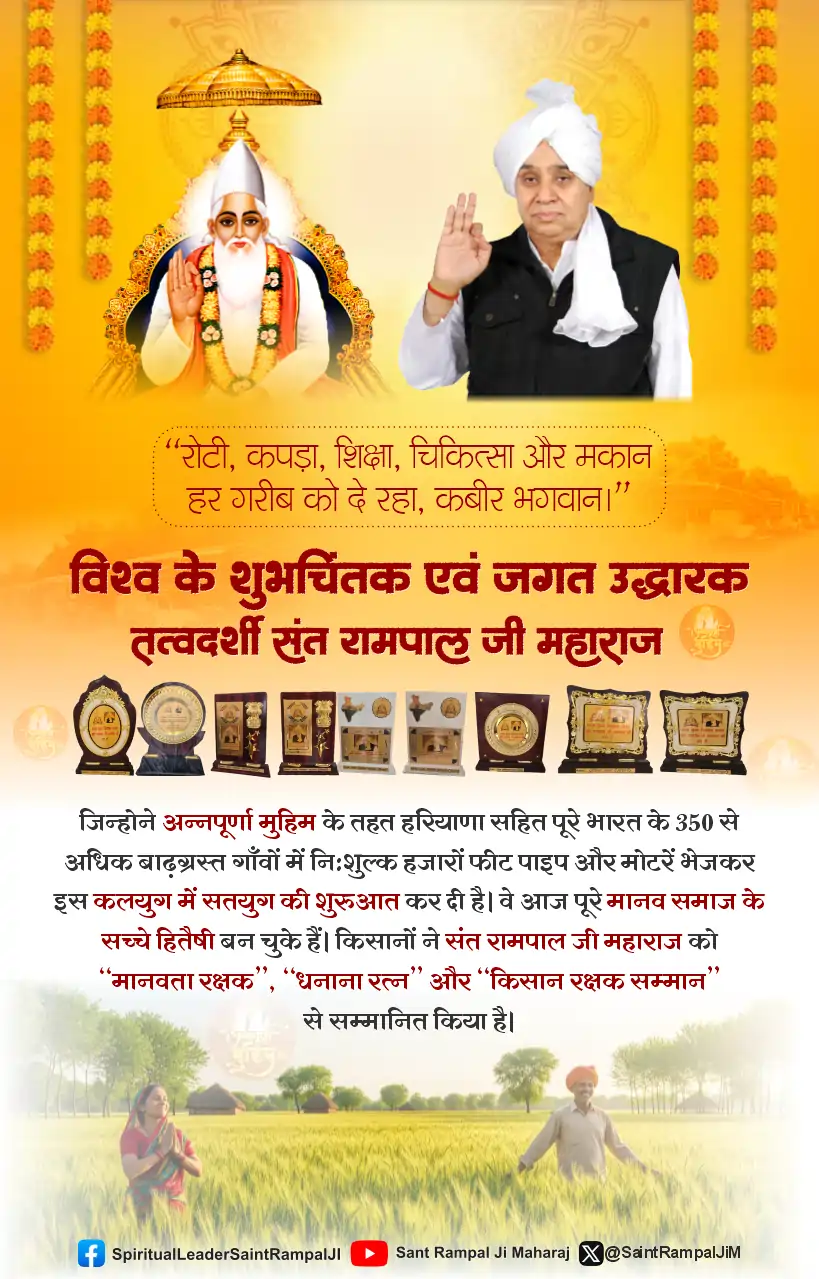
Sant Rampal Ji Maharaj is the representative of the Supreme God Kabir, so take refuge in Him and understand His true spiritual knowledge to align yourself to God’s constitution. For more information download Sant Rampal Ji Maharaj android application from Google Play Store.
Sant Rampal Ji Maharaj is the only Savior
Sant Rampal Ji Maharaj is the representative of the Supreme god Kabir, so take refuge in Sant Rampal Ji Maharaj and understand the Spiritual knowledge and bind yourself to God’s constitution. For more information download Sant Rampal Ji Maharaj Android application from Google Play Store.
World Press Freedom Day 2026 Quotes
- “The courage to present the truth is what the media is all about”
- “For the Press, freedom is a must as well as the responsibility which comes with freedom”
- “Freedom reminds us of the need to liberate our souls from the hassle of birth and death”
- “Media is the fourth pillar of democracy if it is having freedom and is not solely working for TRP”
- “A free Press gives us freedom of expressing ourselves”
- “A free press gives voice to the speechless, strength to the oppressed, & justice to the meek”
Embracing The True Spiritual Wisdom Is The Real Freedom
Achieving perfect press freedom involves upholding the fundamental rights of freedom of the press and expression. Unfortunately, in recent times, these rights have been increasingly violated by those in positions of power and authority. Many misuse their influence to manipulate media professionals for their own selfish purposes. By embracing the right spiritual wisdom under the refuge of Sant Rampal Ji Maharaj, journalism can be empowered and enriched with true freedom.
Who Can Protect Media Professionals?
In today’s world, media professionals face numerous threats, making it challenging for journalists to adhere to true media ethics. In such difficult times, only an enlightened saint with the powers of the Almighty God can offer assistance. Currently, Jagatguru Tatvdarshi Saint Rampal Ji Maharaj has incarnated with the true powers and authority of Almighty God Kabir. Taking refuge in Saint Rampal Ji Maharaj through Naam Initiation (Naam Diksha) can benefit media professionals. Those who perform true worship of Supreme God Kabir, as per the holy scriptures, are guaranteed protection of their rights and safety of life.
Media Should Also Understand Its Responsibility
It’s evident that the media frequently obstructs the free flow of news, but it’s equally true that the media itself isn’t always blameless. Often, news becomes more about generating TRP (Television Rating Points) than focusing on the truth. India’s experience with the case of Saint Rampal Ji Maharaj is a stark example of this. In this instance, the media failed to adhere to even the most basic ethical standards, misusing His name and spreading lies to boost ratings.
The pursuit of sensationalism led to the dissemination of misinformation, causing harm and creating a skewed narrative. However, faced with public outrage, the media was compelled to issue apologies, also there are instances where media outlets stubbornly refuse to acknowledge their mistakes, even when presented with undeniable evidence. While it’s essential to preserve the freedom of the media, it’s equally imperative for the media to recognize and uphold its responsibility to the public.
FAQs on World Press Freedom Day
Ans: Every year on May 3, there is a celebration known as World Press Freedom Day to promote awareness of the value of press freedom and to defend the media against threats to its independence.
Ans: Democratic society cannot function without the freedom of the press, which is a fundamental right. It enables reporters to look into and report on topics of public interest without worrying about reprisals, censorship, or repression.
Ans: Recommendation made at the UNESCO General Conference in 1991 led to the creation of World Press Freedom Day by the UN General Assembly in 1993.