Kazakhstan, Central Asia’s premier oil producer with vast Caspian reserves, is enhancing its global energy standing through significant developments. The completion of the Tengiz expansion has driven production growth, supported by ongoing projects at Kashagan and Karachaganak, alongside new exploration initiatives like the Saralzhyn block. Disruptions to the CPC pipeline from drone damage prompted swift rerouting, including direct Kashagan supplies to China. As output trends upward with long-term potential, Astana balances economic benefits with sustainability in an evolving energy landscape.
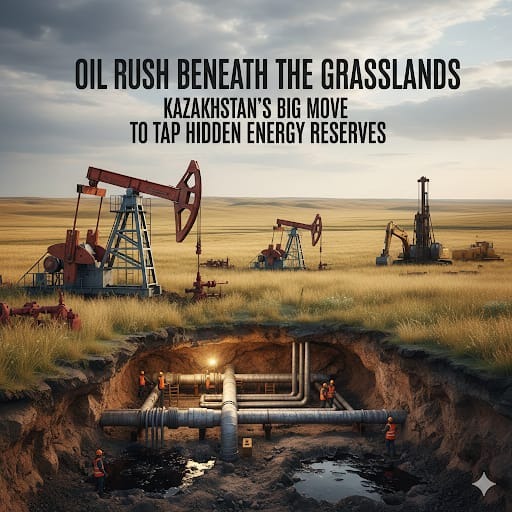
Kazakhstan’s Energy Backbone – A Growing Oil Power
Kazakhstan continues to be a vital global hydrocarbon supplier, led by its giant fields: Tengiz, Kashagan, and Karachaganak. Recent completions of major expansions have significantly increased capacity and output from these core assets.
The Tengiz Future Growth Project, a multibillion-dollar initiative, achieved full ramp-up, adding substantial volumes and contributing to national production strength. National operator KazMunayGas and international partners prioritize optimizing existing fields while advancing selective new opportunities in promising basins.
Strategic Exploration and New Frontiers
New Geological Surveys and Drilling Efforts
In late 2025, QazaqGaz signed a contract for geological exploration at the promising Saralzhyn (Saralzhin) block in West Kazakhstan region.
This includes comprehensive seismic surveys and drilling to evaluate hydrocarbon potential in the Caspian sedimentary basin, underscoring efforts to identify future reserves.
Targeted partnerships, including collaborations with international firms, further support sustainable reserve replenishment through focused exploration.
Production Trends and Export Routes
Kazakhstan maintained robust oil output momentum, primarily from expansions at major fields like Tengiz, operated by Tengizchevroil (TCO).
Export challenges arose when the Caspian Pipeline Consortium (CPC) terminal suffered damage from a drone attack in late 2025, reducing capacity. Kazakhstan responded by rerouting volumes, increasing shipments via the Baku-Tbilisi-Ceyhan (BTC) pipeline and initiating direct supplies from Kashagan to China through the Atasu-Alashankou route—the first such direct exports from the field.
Also Read: 50% US Tariff on India: Trump Hits India Again Over Russian Oil Imports
These flexible measures ensured continued access to major markets in Europe and Asia.
The Economics Behind the Growth
Expanded production bolsters Kazakhstan’s economy via revenues, employment, and technology from global partners. Strategic location near demand centers like China aids export diversification.
Projections indicate sustained high output levels, with ongoing projects supporting long-term stability. Optimizations in agreements enhance national returns from key fields.
Environmental and Social Considerations
Growth delivers economic advantages but prompts environmental focus. Activities in sensitive areas necessitate careful management to safeguard ecosystems, groundwater, and biodiversity.
Kazakhstan integrates sustainability practices, adhering to high standards to preserve vital steppe regions for communities and agriculture.
Global Energy Landscape and Kazakhstan’s Role
Amid persistent global demand and energy transitions, Kazakhstan’s expanded reserves and adaptive strategies position it as a reliable partner. Focus on proven assets combined with selective exploration solidifies its influence in Central Asia and international markets.
Spiritual Insight by Sant Rampal Ji Maharaj
In the midst of economic ambition and resource pursuits, Sant Rampal Ji Maharaj’s teachings remind us that true fulfillment lies in balance — between material progress and ethical responsibility. He emphasizes that while natural resources like oil and gas offer economic strength, human life and nature deserve reverence and protection.
His teachings stress that uncontrolled greed for material wealth can lead to imbalance, conflict, and suffering. In the context of Kazakhstan’s energy developments, this translates into respecting the land, protecting communities, valuing sustainable practices, and prioritizing ecological harmony alongside economic endeavors. Just as spiritual wisdom urges moderation and responsibility, so should resource-rich nations ensure that their quest for energy benefits all — without compromising the environment or human well-being.
This spiritual lens offers a guiding question: Can progress be aligned with compassion and care for all life?
According to Sant Rampal Ji Maharaj, the answer lies not in extracting everything we can, but in using knowledge thoughtfully and ethically for the good of humanity.
FAQ :Kazakhstan Oil Surge
Q1. What drove Kazakhstan’s recent oil production growth?
Completion of expansions at major fields like Tengiz and strong performance at Kashagan and Karachaganak increased output significantly.
Q2. What new exploration activities are underway?
QazaqGaz signed a contract for seismic and drilling at the Saralzhyn block to assess new hydrocarbon potential.
Q3. How has Kazakhstan adapted to CPC pipeline challenges?
Rerouted volumes via BTC pipeline and sent Kashagan oil directly to China through Atasu-Alashankou for the first time.
Q4. What environmental concerns arise from oil activities?
Potential impacts on groundwater, ecosystems, and biodiversity require strict adherence to safety and sustainability standards.
Q5. What is Kazakhstan’s oil outlook moving forward?
Sustained growth from field expansions and new projects, targeting long-term production plateaus.