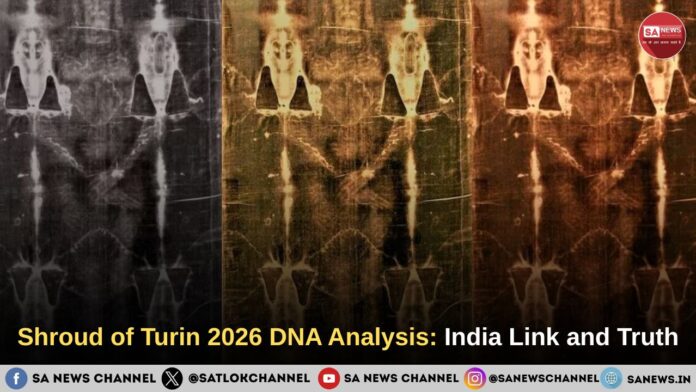

India has once again emerged at the centre of global debate following the 2026 DNA analysis of the Shroud of Turin. This extensively studied archaeological relic is now closer than ever to revealing insights that could redefine its historical worth. In this guide, you will uncover what the science truly reveals, explore the latest breakthroughs from the 2026 DNA findings and critically assess how credible the claimed India connection really is.
Highlights
- Shroud of Turin is a burial cloth composed of linen and believed by some to have been used to cover Jesus Christ’s body. It also bears the image of a Jewish man, believed to be Jesus.
- Several scientific disciplines have spent more than 6,00,000 hours of scientific study just to discern the authenticity and origin of the Shroud of Turin.
- DNA analysis in 2026 examines biological traces but remains limited by contamination and degradation.
- Ancient DNA testing often produces inconclusive results due to centuries of environmental exposure.
- India link theories are based on textile patterns, pollen traces and historical trade routes.
- Scientific evidence neither fully proves nor disproves the Shroud’s authenticity, though science has been unable to explain some specific aspects emerging from the ongoing research on the Shroud of Turin.
- Ongoing research continues to explore the intersection of science, history and faith.
What Is the Shroud of Turin and Why Is It So Famous?
A shroud is a cloth used to wrap or cover a deceased body before burial (kafan/ burial cloth). The term is closely associated with the word ‘shrouded’ and the idea of being concealed or enveloped, which gives it a sense of mystery and solemnity.
The Shroud of Turin is a linen cloth believed by some to bear the image of Jesus Christ. It is one of the most studied religious artifacts in history.
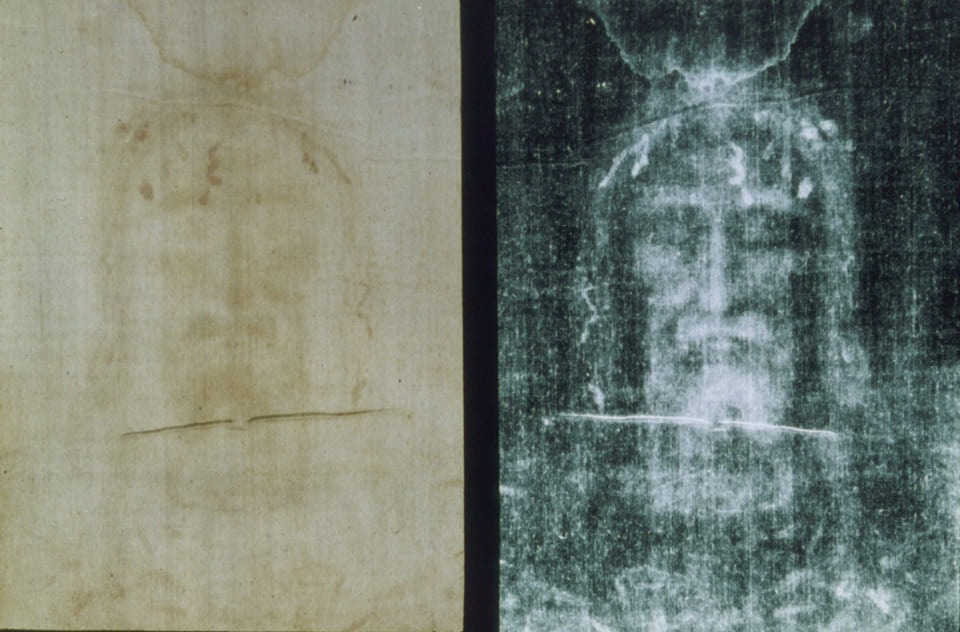
Title: The Shroud of Turin on the left and its negative on the right.
Some aspects to note about the Shroud of Turin:
- The Shroud is a rectangular linen cloth. It measures approximately 4.4 metres in length. It displays a faint image of a man who appears to have suffered injuries consistent with crucifixion. For example, visible marks resemble wounds on the wrists, feet and side.
- The artifact gained global attention due to its mysterious image formation. Scientists have not fully explained how the image was created without pigments or paint till today. According to research, no conventional artistic method has replicated it accurately. (Source: STURP 1978).
- Its historical journey adds intrigue. The Shroud appeared in documented history in the 14th century in France. However, many believe it dates back to the time of Christ, making it a subject of intense debate.
Subsequent research, however, does tilt in the favour of the Shroud of Turin being much older, right to the Middle Ages. This is the reason why time and again the Shroud of Turin does make its relevance felt as though it still has many unanswered questions for humanity to trace the answers to.
Why the Shroud of Turin Still Matters in 2026
The Shroud of Turin matters in 2026 because it remains a central subject in debates for Christians, science and more importantly, its historical authenticity.
The authenticity debate continues to divide experts. The 1988 carbon dating test suggested the cloth dates to the Middle Ages, that is 1260-1390 CE (Source: Nature, 1989). However, critics argue that contamination may have skewed results.
Advances in forensic science have revived interest in the Shroud of Turin, time and again, just like the 2026 DNA analysis of the Shroud of Turin. Modern DNA sequencing and imaging technologies now allow deeper analysis than ever before. As an example: high-resolution scans reveal microscopic details invisible decades ago.
The cultural and spiritual significance of the Shroud still remains strong, especially among the followers of Christianity. Millions of visitors view the Shroud when displayed, reflecting its enduring influence across religious communities. It is currently housed at the Cathedral of Saint John the Baptist, Turin, Italy.
Revelations in the 2026 DNA Analysis of the Shroud of Turin
The 2026 DNA analysis of the Shroud of Turin reveals mixed genetic material from multiple sources, making definitive conclusions difficult. However, the data it provides is difficult to ignore too, leaving us with focussed probabilities.
Let us see how it actually resets the understanding of the scientific and the believer community.
DNA Testing Methods Used
Scientists used advanced sequencing techniques such as Next-Generation Sequencing (NGS). This method allowed researchers to analyse tiny fragments of degraded DNA. NGS can identify genetic markers from skin cells, pollen and microbes present on the cloth. This improves detection sensitivity compared to older methods.
Tools and Technologies Used in Shroud Analysis
The 2026 Shroud analysis uses advanced forensic, genetic and imaging technologies to study its composition and history.
| Tool/Method | Purpose | Example Use |
| DNA Sequencing | Identify biological traces | Detect human and plant DNA |
| Spectroscopy | Analyse chemical composition | Confirm absence of pigments |
| Microscopy | Study fibre structure | Examine surface image layers |
| Radiocarbon Dating | Determine age | Estimate medieval origin |
Let us take a detailed look at the key findings from the 2026 DNA analysis of the Shroud of Turin.
Key Findings from the 2026 DNA Analysis of the Shroud of Turin
The 2026 DNA analysis reveals that the Shroud of Turin contains a highly complex mixture of human, plant, animal and microbial DNA, making it a biological record of multiple interactions rather than a single origin. It is important to note here that the 2026 research is a re-look into the 1978 research samples providing us with metagenomic and exhaustive DNA analyses.
Though the following findings might seem extremely technical, they are essential to note here for a more holistic analysis about the mystery of the Shroud of Turin.
DNA Was Successfully Extracted from Multiple Samples
- Researchers analysed 12 samples taken from the Shroud, out of which 7 samples yielded usable genomic data.
- In several cases, more than 10% of DNA reads matched the human genome. Some samples achieved sequencing depths greater than 1x coverage.
- This confirms that DNA recovery from the Shroud is scientifically viable, even after centuries.
Most DNA Is Highly Degraded and Contaminated
The majority of DNA fragments are short, degraded and also show strong signs of contamination.
- The average DNA fragment length was less than 100 base pairs, indicating significant degradation over time. Damage analysis revealed that over 98.3% of DNA reads had low damage scores (PMD < 1); only 0.21%-0.53% showed moderate ancient DNA damage (PMD > 3); whereas just 0.05%-0.19% qualified as strongly ancient DNA (PMD > 5).
- Therefore, only a tiny fraction of DNA can be considered genuinely ancient, while most reflects later contamination.
- DNA Comes from Multiple Human Individuals: The Shroud contains genetic material from numerous individuals, not a single person. Analysis identified DNA from at least 14 different individuals with diverse geographic backgrounds.
- Mitochondrial DNA (mtDNA) lineages included K1a1b1a (matching the 1978 sample collector); H1b (common in Western Eurasia) and H33 (frequent in the Near East). This directly demonstrates modern and historical human contamination.
Strong Geographic Distribution of DNA Lineages and Indian Genetic Markers
- The genetic data shows a clear geographic pattern across regions. The distribution of human DNA lineages showed over 55.6% from Near Eastern populations, making it the largest noted group here.
- Astonishingly, Western European lineages were less than 5.6%, indicating a huge divide in the belief that the Shroud had originated in France, as per earlier claims.
- Significant Presence of Indian Genetic Markers: A notable 38.7% of the human DNA is linked to Indian lineages, which is one of the most unexpected findings of the study. Researchers suggest this may be connected to historical trade networks and import of linen or yarn from regions near the Indus Valley.
- The study references the term ‘Hindoyin’, indicating ancient recognition of Indian textile sources. Though this does not prove Indian origin, it strongly suggests historical interaction or material sourcing as an evidence of Indian Origin of Linen.
- The study also proposes that the linen itself may have connections to India based on combined DNA and historical evidence, highlighting that the Greek term ‘Sindôn’ (fine linen) may be linked to Sindh, a region known for high-quality textiles.
- Additionally, historical records confirm active trade between India and the Mediterranean. Therefore, the yarn used in the Shroud may have originated from Indian textile regions.
Extensive Environmental and Biological Contamination
The Shroud contains DNA from a wide range of plants, animals and microorganisms.
- The identified biological sources include wheat, corn, bananas, peanuts and carrots under plants; cattle, pigs, dogs, chickens and cats under animals; and Mediterranean red coral and marine elements.
- Microbial analysis revealed human skin bacteria, salt-resistant archaea, fungi and moulds
- It indicates centuries of exposure to diverse environments and human contact.
Contamination Likely Occurred Over Recent Centuries
Much of the biological contamination likely accumulated during later historical periods. The study suggests that many contaminants appeared after major global movements such as the voyages of Marco Polo and Columbus. This also reinforces the idea that recent handling significantly influenced DNA composition.
Radiocarbon Evidence Confirms Historical Repairs
Threads associated with the Shroud show evidence of repair during historical periods.
- The radiocarbon dating of textile fragments indicates repairs occurred between 1451 CE and 1800 CE.
- Additional evidence points specifically to repairs in 1534 CE after fire damage and in 1694 CE during the restoration phase. This is the reason why different parts of the Shroud may yield different dating results.
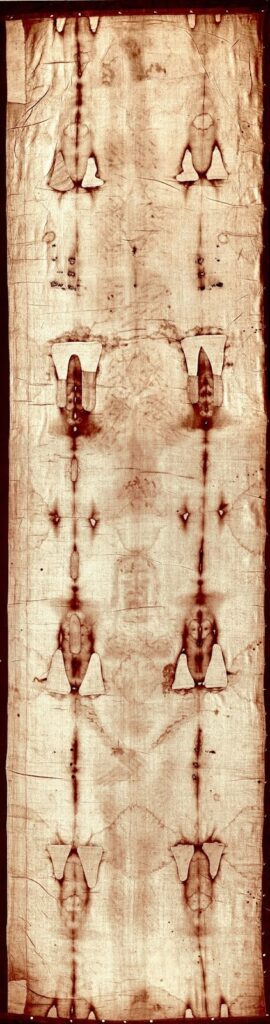
Title: A Complete Image of the Shroud of Turin before it was restored.
The Shroud Functions as a ‘Biological Archive’
The most important conclusion is that the Shroud preserves a layered record of human and environmental interaction over time. DNA reflects multiple handlers, trade movement and the possible storage environments too.
The researchers continue to emphasise that the Shroud still does not contain a single identifiable biological origin, though highly indicative.
You can read the complete pre-print report of the 2026 DNA analysis of the Shroud of Turin here.
How Did the Scientific Investigation of the Shroud Actually Begin?
To be able to understand why the Shroud of Turin remains such a highly researched topic even today, one must go back in time to 1978 when the earliest modern investigation took place. The results were so scarily unexplainable, that it turned sceptic Barrie Schwortz, a scientific photographer of Jewish origin, into a life-long researcher of the Shroud of Turin.
We will take a look at the earlier investigations in detail rather than superficially, for it is in their understanding, the true value of the current 2026 DNA analysis can be realised.
- The modern scientific investigation of the Shroud of Turin began in 1978 when a multidisciplinary team conducted the most intensive study ever performed on a religious artifact.
- A team of over 40 world-class experts, including physicists, chemists, forensic specialists and imaging experts, was granted rare access to the Shroud. Their objective was simple – prove it was a forgery.
- This was especially the case for Barrie Schwortz – a renowned photographer appointed to document the entire research.
- The most common belief before the research began was that the Shroud of Turin was a piece of Middle Eastern art and not really a burial cloth. It was a skilled artist’s work to pass it off as Jesus’s shroud after crucifixion.
- The team conducted more than 120 hours of continuous testing, using techniques such as ultraviolet imaging, infrared scanning, microscopic fibre analysis and spectroscopy
- The results were unexpected. No paint, no dye and no artistic material was found anywhere on the cloth.
- Instead of solving the mystery, the investigation deepened it. The results baffled the experts on board, especially Barrie, who himself admitted to being a skepticist.
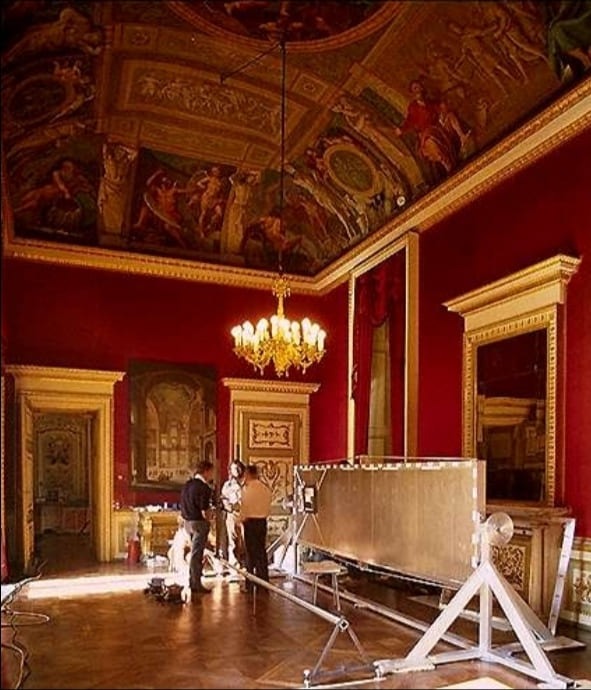
Title: The Examination Room where the 1978 team examined the Shroud of Turin. (Source)
The most important insight from the 1978 investigation was that it proved that the Shroud could not be explained.
What Did Scientists Discover About the Image on the Shroud?
The most striking find of the 1978 research on the Shroud is that the way in which the image is imprinted on the linen burial cloth matches none of the art techniques that exist in the world.
Neither the expert 40-member team of 1978, nor the current researchers have been able to explain successfully how exactly the image was imprinted in the Shroud because the image on the Shroud is a superficial, non-pigmented imprint that behaves unlike any known image in human history.
Here are some aspects one cannot ignore:
- There are no brush strokes visible in any part of fabric, none whatsoever.
- In any painting, there will always be paint pigments or dyes that are traceable. Scientists found none on the Shroud during its chemical analysis. Instead, what they considered earlier as paint or pigment, eventually turned out to be blood stains. Real human blood.
- This shook Barrie Schwortz and the entire team as they further uncovered more shocking details. He admitted in several interviews that the data did not support forgery. The evidence pointed to something real.
- Scientists discovered that the image exists only on the outermost layer of the linen fibres, just 1-3 microns thick. If the surface is lightly scraped, the image will disappear. The underlying fibres remain untouched by the blood stains. This suggests a unique formation process.
- They further realised the image is not flat. When analysed using a VP-8 image analyser, it produced a perfect three-dimensional rendering of a human body.
- This is critical because normal photographs distort in 3D analysis, but the Shroud does not.
- Another important aspect was the brightness levels in the image correspond directly to the distance between the body and the cloth.
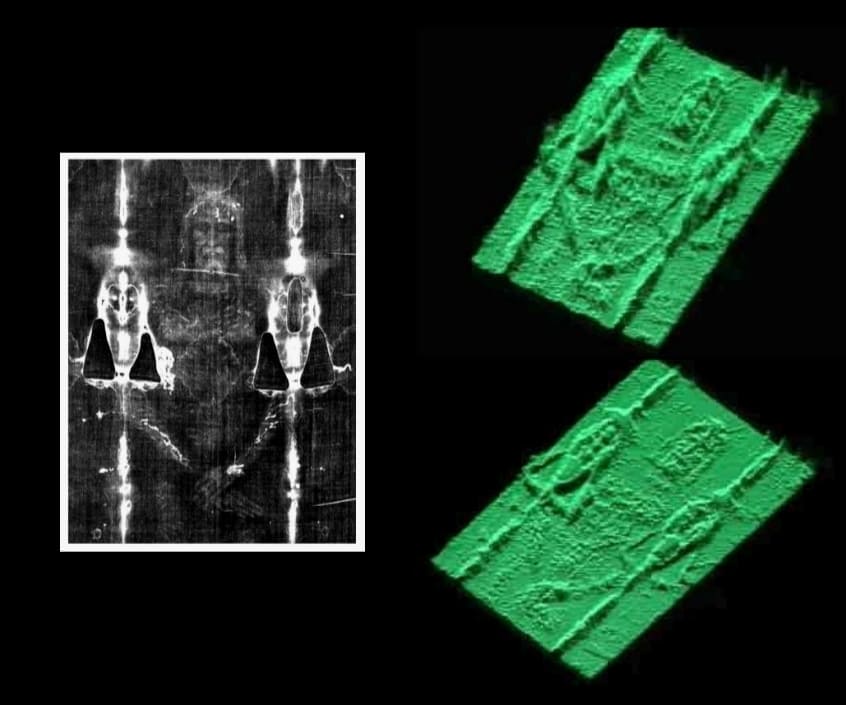
Title: VP-8 image analyser output (Source)
Scientists explain the image on the Shroud as a superficial discoloration of linen fibres without pigments.
Therefore, the 1978 team of experts realised that the Shroud image encodes three-dimensional information, something no medieval artwork can replicate, nor contemporary artwork can.
Step-by-Step: The Exact Sequence of Events Recorded on the Shroud
The Shroud preserves a precise sequence of events – bleeding, contact and then image formation. It reveals a timeline embedded in the fabric. Here is the timeline put together by the team of 40 experts that they concluded their 1978 investigation on the Shroud with.
Step 1: The Body Suffered Severe Trauma
The cloth shows over 100 scourge marks, consistent with a Roman whip. The wounds match crucifixion nail marks in the wrists, a spear wound between ribs, extensive back lacerations and all the wounds as described in the Christian texts about Jesus’s death by the Romans.
Step 2: Blood Transferred Onto the Cloth
Real human blood transferred onto the linen before any image appeared. This is proven because bloodstains are intact and no image appears beneath blood areas, i.e. beyond 1-3 microns from the surface of the linen.
Step 3: The Image Forms After Death
The image is formed after the blood was already present, without disturbing it. This is scientifically extraordinary. The Shroud records not just an image, but also a chronological event sequence. The hypotheses by the research team included chemical reactions, radiation bursts and thermal processes. However, none fully explain all observed properties.
What Makes the Blood on the Shroud Scientifically Extraordinary?
The blood on the Shroud of Turin is real human blood with chemical properties that indicate extreme physical trauma.
- Tests confirmed the presence of human hemoglobin, albumin and immunoglobulins.
- Another very intriguing observation is that the blood is unusually red, even after centuries, whereas stale blood normally turns brown in colour with the passage of time. However, not in the case of the Shroud of Turin.
- The only possible reason here is that scientists discovered high levels of bilirubin, a compound released during intense trauma. This explains why the blood retained its red colour, furthering evidence in favour of the Shroud indeed being the cover cloth for a crucified, profusely bleeding Jesus.
- Both pre-mortem and post-mortem blood are present.
Therefore, the chemistry of the blood suggests a level of suffering so extreme that it altered its long-term preservation. This makes the blood imagery on the Shroud of Turin scientifically extraordinary.
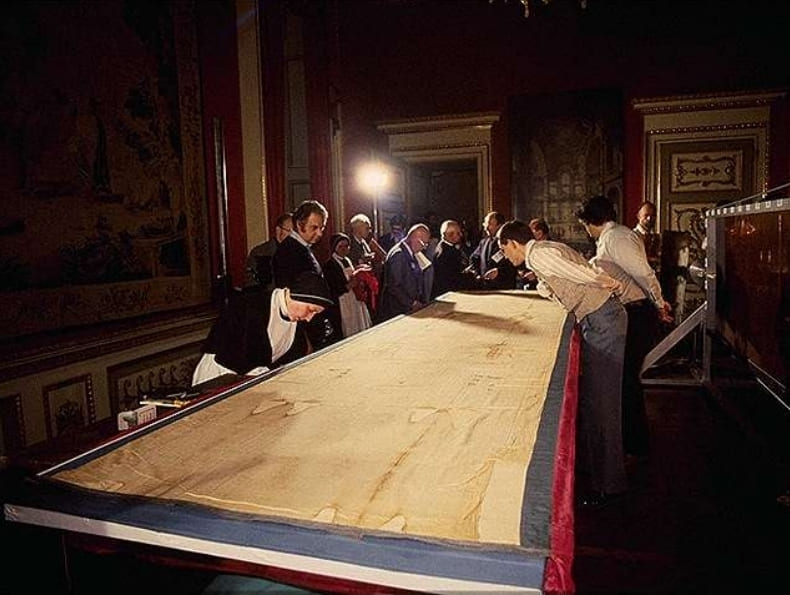
Title: Examination by the 1978 team (Source)
After the blood analysis, another challenge confronting the experts was how exactly did the blood image form, just so surfacial and yet so visible.
The Breakthrough Discovery: Energy Burst and Image Formation
Photographer Barrie Schwortz realised that the image on the Shroud could possibly be the result of exactly how a photograph is taken with a flash light. Further investigation into this thought gave birth to the most compelling scientific theory suggesting the image was formed by a sudden, intense burst of energy that altered the linen at a molecular level.
- Researchers calculated that the image would require up to 34,000 trillion watts of energy released in less than a billionth of a second. Light scientist Paul Dazo played a very important role in this conclusion.
- The energy had to be extremely precise, neither less nor more. For example if the energy was too slow, the fabric would have burned. If it was too strong, the cloth would have been destroyed; and if too weak, then no image would have been formed.
- No existing technology can replicate this effect. None. The Shroud image appears to be formed by a controlled burst of energy beyond current scientific capability.
What Did DNA Analysis Reveal That Shocked Scientists?
DNA analysis of the Shroud of Turin revealed genetic material that does not match typical modern human patterns and shows signs of extreme fragmentation.
- Three independent laboratories analysed DNA from the cloth and all the labs found the same anomalies.
- The anomalies were: DNA linked to ancient populations; genetic markers from multiple regions; no clear match to modern populations. It failed to point towards a single, streamlined, genetic pool of civilisation.
- The DNA structure itself was unusual.
- For example, instead of gradual decay, it appeared violently fragmented at the chromosomal level, as if cells experienced sudden internal disruption.
Therefore, the DNA on the Shroud does not behave like naturally aged genetic material, instead, it behaves like it was disrupted by a sudden event.
How Does the India Link Appear in the DNA Evidence?
The India link emerges from DNA markers embedded within the fibres that trace back to South Asian populations.
- DNA extracted from inside the threads, not surface contamination, revealed markers linked to South Asia, North Africa and The Middle East.
- This could also suggest a historical movement of the Shroud rather than origin. For example trade routes, textile exchange, cultural contact, etc.
- It points to the known ancient trade networks connecting India to the Mediterranean world.
- Therefore, the India link could reflect the Shroud’s journey through history and not necessarily its place of creation, as certain sections of the society view it.
- However, paleographer Ada Grossi also pointed out that the fine linen used in the Temple of Jerusalem is Indian indeed.
Therefore, there are high possibilities of the Shroud of Turin originating from India.
The Most Important Realisation: Why the Mystery Deepens with Technology
The more advanced our technology becomes, the more complex and unexplained the Shroud appears. It is extremely important to note here that despite space exploration, advanced DNA sequencing and high-resolution imaging, scientists still cannot replicate the Shroud.
Every new test raises more questions instead of answers. For example:
- Image formation remains unexplained as most analogies and highly indicative but not conclusive due to lack of substantial evidence.
- DNA anomalies remain unresolved.
- Blood chemistry remains unique.
This has led many researchers to shift perspective. The Shroud is not becoming clearer with science, it is becoming more mysterious. Ironically, most rely on science and technology to seek answers for all happenings in life, but this incident proves science is not the answer to all questions in life.
Also Read: Easter Day: The reality of Resurrection
What Evidence Suggests a Possible India Link to the Shroud of Turin?
The claimed India link to the Shroud of Turin is based on textile patterns, pollen traces and historical trade routes, in the 2026 DNA analysis of the Shroud of Turin.
Textile and Weaving Patterns
Some researchers suggest that the weaving style resembles ancient Indian techniques. For example, the herringbone pattern is similar to textiles found in parts of India and the Middle East.
Pollen Evidence
Pollen grains found on the Shroud have sparked interest. Some species are native to regions extending towards South Asia. However, pollen can travel long distances through trade and environmental exposure.
Trade Route Connections
Ancient trade routes connected India with the Middle East and Europe. The Silk Road facilitated the movement of goods, textiles and artefacts across continents.
Can Textile Analysis Connect the Shroud to India?
Textile analysis suggests possible similarities but does not conclusively connect the Shroud to India.
- Linen weaving techniques vary across regions but can overlap due to trade influences. This makes precise origin identification difficult.
- Fiber analysis shows characteristics consistent with Middle Eastern flax. However, similar materials were also traded globally.
- No definitive study has proven Indian origin. No scientific study has conclusively proven the authenticity or origin of the Shroud of Turin.
- At the same time, one cannot deny the strong possibility of the linen emerging from India due to the DNA analysis of the linen as per the 2026 findings.
Can DNA Evidence Suggest That the Shroud’s Linen Originated in India?
Some interpretations of the 2026 DNA research suggest that the linen of the Shroud of Turin may have connections to India, based on genetic material found not only on the surface but also embedded within the fibres.
Researchers identified DNA traces inside the linen threads, not just on the outer surface. This is significant because internal DNA is less likely to come from casual handling and more likely to reflect earlier stages of the cloth’s history.
To recapitulate, the genetic sequencing also revealed markers associated with:
- South Asian populations
- Plant species linked to the Indian subcontinent
- Agricultural traces consistent with regions where flax or textiles were processed
Why This Discovery Is Different from Earlier ‘India Link’ Claims
This finding differs from earlier theories because it points to DNA embedded within the fabric structure, not just contamination on the surface.
The earlier claims relied on pollen grains, trade route theories and textile pattern similarities. Whereas, the 2026 analysis adds a new dimension. DNA from within fibres suggests exposure during production or early handling, not just later contact.
This is why some researchers cautiously propose that the linen could have been processed or woven in regions connected to India or exposed to Indian materials during its earliest phase.
India was a major hub for textile production and export in ancient times. Indian cotton and linen were widely traded across the Roman Empire. Textile processing often involved multiple regions. This makes it entirely plausible that the linen’s journey could have begun, passed through or been influenced by Indian regions.
The India-origin theory is, though not a confirmed conclusion, but is the strongest evidence yet suggesting the Shroud’s history may extend further east than previously believed.
How Do Jewish Burial Practices Compare with the Shroud of Turin?
Jewish burial practices from the 1st century provide important historical context that aligns with several features observed on the Shroud of Turin. Please note all the information in this section is based on a research study ‘Jewish Shrouds and Funerary Customs: a Comparison with the Shroud of Turin’ by Ada Grossi,
- Archaeological and textual evidence shows that Jewish burial customs during the time of Jesus involved wrapping the body in linen cloth rather than a single elaborate garment. This is significant because the Shroud is made of linen and appears to have been used as a burial covering.
- Historical sources describe that bodies were washed and prepared quickly, wrapped in linen cloth and placed in tombs within a short time frame.
This matches the urgent burial conditions described in the Gospels, especially before the Sabbath.
Alignment with Known Century Burial Methods
Several physical characteristics of the Shroud closely resemble known Jewish burial traditions of the 1st century, such as:
- The positioning of the body image with the hands crossed over the pelvic area, is consistent with burial postures identified in archaeological findings from ancient Judea.
- The absence of elaborate burial ornaments supports authenticity claims. Jewish customs emphasised simplicity, not decorative burial.
- The presence of blood stains without signs of washing suggests a burial performed under time constraints, which aligns with Passover-era practices.
What About the Use of Multiple Cloths?
Historical evidence indicates that Jewish burials often used multiple cloths, which raises questions about how the Shroud fits into this practice.
Ancient texts mention a main linen cloth and additional face cloths or bindings in some places too. Some researchers suggest that the Shroud may have been primary wrapping cloth or part of a larger burial arrangement
This interpretation helps reconcile differences between biblical descriptions and the Shroud’s structure.
The Shroud of Turin: More Than Evidence – A Reflection of Human Nature
The Shroud of Turin remains one of history’s most fascinating unsolved mysteries, blending science, faith and speculation. However, perhaps even more unsettling is this contradiction: when Jesus was alive, he was rejected, ridiculed and ultimately crucified. Today, centuries later, countless believers and seekers devote their lives trying to uncover whether this very cloth once wrapped him.
Why was such a figure met with such cruelty? His message was neither violent nor self-serving. He cautioned people against false spiritual leaders, those who appear righteous outwardly but deceive from within. He spoke of the One Supreme God and consistently referred to himself not as God, but as the ‘Son of God’. And yet, his voice was silenced.
This raises a deeper, uncomfortable, but extremely important question. Why does humanity so often ignore truth when it stands before them, only to revere it once it is gone? In the absence of the living guide, interpretations multiply, meanings shift and the original message is often lost or reshaped. Just like people mistaking Jesus for God and not the ‘Son of God’.
The story of Jesus is not just history, it is a mirror. It reflects a recurring pattern in human behaviour. True well-wishers are rarely recognised in their time, but are revered long after they are gone.
Also Read: Supreme God in Christianity According to the Bible
Are We Repeating the Same Mistake Even Now?
History appears to repeat itself in striking ways, even today. One can’t help but draw parallels between the life of Jesus and the struggles faced by Jagatguru Tatvdarshi Sant Rampal Ji Maharaj, raising profound questions about how society responds to voices that challenge established beliefs.
Just as Jesus spoke against falsehood and guided people towards the true path of worship, Sant Rampal Ji Maharaj has, from the very beginning, challenged practices that go against the teachings of our holy scriptures. He has consistently advocated for worship based strictly on sacred texts, across religions, including the Holy Bible, while exposing self-proclaimed spiritual leaders who mislead innocent devotees for their own benefit.
However, as history has shown, those who speak the truth often face the strongest opposition. The conspiracies of Karotha and Barwala stand as powerful examples of how society can turn against those who seek to reform it. Instead of recognising a true well-wisher of humanity, people often elevate false figures while opposing those who reveal the truth.
But, even in the face of such resistance, Sant Rampal Ji Maharaj’s work has not stopped. His contributions extend far beyond spiritual teachings. From providing historic relief aid to farmers affected by devastating floods across states like Delhi, Haryana, Rajasthan, Punjab and Uttar Pradesh, to building homes for the destitute under the His Annapurna Muhim and offering free ration until families become self-reliant, His efforts reflect a level of selfless service rarely seen today.
In a world where even close relationships are strained by material conflicts, such acts stand out as deeply significant. This brings us to a crucial question that can alter humanity’s destiny. Will history repeat itself once again, or will we learn to recognise truth while it still stands before us?
The choice remains with us, to understand, to question and to seek the truth with awareness. Learn more about Who Sant Rampal Ji Maharaj actually is, what His intentions are, what His contribution to society is with an open and critical mind, so that the world doesn’t lose its Messiah. Instead, we live and learn together from the True Messiah of this world – Jagatguru Tatvdarshi Sant Rampal Ji Maharaj.
FAQs: The Shroud of Turin
Answer: Because they challenge established beliefs and expose false practices, which often threatens existing power structures.
Answer: That recognising truth in the present requires awareness, critical thinking, and the courage to question popular narratives.