
Copernicus’s death is a question that has been laid to rest time and again by scholars, historians, the Church authorities and several individuals who studied about Nicolaus Copernicus and his life. Yet, the recurring curiosity ‘how did Copernicus die?’ remains as strong as ever. Why does humanity keep trying to turn back the clock and know what exactly happened to Nicolaus Copernicus? Are the explanations given by historians and the likes not enough to extinguish this curiosity? Uncover the mystery of Copernicus’s death as we review sixteenth-century correspondences, religious opposition, disputed historical accounts and the identification of his remains while reconstructing the final chapter of Nicolaus Copernicus in this astonishing fact check.
How did Copernicus Die and How Confidently Can We Establish the Answer?
Humanity has gone from believing the Earth was flat and floating on water, to finally accepting it was a sphere. In an era when scientific discoveries were expected to conform to prevailing religious doctrines, challenging the belief that the Sun revolved around the Earth could expose a scholar to serious hostility and potentially dangerous consequences. Nicolaus Copernicus pioneered a revolutionary understanding of the cosmos, establishing the groundwork for humanity to recognise that the Earth travels around the Sun, rather than the other way around.
Today, we know that the Earth rotates on its axis and the complete planetary arrangement. This has also been validated by outer space missions. But, back then, even suggesting that the Earth moved was enough reason to prosecute that person for the crime of ‘hearsay’.
Copernicus spent decades of his life studying the movements of all planets, even building his own instruments to make precise calculations and prove his observations right. He waited for thirty years before he dared to agree to publish his work, as he declares in his own words ‘not nine years merely, but already going on four times nine’. Why did he wait for thirty six years before even consenting to publish his work?
There is something curious about the way his story is usually told. We hear about his revolutionary theory, his reluctance to publish and the eventual triumph of heliocentrism. We are also told that Copernicus died ‘peacefully’ in Frauenburg in 1543, now Frombork, around the time his greatest work appeared in print.
But how was his death documented? Who actually witnessed his final moments? And how much of the account repeated today comes from firsthand testimony rather than later historical reconstruction? These questions become particularly significant when we examine the religious and political environment in which Copernicus lived.
The revolutionary ideas circulated by Copernicus’ revolutionaries were attacked not just by Catholic theologians but also by the Protestants. His published work was also subjected to ‘ecclesiastical censorship’, though officially much later. And decades after his death, some scholars were still defending their condemnation of Copernicus, revealing the intensity of the controversy.
To uncover how Copernicus died requires deeper examination of the more obvious information that exists about him today and that which has been served to readers time and again to assert that Copernicus died in a certain manner.
This investigation is the pursuit of the truth of Copernicus’s death, an examination of the surviving evidence, its limitations and the historical circumstances that not just deserve but demand closer attention. How did these loopholes escape scrutiny by even the most observant for years?
Who is Nicholaus Copernicus and Why Does His Death Matter So Much?
Nicolaus Copernicus (1473-1543) was a Renaissance astronomer, mathematician, administrator and Catholic cathedral canon whose work fundamentally altered our understanding of the heavens and how planets are positioned. Born in Toruń, in what is now Poland, he studied in Kraków and later in Italy, pursuing mathematics, astronomy, law and medicine.
He lived during an era when the prevailing astronomical system placed the Earth at the centre of the universe. But Copernicus reversed their chart, and made the Earth spin first of all, and then also revolve around the ‘inferior’ Sun through an annual cycle. The implications were enormous.
Copernicus’s model was not identical to modern astronomy. Nevertheless, it marked a decisive transformation in astronomical thought. Today, this may seem childish. But, in the sixteenth century Europe, it shook a centuries-old foundation.
Copernicus’s intellectual pursuits reached far beyond astronomy. Hermann Kesten’s ‘Copernicus and His World’ reveals a fascinating side of the astronomer that often goes unnoticed. Beyond his celestial investigations, Copernicus possessed extensive knowledge of medicine, mathematics and law, while also undertaking responsibilities involving finance and public affairs.
He studied at major European centres of learning, including Kraków, Bologna, Padua and Ferrara. He obtained a doctoral degree in canon law, provided medical care and held an ecclesiastical position as a canon within the cathedral chapter of Frauenburg, now known as Frombork. His administrative work was equally substantial. His everyday work was remarkably varied.
Copernicus was far from detached from the political, religious and social structures of his era. His active participation in these spheres makes his willingness to challenge established intellectual beliefs particularly extraordinary. Even as he carried out his demanding official duties, he devoted himself to developing an astronomical theory that questioned the very foundations of the widely accepted model of the cosmos. His ideas circulated among a certain circle of scholars long before the publication of his major work.
For decades, however, the complete theory remained unpublished. The eventual appearance of ‘De Revolutionibus orbium coelestium’ in 1543 marked a turning point in the history of astronomy. His ideas ultimately laid the correct foundation for further astronomical research.
However, Copernicus is believed to have died in May 1543, the very year his groundbreaking book was published. What makes his death particularly intriguing is that it is said to have occurred at almost the exact moment his book came into this world.
But, for a scholar whose observations challenged centuries of accepted thinking left behind a revolutionary book, his missing personal records and history speak a lot, despite being destroyed.
How much of what we have been told about Copernicus should we believe? Let’s discover.
Uncovering the Narrative Surrounding Nicolaus Copernicus’s Life and Final Days
The conventional account presents Copernicus as a scholar who spent much of his working life in Warmia, serving the cathedral chapter at Frauenburg.
- The most common story we hear is that Copernicus suffered a serious illness toward the end of his life and then passed away due to a stroke followed by paralysis.
- His death is generally dated to 24 May 1543.
- That Copernicus was ill and the news of his death are pieces of information picked up from the famous three surviving letters of correspondence by Tiedemann Giese, Bishop of Chełmno.
- He, supposedly, died just after seeing a printed copy of ‘De Revolutionibus’.
- Modern narratives also emphasise that Copernicus maintained connections with Catholic authorities and that was on the whole encouraged by the Catholic society for his astronomical investigations.
- Cardinal Nikolaus von Schönberg backed Copernicus’s work. However, he didn’t survive post 1537. At that time, Copernicus had not even gathered the courage to decide to publish his work, as he admits in his own words.
Does encouragement from a few churchmen establish that Copernicus faced no religious opposition? Certainly not. Institutions are not intellectually uniform and the attitudes of individual patrons cannot automatically be representative of every theologian, bishop or ecclesiastical authority.
Born into a family of comfortable means, Copernicus also enjoyed a stable income through his professional appointments. It would therefore be misleading to assume that his astronomical research depended entirely on ecclesiastical financial support. Claims of the Church financing Copernicus’s spectacular work would therefore be untrue.
We will now examine some crucial aspects of Nicolaus Copernicus’s life that are known from the famous three surviving letters. These letters have been used as the proof of the communication of his death.
The Three Kraków Letters: How Much Do We Really Know About Copernicus’s Death?
The familiar account of Nicolaus Copernicus’s final days has been repeated for generations. The commonly accepted account describes Copernicus’s final months as a period of deteriorating health, marked by paralysis and impaired mental awareness.
But how much of this story comes from direct observation and how much depends on information passed from one person to another?
Jan Chroboczek’s 2013 research paper, Three Letters on Copernicus Published by Joannes Broscius in 1618, provides a valuable starting point for investigating the surviving correspondence behind the widely accepted narrative of Copernicus’s final illness and death.
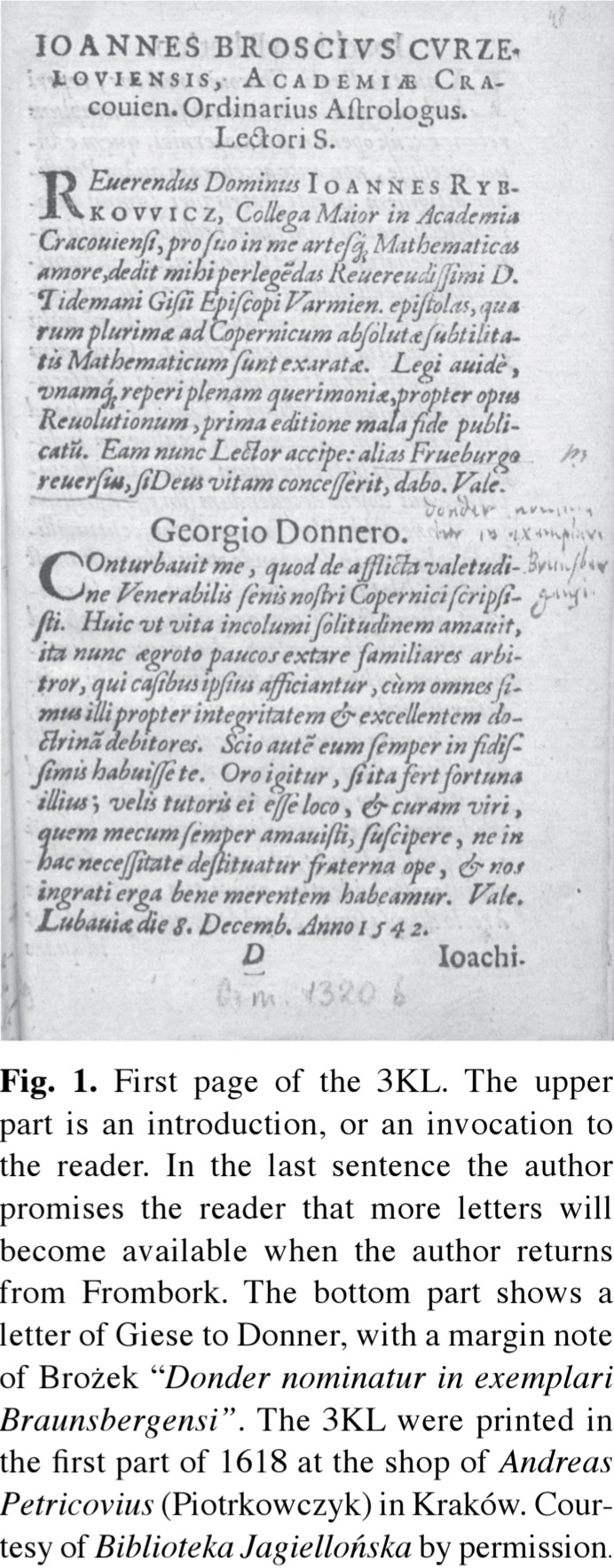
Images of two letters published in Jan Chroboczek’s research paper
A Report of Illness: December 1542
The earliest of the relevant letters was written on 8th December 1542 by Tiedemann Giese, Bishop of Chełmno and one of Copernicus’s closest friends, to Georg Donner, a canon at Frombork Cathedral.
Giese was responding to an earlier message from Donner informing him that Copernicus’s health had suddenly deteriorated. He wrote to Donner while away from Frauenburg at that time. He was in Lubawa. Expressing concern for his elderly friend, Giese requested Donner look after him during his illness.
This correspondence reveals that Giese learns about Copernicus being seriously ill by December 1542. Equally striking is the fact that Giese’s knowledge of Copernicus’s declining health came through reports communicated to him by another individual, rather than entirely from his own observations.
The biggest gap in the historical correspondence is the absence of Donner’s original letter.
The Historical Letter Behind the Accepted Account of Copernicus’s Death
On 26th July 1543, approximately two months after Copernicus’s reported death, Giese wrote to Georg Joachim Rheticus, the astronomer’s former student and an important figure in the publication of De Revolutionibus.
- Giese reported that Copernicus had died on 24 May 1543 following a hemorrhage and paralysis affecting his right side.
- He added that Copernicus had lost his memory and mental alertness several days earlier.
- The correspondence further claims that Copernicus did not lay eyes on the printed edition of his revolutionary work until his final moments.
- Over time, this particular letter exchange has become one of the most frequently repeated pieces of information in the descriptions of Copernicus’s final days.
- However, Giese’s own correspondence introduces an important contradiction. Earlier in the same letter, he explains that he had not learned of Copernicus’s death until returning to Prussia.
- What is nagging here is that this particular correspondence provides no answers as to who provided him with the specific information concerning Copernicus’s medical condition.
Giese’s testimony still remains valuable because he knew Copernicus personally and wrote relatively soon after his death. Nevertheless, its credibility as evidence is not as what would have been an eyewitness account.
These are extremely important points the world seems to have missed out while using these three letters alone to establish how Copernicus died.
Did Copernicus Really See His Finished Book?
The claim that Copernicus received his life’s work on his deathbed has inspired an enduring and an emotional historical image – the dying astronomer finally encountering the printed volume that would transform humanity’s understanding of the universe.
But the wording of Giese’s letter cautions us well to examine something carefully.
According to his own account, Copernicus had already lost his memory and mental alertness many days before his death. If so, what did it mean for him to have seen the book? Was it even really placed before him? The surviving correspondence does not answer these questions.
Also Read: National Science Day: Know about the Knowledge that Connects Science and Spirituality
Over the centuries, historians have generally accepted Giese’s account as credible evidence that a printed copy of De revolutionibus arrived during the closing days of Copernicus’s life, despite so many missing pieces of information. It is clearly not proved that the astronomer actually did receive or died in the same manner as Giese says.
Giese’s statements came from what he had heard from someone in Frauenburg (Frambork currently), that too only when he reached Prussia. This reiteration is extremely crucial and more so as we move deeper into this investigation.
In the years that followed, various publications, historians and other media outlets began speaking and publicising Copernicus’s death, with some authors acknowledging that they had only learned of his passing in the same year that his groundbreaking astronomical treatise appeared in print. Also the reason for Copernicus’s illness varies from narrative to narrative.
We bring one such account to your attention from the Catholic Telegraph published in 1873:
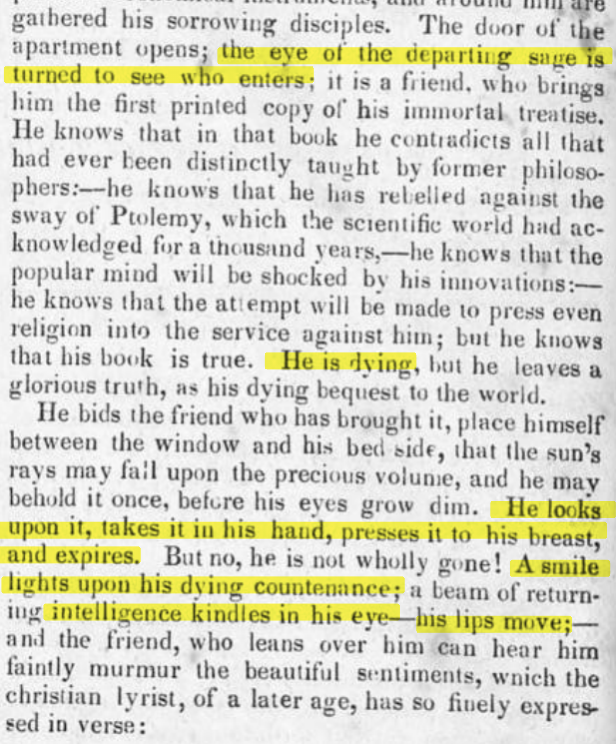
Presented below is a collection of historical writings that offer differing descriptions of the circumstances surrounding Nicolaus Copernicus’s final illness and death.
Three Letters, but Only Two Concern His Final Years
Though the collection commonly known as the Three Kraków Letters, it does not contain three independent accounts of Copernicus’s illness or death.
- Two are letters written by Giese. One to Donner in December 1542 and another to Rheticus in July 1543.
- The third is actually an extract from a dedication by Adalbert Caprinus to Bishop Samuel Maciejowski, praising Copernicus’s mathematical accomplishments. It is no letter.
- It does not provide an additional account of his death.
The Letter Reveals More Than Just the Circumstances of His Death
Giese’s letter of 26th July 1543 is significant for another reason. Alongside the account of Copernicus’s supposed death, it reveals serious dissatisfaction with the newly published De Revolutionibus.
- Giese expressed indignation at alterations to the book’s introductory material after he received two copies from Rheticus
- He initially directed his criticism towards the Nuremberg printer, Johannes Petreius, although the anonymous preface was actually the work of Andreas Osiander most probably.
- Giese informed Rheticus that he had already written to the Nuremberg City Council seeking corrective action.
- He urged Rheticus to pursue the matter and suggested that the opening sheets could be reprinted.
- He also proposed including a biography of Copernicus that Rheticus had previously written, together with Rheticus’s defence of the Earth’s motion against objections based on scripture. It is at this point that we first learn Rheticus has written a biography of Nicolaus Copernicus. What happened to this extremely important documentation about Copernicus?
- These requests reveal crucial information that Giese evidently considered the published edition sufficiently compromised to warrant intervention and he regarded Rheticus as the person best qualified to undertake it.
- Jan Chroboczek records another shocking detail: when Jan Brożek examined two copies of De Revolutionibus during his investigations in Warmia decades later, he found that the anonymous introduction presenting the theory as a hypothesis had been crossed out in both.
- This does not reveal who made the alterations or when. But, it provides further evidence of dissatisfaction with the controversial preface.
- The same letter also raises a question concerning Copernicus’s relationship with Rheticus. Giese acknowledged that Rheticus had been omitted from Copernicus’s dedication, despite his substantial contribution to the book.
- Giese attributed the omission to Copernicus’s supposedly declining health and his apparent ‘indifference to matters outside his scientific interests’.
- Yet we must not forget that this was only Giese’s explanation, not a reason recorded in Copernicus’s own words.
Chroboczek himself questions the adequacy of this justification. The omission therefore remains an unresolved aspect of the publication history, particularly given Rheticus’s central role, as publicised, in bringing the manuscript to print.
Why Were the Letters Published So Much Later?
The letters were first published together by the Polish mathematician Jan Brożek, also known as Joannes Broscius, in 1618, approximately seventy-five years after Copernicus’s death.
Chroboczek’s research establishes that the publication was frequently misdated to 1615 because it had been bound together with another work printed that year. This bibliographical error was subsequently repeated by several historians. It is imperative to underline this observation for this is how data can be peddled for centuries without scholars even realising that the information they picked up, even if from a reliable source, still needs to be verified.
The letters themselves date from Copernicus’s lifetime and shortly afterward. The publication history illustrates the importance of tracing historical claims back to their earliest recoverable documentary sources.
The Missing Correspondence
Perhaps one of the most intriguing discoveries in Chroboczek’s study concerns documents that are no longer available.
- During his investigations in Warmia, Brożek reportedly located more than twenty letters written by Giese to Copernicus.
- He expressed an intention to publish them, but never did. Their subsequent fate remains uncertain.
- These letters might have illuminated Copernicus’s personal relationships, intellectual concerns or circumstances during his later years. We can never know whether they contained information about his final illness.
Their disappearance also raises very serious questions for several important documents related to Copernicus and his life have gone missing without a trace. Rheticus’s biography and even the original autograph manuscript of Nicolaus Copernicus’s De Revolutionibus was lost for several years before it was revealed that it was rediscovered in 1788 in the list of ‘noteworthy libraries of Prague, Czechoslovakia, was published.
It referred to Copernicus’s autograph copy of the book lying in the personal collection of Count Otto F. Von Nostitz (1608-1664) and
his heirs, Jawor in Silesia, Prague’ – as documented by Ramkrishna Bhattacharya in his research paper ‘THE AUTOGRAPH COPY OF COPERNICUS’S ON THE REVOLUTIONS’.
The research paper further discloses some astonishing observations that we will address at this juncture:
- The original manuscript of Nicolaus Copernicus’s work exchanged several hands before finally being stationed ‘in the property of Count Von Nostitz in Prague’.
- And though the Catholic mouthpieces have been vociferous about how they ‘supported’ Copernicus and his fabulous work, denying all the reports of their disapproval of heliocentrism, it is but more than curious to note that ‘These two printed references, however, failed to have any impact on the historians of astronomy’ and not even the Papal community who were ‘supportive’ of Copernicus and his work.
- The research paper further details that the ‘priceless document remained unnoticed in the obscure corner of a private collection’.
- How then was it brought back to importance? An article by Karl Slavomir Amerling in a weekly newspaper in Prague was actually translated from Czech to German for another weekly in Toruń, Poland. The article was also translated and published in Polish.
- This led to Jan Baranaowski, Polish astronomer and scholar in the 19th century, getting hold of the original manuscript of Nikolaus Copernicus and thereafter editing the fourth edition of De Revolutionibus in 1854.
How similar the 1st edition was to Copernicus’s original manuscript is something we will throw light on in this investigation at a later point, for it needs to be treated with utmost respect and care.
Where the Evidence in the Three Letters Ends
The Three Kraków Letters actually supply second-handed information about Copernicus’s health and his supposed death. No data on who witnessed his final hours and who supplied Giese’s medical details.
These two missing pieces of information are extremely crucial because the man whom the religious and cultural leaders have claimed to regard so ‘high’ in esteem was the same person whose all records were destroyed including no death record at the very church of the area they claim he died in.
It will indeed come as a shock to most readers that there is no written record of Nicolaus Copernicus’s death nor burial anywhere whatsoever.
To understand those controversies, we must also examine what happened to Copernicus’s manuscript during its final journey to the printing press.
The Controversial Foreword to De Revolutionibus
This controversy must have truly hurt Nicolaus Copernicus for he refused to present his work as a hypothesis. An anonymous introductory note, ‘Ad lectorem de hypothesibus huius operis’ (To the Reader Concerning the Hypotheses of This Work), appeared in the first edition of De Revolutionibus.
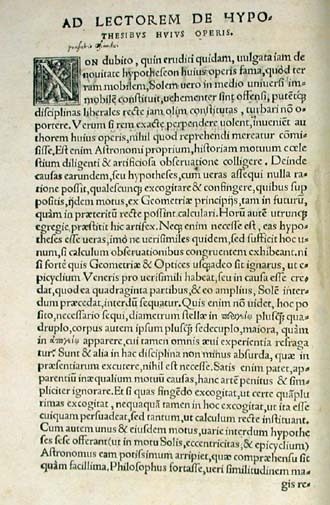
The Anonymous Note Written By Andreas Osiander
- It presented ‘astronomical hypotheses’ as mathematical devices that did not necessarily have to represent physical reality.
- The note is suspected to be written by the Lutheran theologian Andreas Osiander.
- This is important because the note could lead readers to believe that the author himself was unwilling to assert the physical reality of the Earth’s motion. Back in the time, it did so too. It presented Copernicus’s work as a work of hypothesis and not how he wanted the world to receive it.
- Until Giese discovered this grave misappropriation and noticed Rheticus about
- Contrastingly, Copernicus’s own dedication to Pope Paul III took a different approach, defending his decision to publish and anticipating criticism of his work. It showed fearlessness and anticipation of hate and criticism from all quarters.
- Interestingly, the seventeenth-century Catholic theologian Libertus Fromondus later acknowledged that the introductory note had been inserted by Osiander rather than written by Copernicus.
The publication history thus raises an extremely serious question – How accurately did the first printed edition represent Copernicus’s own intentions?
It also provides a reason to further examine other familiar elements of his biography against the earliest available documents.
Osiander’s 1541 Warning: A Controversy Even Before Publication
The controversy surrounding the publication of De Revolutionibus orbium coelestium did not begin when the finished book appeared in 1543.
Two years earlier, Andreas Osiander had already expressed concern about how Copernicus’s astronomical conclusions would be received. In correspondence dated 20th April 1541, Osiander proposed that Copernicus present his system as a mathematical hypothesis rather than insist upon its physical truth. Osiander believed this approach could reduce opposition from Aristotelian philosophers and theologians.
Historian Andrew White traced the correspondence through Johannes Kepler’s writings, identifying a specific source for the Latin text. This became a matter of dispute among Copernicus’s associates, particularly Tiedemann Giese, who subsequently protested the alteration.
Author Hermann Kesten recounts in his book ‘Copernicus and His World’ that the matter also reached the authorities in Nuremberg. However, on 29th August 1543, the city council declined to hold the printer Johann Petreius responsible.
The episode reveals a conflict over how genuine scientific claims could not even safely be presented because it was a period where science and religion had to agree. It also tells us that the dispute and disagreement over how exactly Copernicus’s ideas should be presented to the world began even before the book was published.
It also shows that opposition was anticipated before the book reached its readers.
It is important to note here that Osiander’s ‘concern’ about the reception of Copernicus’s scientific finding is in itself a strong proof of specific prosecution or threat against Copernicus. Underline here readers: Osiander knew the threat that would ensue and therefore, he inserted the anonymous note despite Copernicus’s refusal to present his work merely as a hypothesis.
The Original Manuscript Versus the First Edition
How much of Copernicus’s original work was changed? One of the most shocking aspects of the remnants of Copernicus’s documents is how different the first edition was from his original handwritten manuscript.
Now, let’s circle back to Ramkrishna Bhattacharya’s study, ‘The Autograph Copy of Copernicus’s On the Revolutions’ that traces the manuscript’s extraordinary journey from owner to owner, and examines how its recovery helped scholars distinguish Copernicus’s own writing from the adulterated text that entered circulation in 1543.
The Manuscript That Was Not Used by the Printers
The most significant finding is that the printers in Nuremberg did not work directly from Copernicus’s surviving autograph. For the benefit of those unaware, an Autograph is the original manuscript of a writer, in this case Nikolaus Copernicus.
Here are some critical observations:
- According to manuscript historian Jerzy Zathey, the typesetters used a copy prepared by Rheticus. Copernicus’s original manuscript bears none of the customary markings that would be expected if it had served as the printer’s working copy.
- This creates a paramount distinction between what Copernicus wrote, what Rheticus prepared for publication and what ultimately appeared in print.
- Any differences between the autograph and the first edition could therefore have originated at different stages of the process.
- Some might have been introduced while preparing the working copy, others during typesetting or proofreading, and still remaining one through editorial decisions made by those supervising publication.
Consequently, it would be inaccurate to attribute every alteration to Osiander without examining the evidence for each change. Important here is that the book so celebrated and ‘emotionally’ peddled as being supposedly handed over to a dying Copernicus was a heavily tampered version. Not the work which he safeguarded for thirty six years of his life for the fear of persecution.
The Differences Discovered in the Nineteenth Century
For centuries, scholars relied primarily on printed editions of De Revolutionibus.
The original manuscript had passed through several hands, including those of Tiedemann Giese, Georg Joachim Rheticus, Valentin Otho, Jakob Christmann and Jan Amos Comenius, before eventually entering the private collection of the Nostitz family. Although references to its whereabouts appeared in publications from 1788 and 1795, the manuscript attracted greater attention following an article published in Prague in 1840, as we have described earlier.
Jan Baranowski subsequently consulted it while preparing his 1854 edition. A more detailed comparison followed in 1873, when Maximilian Curtze examined the differences between the handwritten manuscript and the original printed edition. He reported finding practically no page on which the two texts corresponded exactly.
Would Copernicus have accepted such a blasphemous treatment of the sacred work he poured his life into?
The significance of these findings are extremely important because they demonstrate why historians could not simply assume that every detail of the printed edition represented Copernicus’s original wording.
Another significant aspect one must realise here is, if everyone was so supportive of Nikolaus Copernicus’s work, especially as claimed by the Catholic Church, why did Copernicus have to struggle so much to get his original work printed? Copernicus waited for more than three decades to even muster the courage to publish his work and the result was that his work was filled with corrupted texts meant to influence readers.
Was Even the Title Changed?
The manuscript also raises questions concerning the book’s title. Bhattacharya reports that Copernicus’s original title was shorter than the one used in the first printed edition, ‘De Revolutionibus orbium coelestium libri VI’. The original manuscript was titled ‘Libres Revolutionum’ by Copernicus.
The paper suggests that Osiander may have been responsible for the expanded title, though it is probably difficult to establish the truth at this stage. Other sources suggest, however, that the original title by Nicolaus Copernicus given to his work was simply ‘De Revolutionibus’.
How the Printed Editions Preserved Earlier Errors
Bhattacharya’s research notes that the second edition, published in Basel in 1566, reproduced earlier textual errors and introduced additional ones. The third edition, published in Amsterdam in 1617, corrected some mistakes but did not resolve them all. Without direct access to Copernicus’s original manuscript or the working copy used by the printers, later editors faced considerable difficulty determining which readings reflected the author’s intentions.
The manuscript’s recovery therefore became essential not merely for preserving a historical artefact, but for establishing a more reliable text.
The Manuscript’s Return to Poland
After centuries in private collections, the autograph eventually became part of the holdings of the National Museum Library in Prague.
- In July 1956, it was transferred from Czechoslovakia to Poland.
- On 25th September that year, it entered the custody of the Jagiellonian University Library in Kraków.
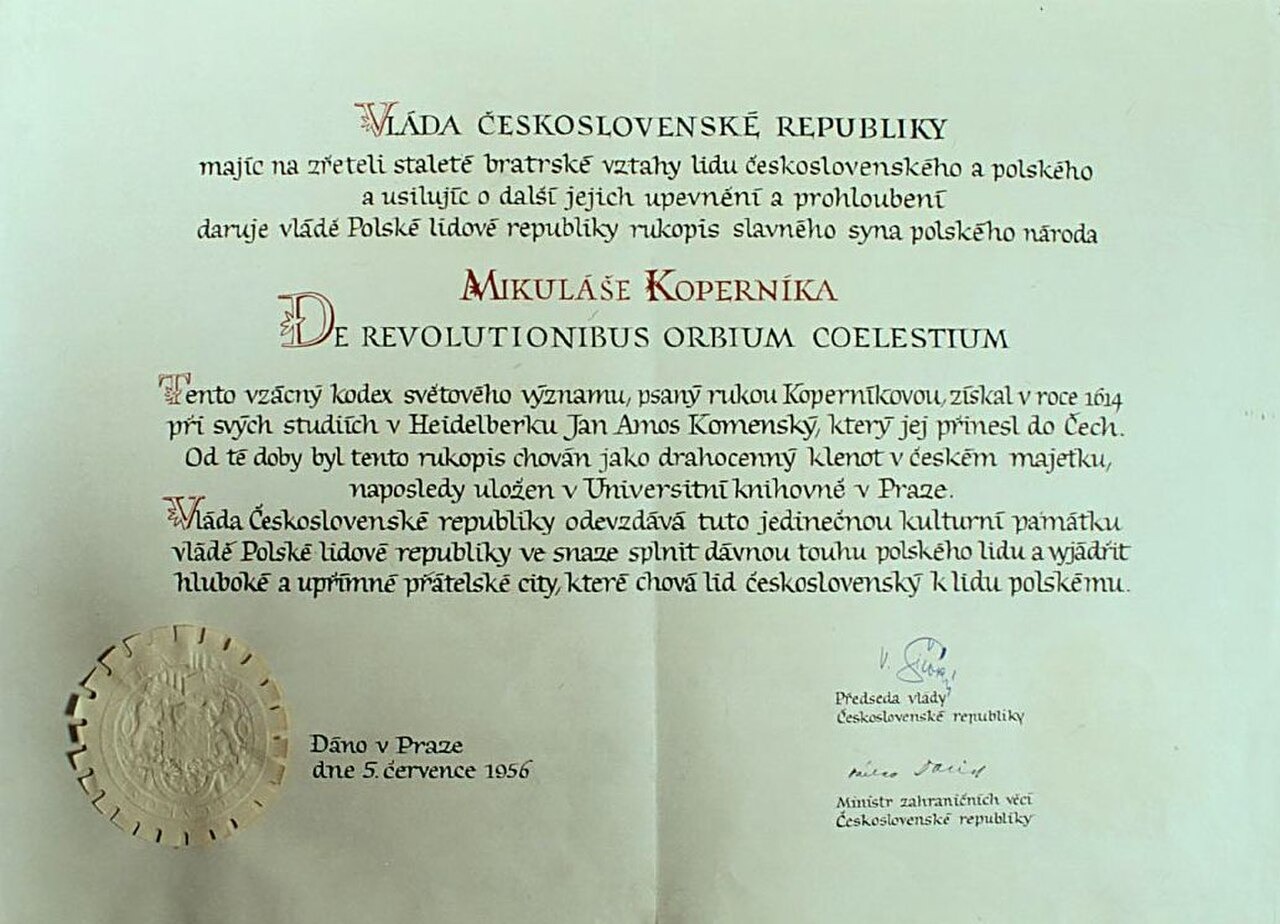
Document describing the donation of Nicolaus Copernicus’s original manuscript to Poland.
The manuscript remains there today under the catalogue designation MS BJ 10000. Facsimile publications in 1944 and 1972 made the document more widely accessible to scholars, while subsequent critical editions enabled detailed comparison with the printed text.
But the unanswered questions still linger on and how. How many changes appeared in the printed edition, but also which changes were substantive, who introduced them and why?
Such was the tumultuous journey of Nicolaus Copernicus’s original manuscript before it landed in Poland again.
A Manuscript Caught Between Religious Censorship and Scientific Conviction
The publication of De Revolutionibus was unfolding during one of Europe’s most volatile religious periods. Catholic and Protestant authorities were fighting over the interpretation of scripture, while printers and scholars faced the consequences of publishing material that might be considered doctrinally unacceptable.
We refer to Geoffrey J. Blumenthal’s 2016 study, ‘Copernicus’s Publication Strategy in the Contexts of Imperial and Papal Censorship and of Warmian Diplomatic Precedents’ for an important explanation for several unusual decisions surrounding the book’s publication.
The sensitive timeline of this period is as follows:
- As early as 1st July 1540, Copernicus had sought advice from Andreas Osiander about publishing his astronomical theory without provoking religious and philosophical opposition.
- In April 1541, Osiander advised treating it as astronomical hypotheses and as mathematical devices for explaining observations, rather than necessarily as descriptions of physical reality.
- Copernicus refused and did not adopt this approach in his own presentation of heliocentrism. Instead, his work advanced a theory that challenged the prevailing understanding of the Earth’s position in the universe.
- Meanwhile, Rheticus had prepared a theological defence of the Earth’s motion, arguing that the theory need not conflict with scripture. Yet this defence was not included in the published book. It was a similar approach to that of Osiander, but only presented differently.
- The failure of the Catholic-Protestant negotiations at Regensburg in 1541 helps explain these decisions. The collapse of those negotiations intensified political uncertainty and increased the risks surrounding publications that appeared to contradict biblical interpretations.
- In this situation, Nuremberg was particularly exposed. De Revolutionibus was being printed in Nuremberg during this period of unrest.
- Although Nuremberg was Protestant, the city remained subject to imperial authority and had to consider the possibility of intervention by Emperor Charles V.
- Charles V was known to be an unpredictable leader. Therefore, there was always a risk of any form of punishment being announced for the crime of publishing works against biblical interpretations.
- Rheticus arrived there in May 1542 to supervise printing.
- However, according to a manuscript note attributed to Achilles Gasser, Copernicus composed his new introductory material in June 1542, after the main manuscript had already been completed and sent to print.
- The timing is particularly striking because on 21 July 1542, Pope Paul III formally established the Roman Inquisition, strengthening the institutional mechanisms through which suspected heresy could be investigated. This move was aimed to ensure a stricter crackdown on those persons whom the Papal court or the ‘protectors’ or the Bible deemed as perpetrators of hearsay, doctrinal deviance and blasphemy.
- The dedication to Paul III and the inclusion of Cardinal Nikolaus von Schönberg’s (who was dead by then) earlier letter may therefore have served more than a ceremonial purpose.
- The dedicatory note to Pope III, the very man who established the Roman Inquisition, might have been thought to help present the work as compatible with papal interests, potentially reassuring printers, censors and prospective purchasers.
- This interpretation does not establish that Copernicus secured papal approval. Rather, it raises the possibility that the dedication was more precautionary because one must not forget that Copernicus completely acknowledges in this dedicatory note the risk he would face once his work was published.
- Then came another development. Rheticus left Nuremberg in late 1542 suddenly before printing was even complete. Osiander is believed to have assumed responsibility for its final stages.
- The published edition subsequently appeared with an anonymous introductory note advising readers not to regard astronomical hypotheses as necessarily true.
Blumenthal suggests that Osiander may have remained concerned about the book’s religious implications even after Copernicus’s own introductory material had been prepared. The surviving evidence, however, does not establish precisely why Rheticus left the final supervision to Osiander, whether he anticipated this intervention or even why Copernicus omitted Rheticus’s name from the dedication. These are some questions that may remain unanswered as majority documentation related to Nicolaus Copernicus has been mysteriously lost.
Nevertheless, the sequence demonstrates that the book’s publication cannot be understood simply as a manuscript being handed to a printer.
The final edition was consequently the product not only of Copernicus’s astronomical research, but also of decisions made under the extreme pressures and dangers of sixteenth-century European politics.
Who Informed the World About Nicolaus Copernicus’s Death?
After understanding the extent of tampering with Copernicus’s work, the amount of pressure he was under when he decided to finally publish his work and the establishment of the Roman Inquisition right in the middle of his work being published, we must now revisit the basic questions before we widen the purview of our investigation.
Before accepting a historical account of someone’s death, the most obvious question any layman would ask is ‘who first reported it?’
In sixteenth-century Europe, information travelled through letters, messengers, ecclesiastical networks, merchants and personal acquaintances. News could take days or weeks to reach someone in another town. This makes the language of surviving correspondence particularly important.
In Copernicus’s case, the only news of Copernicus’s death was through Tiedemann Giese, a bishop and close associate of the astronomer. As discussed earlier in this article, Giese also got to know about Copernicus’s death two months after his death, as per his letter to Rheticus.
But, just to reiterate an already known fact – Giese did Not witness Copernicus’s death, nor are there any records whatsoever of any eyewitnesses of his death.
One finds no mention of who exactly the caretakers were, supposedly tending to Copernicus, with majority accounts stating there was one or two people looking after Copernicus. One is suspected to be Donner.
To reconstruct the original reporting chain, we need to ask:
- Who exactly informed Giese? And no, the answer is not Donner because there is variation in statements made by several researchers who undertook the task to decode Copernicus’s last moments.
- Was the information obtained directly or through another person?
- What exactly did his letters say? This question is especially important as several letters by Tiedemann Giese no longer exist out of the reported 22.
- And did any surviving eyewitness correspondent describe the final moments from personal observation?
These are questions about the quality of the evidence that have often been missed by most historians.
Where Was Copernicus’s Death Officially Recorded?
For centuries, biographies of Nicolaus Copernicus have repeated that the astronomer died on 24 May 1543 at Frauenburg, now known as Frombork in Poland. The date and location appear so consistently in historical accounts that they are rarely questioned.
But where was his death originally documented? An unexpected detail emerged in May 2006, when Smithsonian Magazine published Andrew Curry’s investigation, Copernicus Unearthed.
The article quoted Polish archaeologist Jerzy Gąssowski, who led the modern search for Copernicus’s remains, explaining that the astronomer’s death had NOT been entered in Frombork Cathedral’s records. According to Gąssowski, the date was known just because of the appointment of someone to replace Copernicus as a cathedral canon.
This is a remarkable documentary gap.
- Copernicus had served the cathedral chapter for decades. He had also been consulted on numerous other subjects, like finance too.
- His position, responsibilities and ecclesiastical associations connected him closely with the institution.
- He spent most of his time in the cathedral fulfilling his duties.
- Yet the cathedral’s records contained no entry documenting his death.
Compare this with the surviving biographical documentation of Cardinal Nikolaus von Schönberg, who wrote to Copernicus on 1 November 1536 encouraging him to share his astronomical findings.
Schönberg’s biographical entry in The Cardinals of the Holy Roman Church identifies his death on 7 September 1537, the Dominican convent in Rome where he died and his burial location.
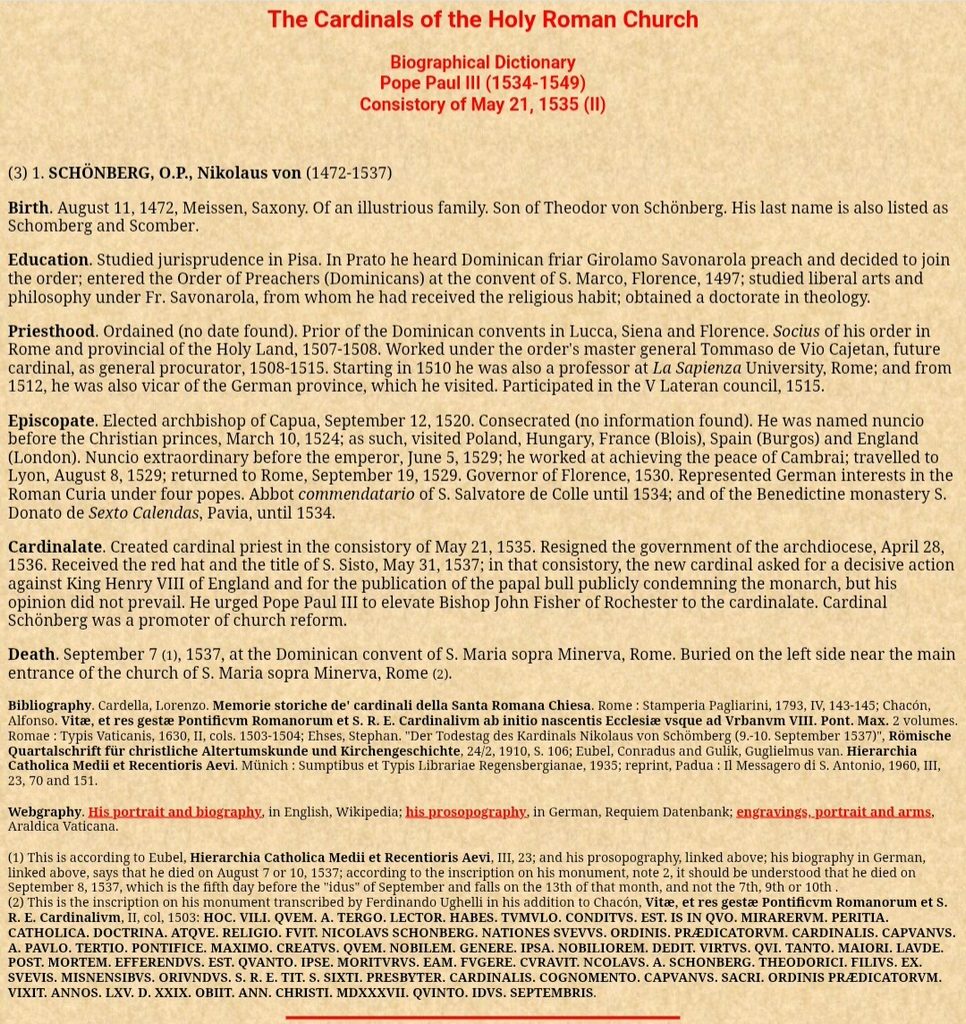
The comparison does not establish that equivalent original records once existed for both men. Nevertheless, it demonstrates the kind of precise death and burial information historians may be able to recover.
For Copernicus, the documentary trail is less straightforward. Hermann Kesten also refers to Giese’s letters dated 8th December 1542 and 26th July 1543, asking similar questions. We do not find any conclusive answers whatsoever. All we are left to do is guesswork.
Additionally some points to highlight here:
- Copernicus was no ordinary citizen of Frauenburg. He legit worked at the church there. The absence of a recorded death entry of such a distinguished individual also raises questions about the burial itself.
- The original grave was not securely identified for centuries and successive archaeological searches failed to locate Copernicus’s remains before the twenty-first-century excavations.
Was There Any Eye Witness to Copernicus’s Death?
The most straightforward answer is No.
One of the most important questions in this investigation concerns direct eyewitness testimony and in Copernicus’s case we have none.
It is indeed most absurd that a person of Copernicus’s stature should die without leaving actual reliable records. Bear in mind, Copernicus was the nephew of Lucas Watzenrode, an influential personality in Frauenburg. It was through his uncle that he secured the post of a Canon at the Warmia Chapter.
Notably, all biographical records of Nicolaus Copernicus were also ‘lost’ or disappeared as most historians report.
Though these observations might sound repetitive, they warrant reiteration for no amount of reiterating can highlight how serious the matter is.
Now we expand the sphere of our examination to Nicolaus Copernicus’s known circle.
What Happened to Copernicus’s Circle?
Though Copernicus did work and live alone, he was not entirely alone. His correspondence and intellectual relationships connected him with scholars, churchmen and administrators across Europe. Among the most important figures were Tiedemann Giese and Georg Joachim Rheticus – people we have already mentioned earlier in this article. Another dear friend was Alexander Sculteti but we will discuss Sculteti a little later in this article.
The Lost Biography of Copernicus: What Did Rheticus Know?
Among the missing documents in the history of Nicolaus Copernicus is a particularly intriguing one – a biography reportedly prepared by his own student, Georg Joachim Rheticus.
Rheticus was no ordinary admirer. He spent considerable time working closely with Copernicus, helped bring his astronomical discoveries to public attention and also played an instrumental role in arranging the publication of De Revolutionibus. He was therefore exceptionally well placed to record details about Copernicus’s personality, private circumstances, intellectual struggles and final years, with absolute direct access to him.
Evidence that such a biography existed or was at least being prepared, appears in the correspondence of Tiedemann Giese, dated 26 July 1543. Yet the manuscript has not survived in any known collection. Giese referred to a biography that Rheticus had written and that he himself had already read. He suggested including it in a corrected edition of Copernicus’s book, explaining that the principal element missing from the account was the conclusion of the astronomer’s life.
Why was it never published? Where did it go? Did later biographers have access to any part of it? Could it have contained information about Copernicus’s death that is now unavailable?
Rheticus, Reinhold and the Limits of Academic Freedom
By now we know that Rheticus occupies an unusually important place in the history of Copernican astronomy. Though he studied directly under Copernicus, promoted his ideas and helped arrange the publication of De Revolutionibus, his professional environment was not welcoming to the theory he had worked so hard to bring before the world.
Historian Andrew White in his book ‘A history of the warfare of science with theology in Christendom’ also describes the difficulties faced by Rheticus and Erasmus Reinhold at the University of Wittenberg, where Lutheran intellectual traditions strongly influenced the teaching of astronomy.
Additional reference from Friedrich Albert Lange’s ‘Geschichte des Materialismus und Kritik seiner Bedeutung in der Gegenwart’ notes ‘Die Herrschaft der Theologie wird durch die Stürme der Reformationszeit hinlänglich bezeichnet, sie unter- drückte eine Zeit lang fast jedes andere wissenschaftliche Interesse, namentlich in Deutschland.’ It reveals the tumultuous environment of Germany and that any interest in all other sciences was suppressed due to the storms of Reformation sweeping the country. This period we refer to is the early 1520s onwards.
According to White, both mathematicians, Rheticus and Reinhold, recognised the importance of Copernicus’s work but faced restrictions in openly teaching heliocentrism as physical reality. Rheticus eventually left his professorship partly because he wanted greater intellectual freedom.
This environment provides useful context for Rheticus’s later career. It also makes the disappearance of his biography of Copernicus especially significant. Whether professional pressures contributed in any way to the biography’s disappearance remains unknown.
White’s discussion also identifies Caspar Peucer, who later occupied a prominent position in Wittenberg’s academic establishment. Peucer rejected the introduction of Copernican astronomy into university teaching. White places this development in 1571, almost three decades after Copernicus’s death.
What can be established here is that the reception of Copernican astronomy involved not only theological debate, but also the institutions responsible for educating future scholars.
When Universities Could Not Freely Teach the Movement of the Earth
In Europe, religious authority could influence what professors taught, which theories students encountered and how scientific discoveries were interpreted. The primary opposition came from both Catholic and Protestant authorities and, in some institutions, developed into formal restrictions on university teaching. The implications were considerable.
Universities, Theology and the Authority of Aristotle
European universities had developed within an intellectual environment strongly influenced by Christian theology and Aristotelian philosophy.
As described in Kesten’s ‘Copernicus and His World’, students generally began their education in the Faculty of Arts, where astronomy formed part of the mathematical curriculum. Theology occupied the highest position in the traditional hierarchy of university faculties, while the founding and privileges of universities frequently involved papal or imperial authority.
This did not prevent medieval scholars from conducting sophisticated astronomical investigations. Nevertheless, the dominant geocentric cosmology had acquired a theological significance that made challenges to it controversial.
The traditional conception of the universe was reinforced through biblical interpretation and scholastic reasoning.
Peter Apian’ Scientific Reputation Within an Ecclesiastical University
Peter Apian, a respected mathematician and astronomer who taught at the University of Ingolstadt, enjoyed considerable prestige, including the favour of the Emperor Charles V. However, his professional position nevertheless placed him within an institution where teaching was expected to remain compatible with theological interpretations of Scripture.
Rather than openly defending Copernicus’s new system, Apian continued to teach traditional astronomy. This stoic silence as evidence of the pressures operating within a university under ecclesiastical influence. The University of Ingolstadt was ‘under the strictest Church control’ (page 126, A History of the Warfare of Science with Theology in Christendom).
Who Determined What Could Be Taught Is The Larger Question
Taken together, all these examples bring us to a vital question extending beyond the history of one astronomical discovery. What happened when an idea could be calculated, discussed privately or employed for mathematical predictions, but could not always be openly taught as an account of the physical universe?
The answer depended on the period, the university, its religious affiliation and the particular authorities involved.
This background is especially relevant to the complicated publication history of ‘De revolutionibus’ – Rheticus’s extraordinary contribution, his departure before printing was complete, Osiander’s assumption of responsibility for the remaining production and the anonymous preface that altered how readers encountered Copernicus’s theory.
When the public defence of a scientific theory could carry religious and professional consequences, how freely could scholars publish, teach and defend what they believed to be true?
Copernicus Condemned: Protestant Religious Authorities Against the Movement of the Earth
To unearth the secret of Nicolaus Copernicus’s death, we must understand why the Copernican controversy became so intense and return to Europe for a moment.
The early sixteenth century witnessed the Protestant Reformation, disputes over ecclesiastical authority and growing disagreement about who had the right to interpret Scripture. But, here we must remember that both the parties regarded the Scripture and their interpretations of it as the unchallengeable authority.
When Nicolaus Copernicus challenged the centuries-old belief that Earth remained motionless at the centre of the universe, he kicked up a storm. Influential theologians from both Catholic and Protestant traditions denounced the movement of the Earth, challenged the legitimacy of his conclusions and, in some cases, advocated restrictions against such teachings.
Their criticism was often direct, personal and referenced to interpretations of Scripture.
Martin Luther Dismissed Copernicus as a Fool
Martin Luther, the leading figure of the Protestant Reformation, was among the earliest religious figures whose criticism of Copernican astronomy entered the historical record.
During a conversation recorded on 4th June 1539, four years before ‘De revolutionibus’ appeared in print, Luther reportedly rejected the idea that Earth moves. His criticism, preserved in his ‘Tischreden’ (Table Talk), objected to the reversal of the traditional relationship between the Earth and the heavens. ‘Der Narr will die ganze Kunst Astronomie umkehren’ (This fool wishes to reverse the entire science of astronomy), was Luther’s scathing remark. He then invoked the biblical account of Joshua commanding the Sun to stand still, rather than the Earth (Aber wie die heilige Schrift anzeiget, so hieß Josua die Sonne still stehen, und nicht das Erdreich). (Source: Projekt Gutenberg)
Though some segments counter this stating Luther did not name anyone specific, it is a well-known fact that Copernicus was already speaking publicly about his findings. We will also discuss a specific incident in Rome in a while. It is evident Luther was throwing a shade at Nicolaus Copernicus.
The timeline here is important as De Revolutionibus has still not been published, yet Nicolaus Copernicus’s findings have already been known to both the warring segments – the Catholic church and the Protestants.
Though supporters of Luther argue he did not use the word ‘fool’, the attempts to whitewash cannot undo the damage already done. The majority of this whitewashing is attributed to Wittenberg and we have already compounded on the dangers there for any pro-science individual, especially those who went ‘against’ the Scripture as held by the Protestants.
Philipp Melanchthon Called for the Restraint of Copernican Teaching
Philipp Melanchthon, Luther’s close associate and one of the most influential figures in Protestant education, expressed his opposition even more explicitly.
Melanchthon’s letter to Burchard Mithobius, dated 16th October 1541, contains particularly strong language, ‘ille Sarmaticus Astronomus qui movet terram et figet solem’ (that Sarmatian astronomer who moves the Earth and fixes the Sun).
He went further, suggesting that rulers should restrain the intellectual freedom that permitted such claims to circulate: ‘Without question, wise rulers should suppress intellectual immodesty’ (original statement in Latin: ‘Profecto sapientes gubernatores deberent ingegnorumpetulantiam cohercere’).
In the book ‘Copernicus in the Cultural Debates of the Renaissance Reception, Legacy, Transformation’, author Pietro Daniel Omodeo also notes that Melancthon’s ‘aversion’ was so ‘tinged with contempt’ as is evident in the original manuscript version of his ‘Initia Doctrinae Physicae’, which one can find in the Stadtbibliothek of Nuremberg (city library). In his original writing, ‘Melanchthon used even ruder words to reprimand Copernicus’, which he mellowed down in the print edition, writes Omodeo on page 88.
These are powerful quotations because Melanchthon is not merely disagreeing with the astronomical theory but also calling upon rulers to restrain the intellectual conduct associated with it.
Giovanni Maria Tolosani: The Theologian Who Tried to Destroy Copernicus’s Credibility
The Catholic opposition to Nicolaus Copernicus did not begin with the formal prohibition of his book in 1616. Its roots can be traced much earlier, to influential theologians who rejected the movement of the Earth within just a few years of the publication of De Revolutionibus.
One of the earliest and most determined opponents was Giovanni Maria Tolosani (1470-1549), a Dominican scholar from the convent of San Marco in Florence. What makes his involvement particularly important is that Tolosani was no stranger to astronomy. Decades before he attacked Copernicus, he had participated in the Church’s efforts to reform its calendar.
Two Scholars Connected by the Calendar Reform
During the Fifth Lateran Council (1512-1517), the Catholic Church examined proposals to correct the Julian calendar, particularly the astronomical calculations used to determine the date of Easter. Tolosani participated in these discussions and authored ‘De correctione calendarii’, a treatise concerned with calendar reform.
Copernicus, whose astronomical expertise had already attracted attention, was also consulted in 1514. He considered the available knowledge of the Sun’s and Moon’s motions insufficiently precise to support a satisfactory reform. Both men were therefore connected to one of the Church’s important astronomical undertakings nearly three decades before De Revolutionibus appeared.
Tolosani’s involvement also placed him in contact with scholarly circles associated with the papal court. This early history is important as it establishes a connection through a common astronomical problem. Their later intellectual positions could scarcely have been more different as Copernicus challenged the traditional arrangement of the heavens. Tolosani defended the established cosmology, drawing upon Aristotle, Ptolemy and his interpretation of Holy Scripture.
The Attack That Followed the Publication of De Revolutionibus
Copernicus’s revolutionary work appeared in Nuremberg in 1543. Now remember, here comes the documented attack.
By June 1544, Tolosani had completed his theological treatise ‘De veritate sacrae scripturae’ (On the Truth of Holy Scripture). Around 1546-1547, he added an anti-Copernican appendix known as ‘De caelo et elementis’ (On Heaven and the Elements). Its fuller title was ‘De caelo supremo immobili et terra infima stabili caeterisque caelis et elementis intermediis mobilibus.’ The title itself defended an immobile highest heaven and a stable Earth, together with the motion of the intervening heavens and elements.
This was not at all a passing criticism. Tolosani devoted an extended discussion to refuting the central principles of Copernicus’s cosmology. Historian Andrzej Kempfi reveals the attack was inspired by Bartolomeo Spina, Master of the Sacred and Apostolic Palace under Pope Paul III.
Tolosani was therefore writing within a network of influential Dominican theologians, one of whom held a senior position in the papal establishment.
Copernicus Accused of Seeking Recognition Rather Than Truth
Tolosani opened his attack by portraying Copernicus’s revival of the Earth’s motion as an attempt to resurrect an ancient Pythagorean theory that had long been abandoned.
He then questioned Copernicus’s motives. Rather than accepting that Copernicus genuinely believed his theory to be true, Tolosani suggested that he was primarily interested in demonstrating his own intellectual ingenuity. The accusation was serious because it implied that Copernicus had promoted a revolutionary account of the universe not because he was convinced by the evidence, but because he wished to display his brilliance.
The resemblance to Martin Luther’s earlier mockery of the astronomer is indeed striking here. Both critics suggested that intellectual novelty, rather than a sincere pursuit of truth, lay behind the proposed movement of the Earth.
But Copernicus had already anticipated hostile reactions. In his dedication to Pope Paul III, he acknowledged that readers might immediately demand the rejection of both himself and his conclusions upon discovering that he attributed motion to the Earth.
Tolosani’s attack was precisely the kind of reaction Copernicus had feared.
A Direct Assault on Copernicus’s Intellectual Competence
Tolosani’s criticism became considerably more personal when he evaluated Copernicus’s qualifications. He acknowledged that Copernicus possessed a sharp mind, knew Latin and Greek, and was accomplished in mathematics and astronomy.
Then came the condemnation as Tolosani declared that Copernicus was ‘very deficient in physics and dialectics’. He further accused him of unfamiliarity with Scripture and suggested that his conclusions endangered both himself and his readers by leading them away from religious truth.
Tolosani thus placed religious and philosophical authority above Copernicus’s astronomical reasoning. Copernicus had anticipated this when he appealed to Pope Paul III for protection against critics who would misuse biblical passages to judge astronomical questions.
The Anonymous Preface Turned Against Copernicus
Another striking aspect of Tolosani’s attack concerns the anonymous introduction to De Revolutionibus. Tolosani seized upon its argument and turned it against the book.
‘Almost all the hypotheses of this author Copernicus contain something false, and very many absurdities follow from them. Hence that writer, whose name is not indicated there, and who speaks “To the Reader Concerning the Hypotheses of This Work’ wrote Tolosani, as testified by Eugenio Garin in ‘Copernico E I Filosofi Italiani Del Rinascimento’ and Edward Rosen too.
Andrzej Kempfi also notes Tolosani recognised that the anonymous preface had a different author. This observation is extremely crucial. Until Tiedemann Giese wrote to Rheticus about the anonymous preface and his agitation on seeing it, it never struck anyone else that this preface did not belong to Copernicus.
The point here we must assert is how did Tolosani, sitting in Italy, know that this was not written by Copernicus? Naive readers may attribute it to differences in the writing skills of both writers, but there is more that meets the eye. Was it a premeditated statement? Tolosani was so sure of the difference in authorship as is evident in his piercing words.
We must remember that Nicolaus Copernicus’s findings did not come to light suddenly, they were known to, at least, the intellectual circles beginning in the 1500s already. It was also known that Copernicus had not stopped working on his treatise since. Tolosani had prior knowledge of the deliberately inserted preface that was against the wishes of Copernicus to conceal his efforts merely as a hypothesis. This is no baseless allegation, we further prove it in the subsequent section.
This episode also exposes how damaging Osiander’s intervention became in the hands of an opponent. A preface inserted without Copernicus’s authorisation was now being used as ammunition against the scientific claims of his book.
A Claim About Copernicus That Is Dismissed by Historians, But Is True
Tolosani’s polemic has been claimed to contain a ‘striking historical error’. Or at least the historians believe so. He referred to a dispute in Rome involving Copernicus after the publication of De revolutionibus.
Tolosani wrote, ‘Where he wished to show off the keenness of his mind in the book he published, by his own words and writings he rather revealed his own ignorance. Hence he has no right to complain about the men with whom he disputed at Rome, and by whom he was most severely condemned. On the contrary it is more appropriate for him to thank those from whom he learned what he did not know. But that discussion took place belatedly or after the printing and publication of his book’. (Source: Andrzej Kempfi ‘Tolosani versus Copernicus: on Certain Appendix to the Treatise ‘On the Truth of Holy Scripture’ from the Forties of the 16th Century’).
Most scholars and historians, including Kempfi and Rosen, could never see the truth in this admission because they chose to believe the peddled second-narratives that Copernicus died in Frombork on 24th May 1543, after a period of severe illness. So definitely he would not have travelled to Rome to participate in such a controversy, they thought.
But they missed another big loophole in the heart wrenching story of Nicolaus Copernicus’s fight to prove his truth. We will place all these pieces of the jigsaw puzzle one by one as we proceed ahead.
Bartolomeo Spina: The Papal Official Who Intended to Condemn Copernicus’s Book
Tolosani’s manuscript was not an isolated expression of theological hostility towards Nicolaus Copernicus. A much more consequential figure, Bartolomeo Spina, the Dominican who served as Master of the Sacred and Apostolic Palace under Pope Paul III, is also linked to Tolosani’s attack.
According to Tolosani, Spina had openly intended to condemn Copernicus’s book but was prevented from completing that plan by illness and death. ‘Condemn’ we reiterate readers. Tolosani then described his own work as an attempt to carry forward the opposition in defence of religious truth.
This testimony provides a direct connection between the written attack on Copernicus and a senior official within the papal establishment. This is very significant because the earliest Catholic opposition to De revolutionibus was not confined to an obscure scholar solely. It involved a theologian who had participated in Church-sponsored astronomical discussions and who was closely associated with an official responsible for examining potentially objectionable books.
Though the ‘official’ and public condemnation direct from the Catholic Church came in years after Copernicus’s death, his work was already being denounced as philosophically unsound, contrary to Scripture and dangerous to religious belief. Tolosani’s literature proves that a senior papal theologian had reportedly contemplated its condemnation immediately. Therefore, the hostility was already present.
But Who Exactly Was Bartolomeo Spina?
Bartolomeo Spina was not an ordinary critic of Copernicus. He was a Dominican theologian who became Master of the Sacred and Apostolic Palace under Pope Paul III in July 1542, less than a year before De revolutionibus was published. This is just when the Roman Inquisition was set up.
- The office carried considerable religious authority within the papal court and included responsibilities relating to the examination and control of books.
- Spina’s position therefore makes his reported intentions particularly significant.
- Here was an influential official, closely connected to the papal establishment, who had contemplated condemning Copernicus’s work.
- Spina was a theologian who placed religious authority above other sciences
- In 1525, he published a treatise whose title explicitly asserted the superiority of sacred theology over other branches of knowledge: ‘Tractatus de praeeminentia Sacrae Theologiae super alias omnes scientias & praecipue humanarum legum’. In English, this means ‘Treatise on the Preeminence of Sacred Theology over All Other Sciences, Especially Those Concerning Human Laws’.
When Copernicus published an astronomical theory that challenged the traditional interpretation of the universe, he entered an environment in which influential theologians claimed the authority to judge conclusions reached through other disciplines.
The documented relationship between Spina and Tolosani by historian Edward Rosen also establishes that Spina and Tolosani were not merely members of the same religious order. They had a longstanding personal and intellectual association. Tolosani submitted his theological work for Spina’s examination. Rosen discusses a letter dated 16th August 1546 in which Spina praised the work and recommended it.
Historian Gereon Wolters also refers to Spina’s written approval, although he gives the date as 6th August 1546. Nevertheless, this detail proves that Spina had examined and approved Tolosani’s work, and how closely connected the two men were connected.
What Did Copernicus Himself Fear?
Nicolaus Copernicus understood that his astronomical conclusions would challenge far more than just the prevailing scientific explanation of the universe. It would rattle the Catholic Church and all its proponents. For centuries, the Earth had been regarded as stationary at the centre of creation, an understanding reinforced by philosophical traditions and interpretations of sacred scripture.
Copernicus proposed a fundamentally different arrangement. In his system, the Earth rotated on its axis and travelled around the Sun, challenging assumptions that had shaped European intellectual life for generations. In short, Copernicus made the very ‘sacred’ Earth ‘move’. That was his crime.
But how did Copernicus himself perceive the risks associated with presenting this theory? The most important disclosures on Copernicus’s approach lies in his own letter of dedication to Pope III in De Revolutionibus that he wrote at a later stage, months after his original manuscript was taken to Nuremberg for printing.
- Copernicus acknowledged that his ideas might provoke ridicule and opposition.
- He anticipated critics who would reject his conclusions simply because they contradicted established assumptions.
- He also challenged those who attempted to settle mathematical questions through scriptural interpretations without possessing the necessary mathematical knowledge.
- His concerns were genuine because by the early sixteenth century, the traditional cosmological model had become closely associated with theological teaching.
- Andrew Dickson White, writing in 1897, interpreted Copernicus’s reluctance to publish as evidence that he feared serious religious consequences.
- In Copernicus’s own words, ‘he almost abandoned’ his work. What circumstances can push an individual to sacrifice an extraordinary piece of work, but for the fear of his own life?
Nicolaus Copernicus held dearly onto his developing treatise for as many as thirty six years, by no means an ordinary period. Surely he anticipated huge backlash and danger to his life, and also kept gathering more evidence to support his truth.
His retreat to the quieter Ermland (Warmia), Poland, was also a result of this fear.
Why Did Nikolaus Copernicus Leave Rome?
Copernicus’s years in Italy are essential to understanding the development of his intellectual career. He studied in Bologna, Padua and Ferrara and spent time in Rome, where he was associated with astronomical instruction.
After his studies were complete, Copernicus went back to Warmia only to return back to Italy now in pursuit of medical studies. Was he simply completing a period of study and returning to his ecclesiastical responsibilities? Or did his astronomical views contribute to tensions that influenced his movements?
The surviving chronology will guide us to the answer. It has been widely acknowledged by several historians that Copernicus was already discussing his astronomical findings with students and other scholarly circles.
Why did Copernicus then return back to Poland for the second time from Rome?
Copernicus in Rome: An Astronomer Who Left Under Pressure?
When Copernicus travelled through Italy at the turn of the sixteenth century, he entered a world of extraordinary intellectual achievement but also ruthless religious and political conflict. The Renaissance had revived interest in classical philosophy, mathematics and scientific inquiry. However, religious dissent could still invite excommunication, torture and execution.
Copernicus had taught in Rome around 1500 and had already introduced ideas concerning the movement of the Earth. These ideas were initially received as intellectual curiosities rather than as a fully developed challenge to the accepted structure of the universe.
As Copernicus became increasingly convinced of the reality of the Earth’s motion, he came to believe that Rome was no longer a safe environment in which to defend his conclusions.
Did Copernicus anticipate difficulties if he continued publicly advocating a cosmological theory that contradicted prevailing religious and philosophical assumptions? It was extremely well-known to all citizens that any concept that challenged the Catholic Church was met with deadly consequences. The case of Giralamo Savonarola never left the memory of people across Europe.
Girolamo Savonarola, a Dominican friar who openly denounced corruption within the papacy, Savonarola was repeatedly ordered to stop preaching by Pope Alexander VI. Excommunicated in 1497, he was arrested, tortured and condemned. On 23rd May 1498, he and two fellow friars were tortured, hanged and their bodies burned publicly in Florence. Their ashes were scattered into the Arno.
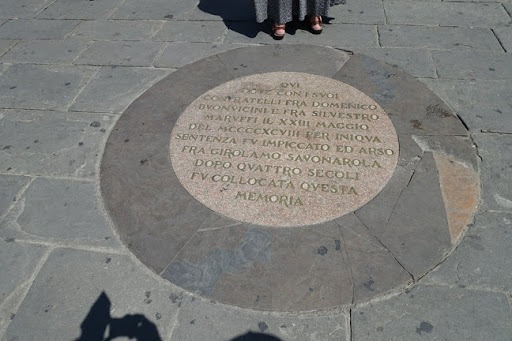
The exact spot where Savonarola was hanged and burnt
Intellectual suppression was not just confined to Rome. Though Savonarola was himself a prominent Dominican preacher, this did not spare him. Papal power could be used to silence influential critics.
Copernicus was studying in Italy during these years. Whether he personally witnessed Savonarola’s execution is unknown. But the episode reveals the atmosphere in which he lived – challenging powerful religious authorities could carry consequences far beyond scholarly disagreement.
Decades later, Copernicus acknowledged in his dedication to Pope Paul III that fear of ridicule had helped keep his revolutionary astronomical work unpublished. He also asks the Pope to protect his work against malicious attacks. Though it must be noted that Pope Paul III is the very authority responsible for the establishment of the Roman Inquisition in July 1542, just as Copernicus’s work was already into print.
Did Copernicus Defend His Theory Before 2,000 Scholars?
One of the more remarkable revelations concerning Copernicus’s early career is that he publicly defended his astronomical theory before approximately 2,000 scholars in Rome around the year 1500.
This disclosure appears in a nineteenth-century Catholic account – the January 1869 issue of The Catholic World. That publication cited a speech by the Archbishop of Mechlin (Malines in French) before the University of Louvain, asserting that Copernicus had defended his theory before a large Roman audience. He says, ‘Again, at Rome, toward the year 1509, that Copernicus explained and defended this system before an audience of two thousand scholars’.
The claim is significant in the nineteenth-century debate over the Church’s relationship with Copernicus because all through, the mouthpieces of the Catholic Church have made us believe that they were never averse to Copernicus’s work, in fact, they encouraged him. The most important word here in the Archbishop’s sentence is that Copernicus ‘defended’ his theory.
Though the Archbishop further goes on to glorify the Catholic Church’s support to science, the fact that Copernicus even thought of abandoning his research and path breaking treatise is evidence enough of the storm he expected.
Was the Vatican’s Silence Evidence of Approval by Pope III?
For decades after the publication of De revolutionibus, Rome did not issue a formal prohibition of Copernicus’s book. That silence has been interpreted as evidence of tolerance or approval and vociferously reiterated across Catholic literature, including publications like the Catholic World that was brought to life to advocate the positive image of the Catholic Church.
But some surviving evidence demands a more careful examination and we stress on the word ‘some’ because a lot has been mysteriously ‘lost’.
How Did the Story of Papal Approval Begin?
Rosen demonstrates that the frequently repeated story of Pope Paul III approving De Revolutionibus rests originally on an unsupported claim made decades later by Bernardino Baldi. Rosen writes, ‘There is no evidence that Paul III ever listened to a pro-Copernican lecture that Schönberg showed him Copernicus’s Revolutions before it was first pushed in 1543’.
It is important to note here that the first edition of Copernicus’s biography written by Baldi did not go into print as ‘the manuscript was too bulky to be printed’. It is in this edition that Baldi has mentioned Pope III. In order to get his work published, Baldi then condensed his work and created Cronica de’ matematici that was published in 1707. In this condensed edition, Baldi mentioned that Copernicus dedicated his work to Pope III but omitted all the claims about permissions received or orders received from Pope III by Copernicus to publish his work.
By now we are well aware of the extreme hostile ecosystem of science versus religion prevalent at the time. If Copernicus had received any order or permission from the highest Catholic authority, he would have made sure to publish that too. Just like in an effort to demonstrate support from the Catholic camp, Copernicus published Cardinal von Schönberg’s letter of encouragement as part of De Revolutionibus. Why would he not do the same if he indeed had permission from Pope III? In fact, in his dedication, Copernicus ‘seeks’ protection from the Pope from any miscreants which he knew would definitely come after him.
Gereon Wolters uncovers another dimension to this question. He argues that Tolosani and Spina represented early opposition that never developed into an effective institutional campaign because both men died before such action could be pursued. But, one must not overlook the choice of words Walter exercises to denote the Catholic authorities – ‘wolves’ he calls them.
Was the Favourable Reception of Copernican Ideas Attributed to the Wrong Pope?
Another possible source of confusion could be attributing the wrong pope. In 1533, Copernican astronomy was believed to have been explained in the Vatican gardens before Pope Clement VII and several associates. The presentation was favourably received and the pope rewarded the lecturer with a valuable Greek manuscript.
But Clement VII died in 1534, almost a decade before De Revolutionibus was published. His successor, Pope Paul III, was a different individual whose attitude towards Copernicus’s completed work cannot simply be inferred from Clement VII’s earlier response.
Though a copy of Copernicus’s work De Revolutionibus was dispatched to Pope III formally as we have already seen in the Three Letters by Giese, neither did the Pope nor any other church authority issue an official acceptance or received statement.
There was always a stoic silence on any reference to Copernicus, except the fervent efforts to repeat the same narrative of how Copernicus received his treatise when he was on his deathbed and magically woke up from come, as some say, at that very moment and passed away ‘peacefully’ after looking at his book. Creative minds did not stop there; a few years later artists took the creative liberty to even depict his deathbed emotional scene, thereby planting these visuals in unsuspecting minds. Given below is an example of the creative liberty taken by artists at the risk of feeding this narrative into unsuspecting minds.
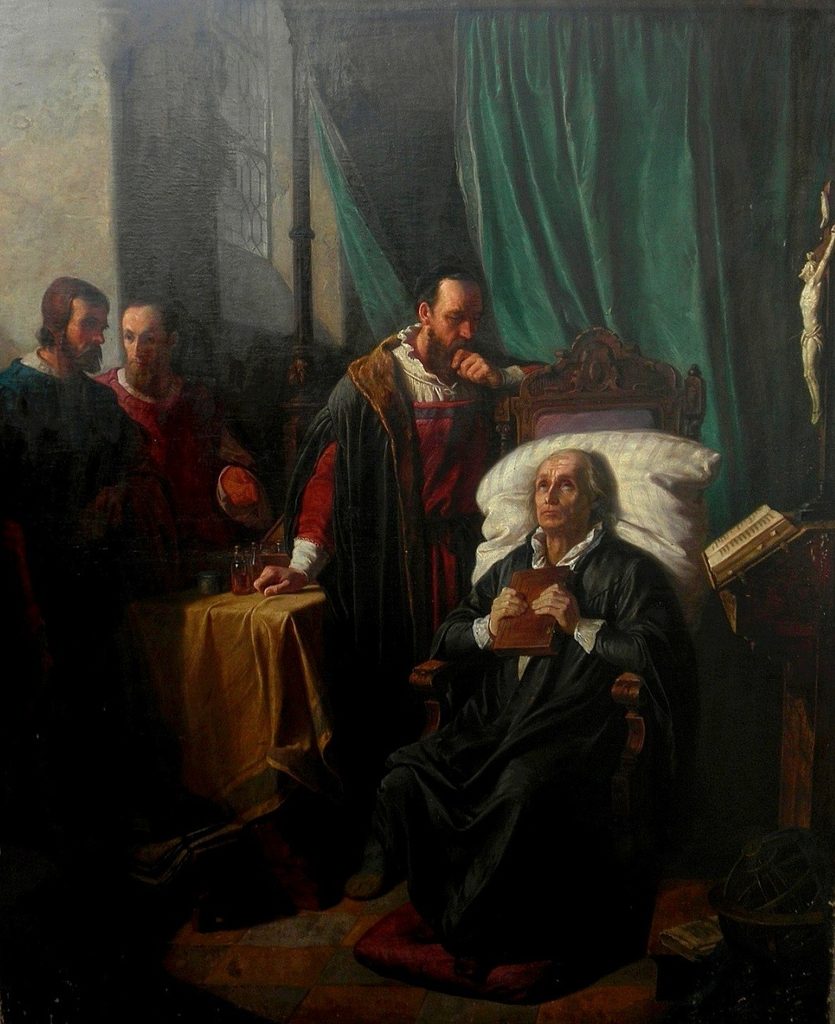
We must remind ourselves at this juncture that the news of his illnesses was conveyed to Giese by ‘someone’, as per the three letters. That’s all! No other source of information. This carefully planted narrative was immediately picked up as time passed and Copernicus’s name gained prominence.
An example of such a victim is Mr. Everett’s address at Amherst College whose use of a vivid description of Copernicus’s death scene even caught the attention of the otherwise scornful (to the opponents of the Catholic church) magazine, The Catholic Telegraph, as published on 10th December 1835 (picture below).
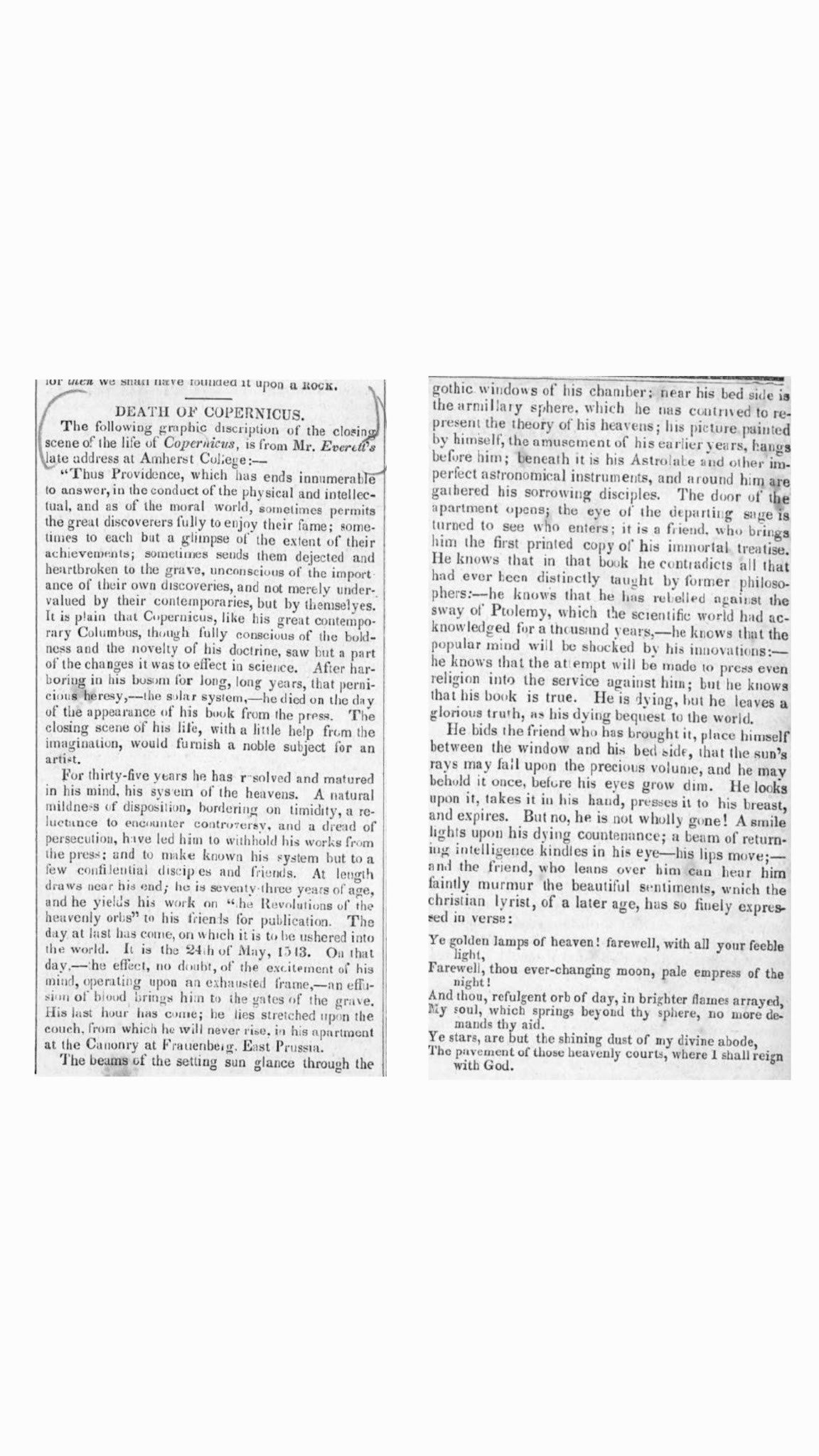
Funnily enough, the same Catholic Telegraph rebuked this very Edward Everett in an open letter in the 17th January 1857 issue, when Everett expressed his views on the ‘early advocates of the Copernican System’ (picture below).
Pope Paul III and the Roman Inquisition
The establishment of the Roman Inquisition by Pope Paul III on 21st July 1542 is an event hard to ignore, especially given the timing of Nicolaus Copernicus’s publishing of his work.
Pope Paul III established the Roman Inquisition through the papal bull Licet ab initio, strengthening the institutional machinery for investigating and combating heresy. It was to this same pope that Copernicus addressed the dedication accompanying his revolutionary work, De Revolutionibus orbium coelestium, published in 1543.
The connection gains more significance when another appointment made under Paul III is considered. In July 1542, Bartolomeo de Spina became Master of the Sacred and Apostolic Palace, an influential position involving theological scrutiny of writings. We have established how Bartolomeo Spina had expressed his desire to condemn Copernicus’s treatise, as confirmed by Tolosani in his literature.
Thus, the pope to whom Copernicus dedicated his work was also the pope under whom the Roman Inquisition was established and Spina held office.
Though these circumstances may not directly point out that Paul III personally opposed Copernicus, what they do tell us is that it is historically untenable to infer papal approval merely from the dedication or the absence of an immediate decree.
Why is there no open record about Pope III’s approval or disapproval of the Copernicus System? A historian elaborating the character of Pope Paul III reveals him to be ‘this skilled diplomatist succeeded in tracing out the most secret intentions and schemes and turning them to his own uses. With the same skill he knew how, in a conflict of opinion, to steer clear on a middle course’.
This also explains why and how the Roman Inquisition executed several individuals under ‘secret trials’ that of course were never publicly declared, especially during Pope III’s leadership. It is believed that a minimum of 50,000 secret trials were carried out by the Inquisition on account of heresy, danger to Catholicism and to ‘regain authority’.
At this point, we draw your attention to a crucial timeline:
- Copernicus’s book was already being published in 1542.
- He wrote his dedication letter to this very pope only in June 1542 after his work was published, as an afterthought with religious unrest building and talks of the formation of the Roman Inquisition already.
- The Roman Inquisition was established by Pope III on 21st July 1542.
- Nicolaus Copernicus dies as soon as he sees his book, as per what we have been told.
This chronology and Copernicus’s visit to Rome has a big connection which we will expose as we proceed to fit this jigsaw puzzle step by step.
Copernicus and Galileo: Does the Absence of Condemnation Mean the Absence of Opposition?
Galileo Galilei was that scientist publicly condemned by the Church for defending the movement of the Earth, Giodarno Bruno being the other known Copernican supporter. Nicolaus Copernicus, by contrast, is frequently presented as someone who encountered no comparable opposition from Catholic authorities during his lifetime.
But now that we have established the stealthy modus operandi of the Catholic Church under Pope III during the Roman Inquisition, this contrasting narrative for Nicolaus Copernicus receiving an all-out support from the Catholic camp tells a different story.
The experiences of Copernicus and Galileo also reveal something important about the way religious opposition to scientific ideas developed. Neither man’s relationship with ecclesiastical authorities can be understood simply by looking at the final official decisions.
Let us consider Galileo’s experience. When Galileo began attracting attention through his telescopic discoveries in 1610, he did not encounter universal hostility from the Catholic world. His astronomical observations earned recognition, including from Jesuit mathematicians. He also received encouragement from influential churchmen.
Yet opposition developed as Galileo increasingly defended the Earth’s movement as a physical reality and argued that biblical passages should not be interpreted in ways that contradicted demonstrated natural phenomena. Trouble started brewing for Galileo the moment he became an open proponent of the Copernican study.
As historian Rafael A. Martínez explains in ‘What Does the Decree on Copernicanism Say?’, the decree issued on 5th March 1616 was not an isolated or spontaneous act of condemnation. It followed complaints against Galileo, investigations by the Holy Office, examinations of his writings and consultations with theologians. In February 1616, theological advisers judged the motion of the Earth and the stability of the Sun to be philosophically false and contrary to accepted interpretations of Scripture.
Please note here, the Holy Office did not formally adopt the advisers’ harshest theological classifications through a public doctrinal ruling. Nevertheless, Galileo was personally instructed to abandon the disputed doctrine, while Copernicus’s De Revolutionibus was suspended until corrected.
The distinction between a formal doctrinal condemnation and an institutional restriction was therefore far from insignificant. The absence of a formal condemnation therefore did not prevent the latter.
Galileo’s story did not end there. Following the election of Pope Urban VIII, he pursued another opportunity to discuss the competing cosmological systems. His ‘Dialogue Concerning the Two Chief World Systems’ received permission for publication in 1632, subject to conditions.
Yet that permission did not protect him from prosecution. We are all aware of the 1633 trial of Galileo by the Roman Inquisition, where he was found vehemently suspected of ‘heresy’ (read Copernican study) and sentenced to imprisonment for life that was subsequently served under house arrest.
The same scientist who had received encouragement and permission to publish ultimately faced condemnation.
Now let us go back to Copernicus. His ‘De Revolutionibus orbium coelestium’ appeared in 1543, dedicated to Pope Paul III. No formal decree condemning the book was issued during Copernicus’s lifetime. But is that sufficient evidence that Catholic authorities and theologians accepted his ideas without objection?
Martínez’s account itself provides an important qualification in this regard. He records that Bartolomeo de Spina, Master of the Sacred Palace, attempted to examine Copernicus’s work with the intention of condemning it, according to the testimony of Giovanni Maria Tolosani. We must reiterate that a Master of the Sacred Palace was a position that maintained a close association with the Pope within the Catholic fort. Pope III held Bartolomeo Spina in very high regard and considered his opinions, especially in matters of theology particularly important. Spina was also the official censor of books and literature.
The Condemnation of 1616 and the Corrections of 1620
In 1616, the Roman Congregation of the Index formally and publicly suspended ‘De Revolutionibus orbium coelestium’ pending correction.
In 1620, specific corrections were issued for passages in Copernicus’s book. Andrew White drew attention to these changes in his writings and cited earlier scholars who had examined their wording. The corrections sought to alter the presentation of claims concerning the Earth’s motion, particularly where the original text treated them as descriptions of physical reality. This creates an important connection with Andreas Osiander’s anonymous preface of 1543.
Osiander had already encouraged readers to regard Copernicus’s system as a mathematical hypothesis rather than necessarily a true account of the universe. Now decades later, ecclesiastical authorities formally required modifications to the text as Copernican theory was being more and more readily embraced by curious individuals and more so after Galileo gathered evidence for them to literally ‘see’ the truth of Copernicus’s work through his telescope.
The church could no longer conceal their disapproval of Copernican astronomy as the audience for it kept increasing. Voices turning to Nicolaus Copernicus’s work were being felt as difficult to silence.
At the same time, we must also recollect that the voices condemning Copernicus and acting as the protectors of religion and of the Catholic Church were never silent!
Fromondus and the Defence of the Anti-Copernican Decree
The theological opposition to heliocentrism continued long after Copernicus’s death too.
One particularly notable example is Libertus Fromondus’s ‘Ant-Aristarchus sive Orbis-Terra Immobilis,’ published in Antwerp in 1631. The title of the book is not merely descriptive, it is dripping with hostility for it declares ‘The Earth is Immovable’ (Orbis-Terra Immobilis). It connected its argument to the defence of the ecclesiastical decree issued against Copernican teachings in 1616. On the title page also, Fromondus explicitly mentions the 1616 decree: ‘In which the decree of the Sacred Congregation of Cardinals of the Holy Roman Church, issued in the year 1616 against the Pythagorean-Copernicans, is defended’.
A special mention of the author here, Libertus Fromondus who was the Doctor of Sacred Theology and Ordinary Professor at the University of Louvain. This is the same University of Louvain where Archbishop of Mechlin disclosed how Copernicus had to defend his findings in front of 2,000 scholars in Rome around 1500. One can easily connect the dots also to our disclosure about how the Catholic Church exercised a strong hold over educational institutions too.
Fromondus accuses Copernicans of handling Scripture rashly and criticises those who interpret biblical passages independently of ecclesiastical authority. Ridiculing the idea of terrestrial motion. Fromondus writes, ‘…..suffer from dizziness, those who think that everything in the world is turning, when in fact they themselves are turning. This dizziness, I say, by which they imagine the roofs of taverns and buildings to be revolving, is in their feverish brains. Such a thing sometimes happens even to drunkards’.
This book bears an approval mark and a summary of protection by the royal privilege for the publisher’s exclusive commercial rights. Its confiscation provisions concerned unauthorised editions of Fromondus’s book. In addition to the support from Philip IV, the Catholic King of Spain, this book was approved by an authority of the Catholic Church too – Martin Lunacenius, Licentiate in Sacred Theology, Ordinary Professor, and Apostolic and Royal Censor of Books. Again, a crucial piece of information here. The ecclesiastical censor does not merely certify the book for publication. He also mocks supporters of the Earth’s motion as intellectually self-satisfied and spiritually misguided.
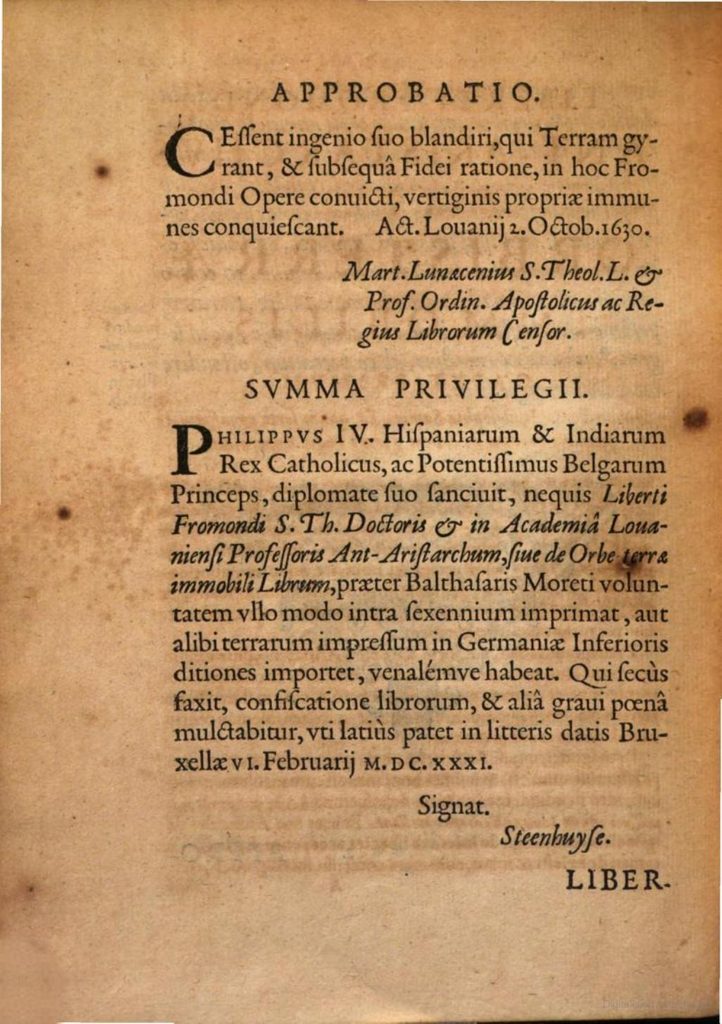
Fromondus also acknowledges Copernicus’s importance, crediting him with reviving and spreading the moving-Earth theory. His words ‘and since they have now spread from him throughout almost the whole world, they also bear the name of Copernicans’ speak volumes about how Copernicus’s study was being embraced worldover.
In his firm criticism towards Copernicus, one can also sense the reason of this dispute – ‘That the Sun is wrongly placed at the centre of the universe and in the middle of that orbit, and that the Earth was very improperly removed from there by Aristarchus and cast, as it were, into the mire – this little book undertakes to demonstrate as his error’. Fromondus further laments, in his foreword to the readers, ‘The question has been raised in the dust of the schools: whether the heavens revolve while the Earth remains still, or whether the Earth revolves while the heavens remain still’.
One particular statement effectively points out the pulse of the Catholic authorities that Copernicus seems to have pressed through his pursuit of truth – ‘….whether God moves everything around us, or whether He moves us’.
This is the danger that the Catholic Church and its bearers felt because of their incorrect interpretation of their own scriptures. For only a truly Enlightened Saint can decode the real essence of holy scriptures. Such a Saint would Never commit the abdominal sins committed by the Catholic Church in the name of God.
Copernicus and Bishop Johannes Dantysek
Here we bring into focus another important figure in Copernicus’s later life, Johannes Dantiscus, also known as Jan Dantyszek, who became Bishop of Warmia. It is only apt to discuss Dantiscus here as he was also associated with the Catholic Church.
Dantiscus exercised authority within the ecclesiastical environment in which Copernicus lived and worked. The dynamics of their relationship is crucial because Copernicus was not merely an independent astronomer working outside institutional structures. He was also a cathedral canon whose position involved obligations, hierarchy and ecclesiastical supervision. Surviving correspondence and accounts of Dantiscus’s involvement in the affairs of the Warmian chapter reveal tensions concerning personal relationships and clerical conduct.
The episode involving Anna Schilling, who was associated with Copernicus’s household, is particularly pivotal to understanding these tensions.
Copernicus Under Ecclesiastical Scrutiny: The Anna Schilling and Alexander Sculteti Affairs
The relationship between Nicolaus Copernicus and the Catholic Church was more complicated than the simple picture of a clergyman enjoying uninterrupted institutional support. His correspondence with Bishop Johannes Dantiscus reveals that, during his later years, Copernicus faced direct interference from ecclesiastical authorities concerning his household and personal associations.
The most notable controversy here involved Anna Schilling, a woman associated with Copernicus’s household. She was rumored to be Copernicus’s distant familial relation. Dantiscus objected to her presence and demanded that Copernicus dismiss her.
On 2nd December 1538, Copernicus responded to the bishop’s admonition. His letter, reproduced in Hermann Kesten’s ‘Copernicus and His World’, acknowledged the bishop’s authority while requesting a short period to make the necessary arrangements. By 11th January 1539, Copernicus informed Dantiscus that he had complied.
But the controversy did not end there. Reports subsequently reached Dantiscus alleging that Copernicus continued to meet Anna Schilling. In a letter dated 12th September 1539, Tiedemann Giese defended his friend, explaining that Copernicus had denied the alleged secret meetings and acknowledged only a brief encounter with her in the marketplace at Königsberg. Giese also cautioned the bishop against placing excessive confidence in accusations made by hostile informants. This point needs to be etched in our judgment of Copernicus’s life – he had hostile informants around him.
Another source of tension was Copernicus’s friendship with Alexander Sculteti (Sculteti has been spelt differently in different languages), a fellow canon who had attracted ecclesiastical suspicion over his religious beliefs and personal conduct.
In correspondence from 1539, Dantiscus asked Giese to warn Copernicus that maintaining this friendship could damage his position. The bishop reportedly wanted the warning conveyed without revealing that it originated from him.
Copernicus nevertheless resisted pressure to abandon Sculteti. These episodes highlight a man whose relationships and private affairs were subject to ecclesiastical scrutiny, even as he continued his astronomical work.
They deliver significant insights to the extent of the institutional pressures operating around Copernicus during the years immediately preceding the publication of his revolutionary work.
Did Copernicus really die in Frambork?
Most modern historical accounts identify Frauenburg, now Frombork in Poland, as the place of Copernicus’s death.
However, one striking variation was delivered in a public address by the former United States President John Quincy Adams before the Cincinnati Astronomical Society in 1843. Adams stated that Copernicus died at Nuremberg on 25th May 1543.

Part that mentions Copernicus’s birth and death details in Quincy Adams’ speech
That differs from the currently accepted account in both place and date.
Nuremberg is where Copernicus’s work was under publication in 1542. Did Copernicus really die in Nuremberg? It would certainly be difficult to ascertain given that most archival communication records of Nicolaus Copernicus and also those mentioning him have been wiped away.
The significance of Adams’s statement is that a prominent nineteenth-century public figure repeated a different account, raising the question of which sources informed him.
Whether Copernicus really died on 24th May 1543 needs to be contested too. Most publications have picked up the date from Giese’s letters. However, the minute book of Georg Donner notes the date as 21st May 1543 (Source: Preußenland, 1974). Therefore, it is safe to say that the accepted date of death of Nicolaus Copernicus is more of a common consensus than that which can be verified.
Similarly, Quincy Adams mentions the birth month of Copernicus as January, not February. Though Kasten’s book ‘Copernicus and His World’ mentions the date of birth as 19th February 1473, he also states that a certain astrologer noted 10th February 1473 as Nicolaus Copernicus’s date of birth as the planetary positions for this particular date were more favourable.
Hence, this proves that the dates that we see reflecting in most articles are indeed a common consensus.
The Catholic newspaper’s response to Quincy Adams
In an interesting twist of events, in December 1843, The Catholic Telegraph challenged Quincy Adams’s statements. Its editor specifically disputed his claim that Copernicus died at Nuremberg.
Snippet from the Catholic Telegraph’s counter to Quincy Adams in December 1843
Note the tone of this rebuttal – extremely sharply defensive and confrontational. Why is this important? Firstly, the role of Catholic Telegraph and such publications fulfill the same role as that of Fromondus’s book – upholding the image of the Catholic Church. Secondly, what also helps us decode the attitude of the ecclesiastical authorities towards those who disagree with them is reflecting in the unmistakable scornful language of this publication. One can only imagine what would have happened to those who actually live through the condemnation of the Catholic Church.
The vehemence of the newspaper’s response is evidence of the polemical atmosphere of the whole Copernican debate.
The Missing Grave, the Tombstone and the Memorial That Came Later
The uncertainties surrounding the documentation of Copernicus’s death also extend into the history of his burial, not just dates and places.
According to Andrew White, Copernicus’s tombstone inscription did not celebrate Copernicus’s scientific achievements or mention the heliocentric theory that would eventually transform astronomy. Instead, it contained a religious appeal for mercy, invoking the grace shown to the repentant thief crucified beside Jesus Christ. White further claimed that a memorial acknowledging Copernicus’s discovery was erected only decades later, of course, once Copernicus’s truth was proved to the world.
He remarked this omission as evidence that those responsible for Copernicus’s burial feared hostility toward the astronomer, even after his death. Even death could not erase Copernicus’s findings from the papal authorities’ lives.
Further, White’s account raises questions about the physical evidence. Which grave marker contained the prayer? When was it erected? Did it stand over Copernicus’s actual burial place? What became of it? And how does its history relate to the later memorial?
These questions gain more relevance when considered alongside the modern archaeological investigation that took place in the 2000s.
In a 2006 article titled ‘Copernicus Unearthed’, Smithsonian Magazine quoted archaeologist Jerzy Gąssowski as stating that Copernicus’s death had not been entered into Frombork Cathedral’s records. The author, Andrew Curry, also described the difficulty of identifying Copernicus’s burial place and the repeated unsuccessful attempts to locate his remains.
The combination of an unlocated original grave, disputed memorial traditions and an absent cathedral death entry leaves us with many dark holes.
We will now examine the famous excavations of the alleged putative remains of Nicolaus Copernicus.
Excavated ‘Remains’ of Copernicus?
For centuries, the precise burial place of Nicolaus Copernicus remained uncertain. Although historical tradition placed his burial in Frombork Cathedral, the absence of an unequivocally identified grave left a question that archaeologists hoped modern science could finally resolve.
In the early 2000s, a Polish research team led by archaeologist Jerzy Gąssowski undertook a search inside the cathedral. In 2005, skeletal remains recovered from a burial designated 13/05 became the focus of an extraordinary claim. Apparently, the long-lost remains of the astronomer had been found – so they claimed. This was not even a complete skeleton. It consisted of a skull and some bones, as seen in the picture below.
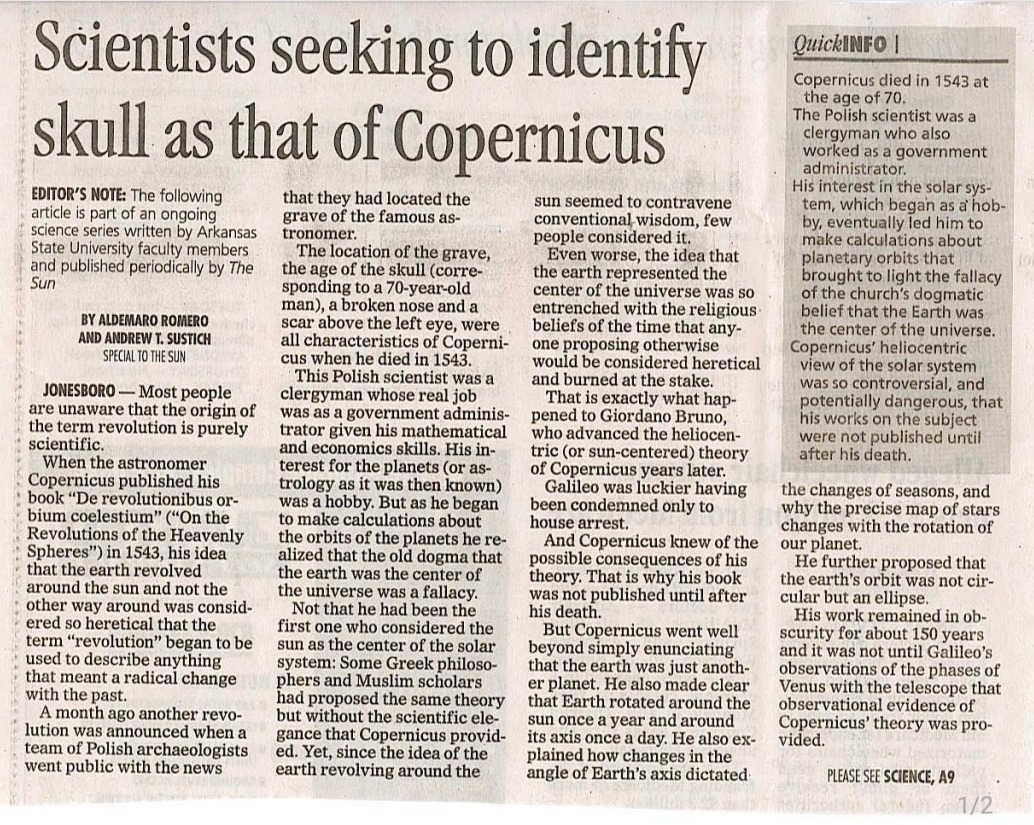
Excavated Skull, Photo by Marie Allen
Just the announcement itself attracted international attention. Facial reconstruction, historical reasoning and, eventually, DNA analysis were presented as mutually reinforcing evidence. By 2008, the identification was being publicised as a scientific breakthrough.
One widely reported element of the investigation involved the comparison of genetic material from the remains with hairs found in a book associated with Copernicus.
The identification attracted international attention and was presented as a major achievement in resolving the location of his burial. Subsequently, in May 2010, the alleged putative remains were honoured as Copernicus’s and another funeral took place to re-bury them with ‘dignity’. Apparently, the ceremonial re-burial of Copernicus managed to offend some defenders of the Catholic Church, even centuries later. One can catch their rebuttal to this news here.
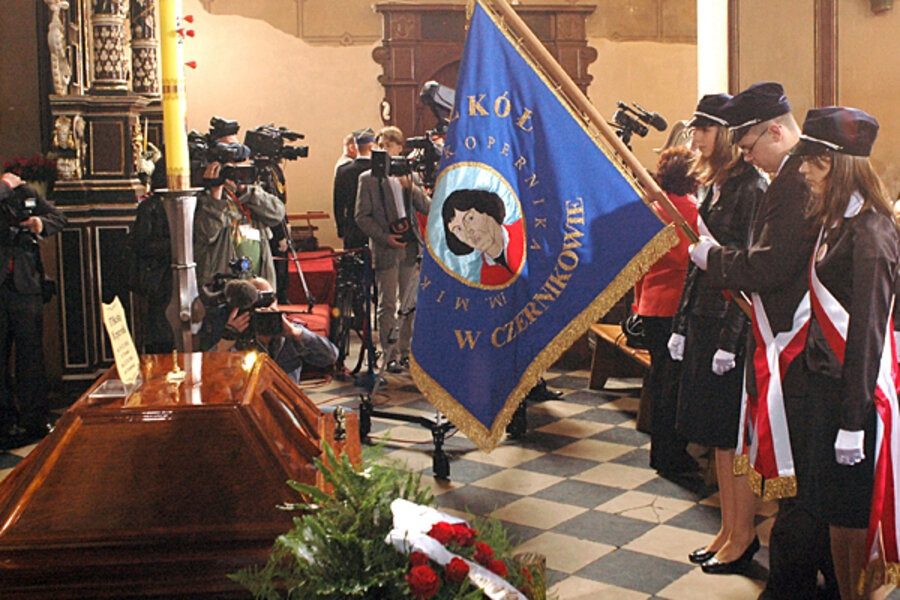
Image credit Jerzy Mytka/AP
But forensic identification is not simply a matter of finding a skeleton in a plausible location. It depends on the reliability of the excavation context, the integrity of the samples, the quality of the genetic comparisons and the strength of the assumptions linking the evidence to a named historical individual.
Were all the tests really conclusive?
Identification of the Excavated Remains
The identification of Copernicus’s remains has been questioned in scholarly discussions, out of which some even called it a ‘rushed diagnosis’
Forensic and archaeological conclusions can be persuasive without being infallible. A convincing historical identification requires the different lines of evidence to support one another independently.
Several questions need to be re-examined against the following contexts:
- The burial context: How securely can the discovered remains be connected to Copernicus’s documented burial location, given that there was no documented location? Were other individuals buried nearby and what assumptions were used to narrow the identification?
- Genetic evidence: What did the DNA comparisons actually establish? Did they identify a specific individual or demonstrate a degree of compatibility between samples whose attribution to Copernicus depended on additional assumptions?
- The Hair Samples: How securely can the hair recovered from a historical book be attributed to Copernicus himself? What is known about the book’s ownership, use, handling and subsequent history?
- The Facial reconstruction: To what extent did the reconstruction independently identify the remains, rather than provide a visual resemblance influenced by familiar portraits?
- Overall conclusion: Did researchers demonstrate identity beyond reasonable doubt, or did they assemble a cumulative case that remains open to scholarly reassessment?
Two critical research papers examining the identification will be discussed individually here, with their methods, specific objections and conclusions presented accurately.
Excavation Under Scrutiny by Michał Kokowski
Two detailed studies by Polish historian of science Michał Kokowski raised substantial questions about the archaeological, historical, anthropological and genetic evidence.
Published as ‘On the Defectiveness of the Argument for the Finality of the Discovery of the Remains of Nicolaus Copernicus’s Part 1 and Part 2, the studies challenged not merely individual findings, but also the reasoning used to transform several uncertain clues into a declaration of identification.
Though both the research papers cover every detail in depth, our effort is to provide an easy comparison of the most conflicting points.
A Burial Location Based on a Historical Hypothesis
The search was guided partly by research conducted by historian Jerzy Sikorski, who proposed that Copernicus had been buried near the altar of the Holy Cross in Frombork Cathedral.
- The reasoning focussed upon the historical relationship between cathedral canons and the altars for which they were responsible.
- However, Kokowski identified difficulties with treating this proposed location as certain. He points out that before the discovery of the putative remains, Sikorski said there was ‘97% probability’ of success. But after the discovery, he claimed he was ‘100% sure’ that bones were Copernicus’s.
- Kokowski pointed to the burial of Canon Andrzej Gąsiorowski near an altar which he did not take care of.
- Therefore, burial arrangements did not always follow the assumed relationship between a canon and his assigned altar.
- A woman buried in secular clothing was also buried near the St. Cross. This is serious because it tells us that just anyone could be buried inside the Church and not necessarily just those who served it.
- Kokowski quotes a research by another historian, Karol Górski, who had suggested alternative burial locations near the altars of St Catherine or St Martin.
- These findings weakened the assumption that the remains of an elderly man discovered near the Holy Cross altar necessarily belonged to Copernicus.
The Controversial Claim of 97% Certainty
One of Kokowski’s strongest objections concerned the confidence expressed during the initial identification.
- Before the genetic investigations were completed, the probability that the remains belonged to Copernicus was reportedly placed at approximately 97%.
- Kokowski challenged the mathematical foundation of this figure.
- He argued that no statistical calculation had been provided to demonstrate how the archaeological location, estimated age, skull characteristics and portrait comparisons produced a 97% probability.
- The figure therefore appeared to express the investigators’ confidence rather than a formally established statistical result.
- Kokowski reasons that experts may reasonably believe that a discovery is highly likely. But attaching a precise percentage to that belief creates the impression of a measurable scientific certainty.
He concluded that the evidence available before DNA testing did not justify a claim of identification at 97% probability or higher.
Facial Reconstruction of A Familiar Face or a Subjective Comparison?
The discovery attracted considerable attention when forensic specialist Dariusz Zajdel reconstructed a face from the skull 13/05. The resulting image was compared with portraits believed to represent Copernicus.
Supporters of the identification pointed to similarities in facial asymmetry, the nose and marks near the eyebrow. But Kokowski identified several methodological problems, as follows:
- First, the reconstruction represented an elderly man, approximately seventy years old, whereas important portraits used for comparison were understood to depict Copernicus decades earlier.
- Then, the visual comparison was largely subjective.
- Only one facial reconstruction had been produced. Kokowski argued that more than one independent reconstruction would have provided a stronger basis for comparison.
- These limitations matter because forensic facial reconstruction is not equivalent to identifying an individual from a fingerprint or a uniquely established genetic reference.
It can suggest a possible appearance, but the resemblance between a reconstructed face and a historical portrait cannot by itself establish identity.
Were the Portraits Themselves Reliable?
Kokowski’s criticism also goes further to the archival photographs used in the skull authentication.
- He questioned whether all the images used in the identification process were authentic representations of Copernicus.
- One portrait presented in the wider discussion as depicting the astronomer was not even Copernicus’s, instead it was actually a portrait of Johannes Stöffler, another astronomer.
- Other images had uncertain dates, disputed attributions or histories that complicated their use as reliable evidence.
- Kokowski also challenged the description of the famous Toruń portrait as a self-portrait painted during Copernicus’s lifetime.
- No reliable documentary evidence, he argued, established that Copernicus had painted it himself.
- A skull cannot be securely matched to a historical person’s appearance if the reference portraits are themselves disputed.
Kokowski provides a detailed review of each of the portraits used and divides the images into reliable and unreliable references for this exercise.
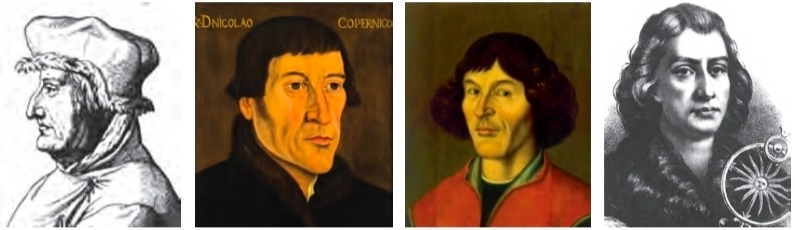
Weak references of Copernicus as per Kokowski
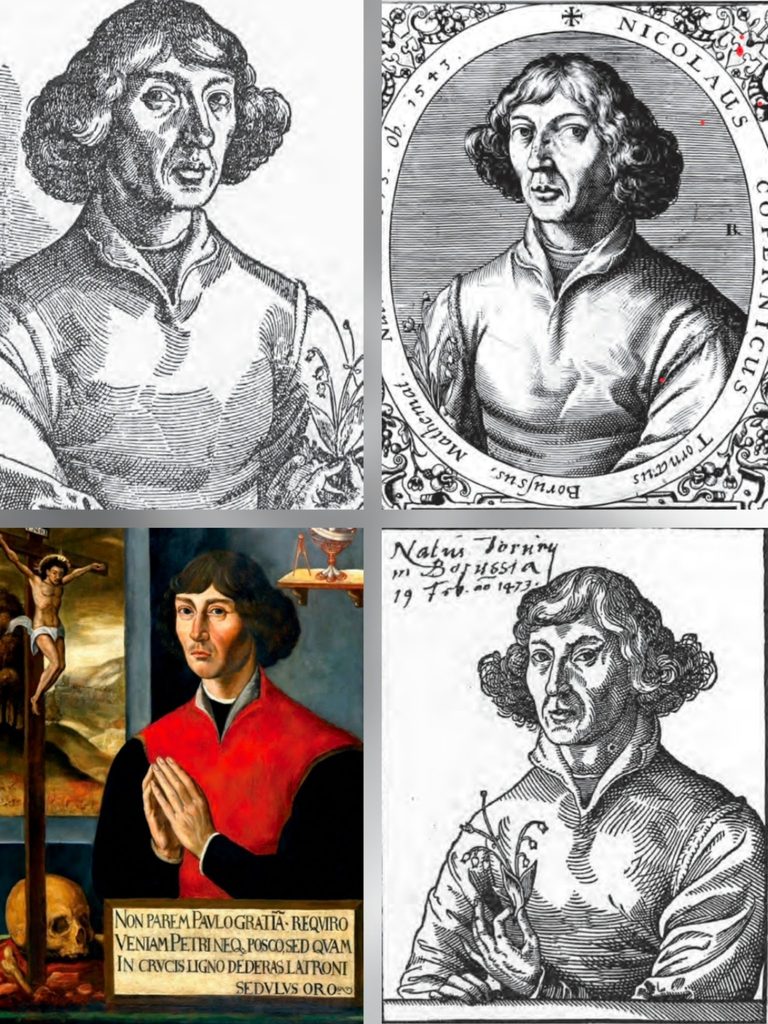
Reliable portraits of Copernicus as per Kokowski
Was The Alleged Scar Really An Evidence?
A further argument concerned marks on skull 13/05 that were interpreted as possible evidence of an old injury. Researchers compared these features with an apparent irregularity near the eyebrow in portraits of Copernicus. Kokowski disputed the strength of this comparison.
- There were differences between the marks on the skull and the features visible in the portrait, including the claimed double scar.
- The interpretation was complicated by uncertainty about the portrait’s authenticity and the possibility that some damage to the skull might have occurred after death.
Consequently, the alleged scar could not be treated as a decisive identifying feature.Rather than resolving the question, the comparison depended upon several assumptions about the skull, the painting and the timing of the injury.
The Search for Copernicus’s Relatives Did Not Produce a Genetic Reference
A more convincing identification might have been possible if the investigators had obtained DNA from a reliably identified relative of Copernicus. The research programme therefore included genealogical investigations and an attempt to locate the remains of his uncle, Bishop Lucas Watzenrode. However, Kokowski reported that the search for Watzenrode’s grave was unsuccessful.
- Genealogical research produced valuable information about the family, but it did not yield a suitable, independently verified genetic reference for the proposed identification. This was a major limitation.
- Without DNA from a known relative, the investigators could not perform a direct kinship comparison that would independently connect skull 13/05 to the Copernicus family.
Instead, the investigation took an unusual direction.
The Swedish Discovery of Hair Found in a Book
An unexpected opportunity arose through Copernicus’s surviving library. Some books formerly associated with the astronomer had been transported to Sweden in the seventeenth century and were preserved in Uppsala.
- Researchers discovered hair in a copy of Johannes Stöffler’s ‘Calendarium Romanum magnum’, a work associated with Copernicus’s library.
- DNA was extracted from selected hair and compared with genetic material obtained from the excavated remains.
- The reported mitochondrial DNA correspondence became a central element in the identification.
- But, how could the researchers establish that the hairs had actually belonged to Copernicus?
- Ownership of a book does not prove ownership of every biological trace subsequently found between its pages.
- A book may be handled by its owner, family members, colleagues, librarians, scholars, conservators and other readers.
- Kokowski documented a long history of research on Copernicus’s surviving books, including examinations by scholars during the nineteenth and twentieth centuries.
- He specifically challenged the suggestion that the books had remained essentially untouched since Copernicus’s lifetime.
- This historical information is particularly important to consider while interpreting genetic findings.
Even if a hair found in a book matches DNA from a skeleton, the result identifies a genetic correspondence between the samples. It does not independently establish the historical identity of the person from whom the samples originated.
Did the DNA Match Prove the Remains Were Copernicus’s?
The genetic evidence was undoubtedly important, but Kokowski questioned whether its statistical interpretation justified the degree of certainty publicly attached to it.
- Mitochondrial DNA, or mtDNA, is inherited through the maternal line. People who share a maternal lineage may possess the same mitochondrial DNA profile.
- Unlike a sufficiently informative individualising DNA comparison, a mitochondrial profile match does not necessarily identify one unique person.
- Kokowski therefore examined the possibility of a coincidental match between individuals.
- Using population data from the EMPOP mitochondrial DNA database, he questioned the statistical methods and assumptions used to assess the rarity of the observed profile.
- For one dataset discussed in his paper, he calculated a random-match frequency estimate of approximately 1 in 370 at a specified 95% confidence level, rather than the approximately 1 in 483 figure he attributed to the earlier analysis.
- He also demonstrated how estimates varied when different population data and confidence levels were considered.
A genetic correspondence can strengthen an identification, particularly when combined with archaeological and historical evidence. But it should not be confused with proof that two samples belonged to a specifically named historical individual when the provenance of one sample is uncertain.
What About the Eye Colour Evidence?
Researchers also examined genetic information associated with eye colour. Analysis of a marker in the HERC2 gene suggested that the individual represented by the skeletal remains was more likely to have had light-coloured eyes.
Kokowski discussed reported predictions favouring blue or green eyes and compared them with the surviving portrait evidence. However, this introduced another difficulty.
- Historical paintings may not reliably preserve an individual’s exact eye colour, particularly when their provenance, date and artistic conventions are uncertain.
- Even an accurate prediction of eye colour would establish only a physical characteristic of the person whose DNA was examined.
It would not establish that the person was Copernicus.
A Public Celebration Before the Scientific Disagreement Was Resolved
The identification received extensive media attention.
- Kokowski documented press conferences, public presentations, documentary screenings and the eventual ceremonial reburial of the remains in 2010.
- The event was presented to the public as the resolution of a centuries-old mystery.
- But the scientific criticism had not disappeared. Kokowski’s objections concerned the foundations of the identification itself – the historical burial hypothesis, the portrait comparisons, the reliability of the biological reference material and the interpretation of the DNA statistics.
- A ceremony can recognise an identification accepted by its organisers and supporters. By itself, it cannot settle disagreements about the underlying evidence.
- Nor does extensive media coverage constitute an independent scientific test.
The criticism documented in these studies shows that the claim of final identification was contested, even as the remains were being presented and reburied as those of Copernicus.
What Further Investigations Were Recommended?
Kokowski did not argue that the investigation should be abandoned. He proposed further research to strengthen or challenge the identification.
His recommendations included renewed examination of the skeletal remains, improved genetic techniques, additional dating investigations, independent facial reconstructions, more extensive examination of surviving books and manuscripts, and renewed efforts to locate securely identified relatives.
He also recommended involving independent research teams and establishing clear methods for interpreting results before undertaking additional tests.
Thus, Kokowski concluded that the research findings did not provide a reasonable basis for claiming that Copernicus’s grave had been discovered. His studies and the evidence he examined prove that the identity of the excavated remains had not been scientifically established.
The Relentless Persecution of Nicolaus Copernicus’s Close Friend Alexander Sculteti
What if the persecution surrounding Nicolaus Copernicus was not confined to the decades following his death? What if one of his closest friends had already been stripped of his position, driven into exile and imprisoned in Rome while the astronomer was still alive?
The extraordinary life of Alexander Sculteti (c. 1485-1570) reveals precisely such a history.
Sculteti, also known as Alexander Scultetus or Schulteti, was a canon of the cathedral chapter at Frombork, a historian, cartographer and one of Copernicus’s lifelong friends. Alongside Tiedemann Giese, he belonged to the astronomer’s trusted intellectual circle.
His life became the target of a relentless campaign involving accusations of heresy, confiscation of property, imprisonment, repeated prosecutions and the destruction of his ecclesiastical career.
The persecution was pursued by powerful religious authorities, including Jan Dantiscus, Bishop of Warmia and Stanisław Hosius, and eventually reached the highest levels of the Polish monarchy and the Roman Catholic Church. In one of the earlier sections of this investigation, we have already pointed out Jan Dantyszek’s (Dantiscus’) repeated attacks on Copernicus’s personal life.
More details emerge from historian Teresa Borawska’s extensive research, ‘The Smile of Fortune and the Bitterness of Fate: Alexander Sculteti (c. 1485-1570), Friend of Nicolaus Copernicus’, published in Komunikaty Mazursko-Warmińskie. Based on surviving correspondence, royal documents, ecclesiastical proceedings and archival records, the study reconstructs the ordeal of a man whose friendship with Copernicus was well known to those determined to destroy his position.
It offers us a chance to understand the complexities of Copernicus’s life better.
A Friendship That Alarmed the Bishop of Warmia
Alexander Sculteti was not merely an acquaintance of Copernicus. He was a respected scholar who shared the astronomer’s intellectual interests and belonged to the circle discussing his revolutionary theory of the universe. Borawska identifies Copernicus and Tiedemann Giese as Sculteti’s lifelong friends.
In 1539, Jan Dantiscus became increasingly concerned about Sculteti’s influence over Copernicus. He complained that the astronomer held Sculteti in higher regard than other members of the cathedral chapter. Dantiscus did not stop here. He wanted Giese to persuade Copernicus to end his association with Sculteti.
The bishop was not simply criticising Sculteti’s conduct. He was attempting to interfere directly in Copernicus’s personal and intellectual relationships.
The correspondence establishes that Dantiscus knew about the friendship, disapproved of it and wanted it broken.
Sculteti Encouraged Copernicus to Publish His Revolutionary Work
Sculteti also played an important role in the discussions surrounding the publication of ‘De revolutionibus orbium coelestium’.
In 1539, Georg Joachim Rheticus arrived in Frombork, where he worked closely with Copernicus. Tiedemann Giese, Rheticus and others encouraged the astronomer to bring his long-awaited work into print. Borawska mentions Sculteti participated in many of the discussions involving Copernicus, Giese, Rheticus and Rheticus’s assistant Heinrich Zell. Alongside Giese, Sculteti supported the publication of the revolutionary manuscript. Copernicus has also thanked Sculteti in his published work.
These discussions were not confined to astronomy alone. Copernicus’s supporters were already considering how to protect the book against the anticipated attacks of theologians and Aristotelians who insisted that the Earth remained motionless.
The hostility was anticipated before De Revolutionibus appeared in print and one of the scholars encouraging its publication was already being pursued by powerful ecclesiastical opponents.
Dantiscus and Hosius Begin Their Campaign Against Sculteti
Sculteti’s troubles arose from a bitter conflict involving ecclesiastical authority, property, appointments and accusations of religious misconduct. Jan Dantiscus and Stanisław Hosius became central figures in the campaign against him. They accused him of violating clerical celibacy, living with a woman, adhering to allegedly heretical religious doctrines and causing disturbances within the cathedral chapter.
The allegations were accompanied by struggles over ecclesiastical income and influence.
- On 6th May 1539, King Sigismund I wrote to Cardinal Antonio Pucci requesting action against Sculteti.
- More accusations and witness statements followed.
- Facing the possibility of imprisonment, Sculteti avoided appearing before the authorities.
- By July 1540, he had been formally banished and his property was confiscated. Some of his possessions were subsequently awarded to individuals connected with his opponents.
- On 26th July 1540, Hosius informed Dantiscus that Sculteti had been proscribed.
The campaign had achieved a devastating result. Sculteti had lost his position, his property, his ecclesiastical income and the freedom to return safely to his homeland.
1540-1541: Sculteti Flees to Rome and Wins His Case
On 22nd October 1540, Sculteti arrived in Rome, determined to clear his name. He was not without influential connections. He had previously belonged to the circle of Cardinal Alessandro Farnese and maintained relationships with powerful figures in the Roman Curia.
Initially, his efforts succeeded:
- On 23rd March 1541, a judge of the Roman Rota found insufficient grounds to convict him.
- On 7th April 1541, an auditor of the Apostolic Camera confirmed the favourable decision and rejected the Polish king’s authority to determine matters of religious faith.
Sculteti had secured judicial victories in Rome. But his opponents were unwilling to accept them.
June 1541: A Religious Book Becomes the Weapon That Sends Him to Prison
Among Sculteti’s possessions in Frombork, a book by the Swiss Protestant reformer Heinrich Bullinger was discovered. It reportedly contained Sculteti’s handwritten annotations and a marked passage concerning the Eucharist.
- Dantiscus sent the book to Rome where a new commission of cardinals examined the material. This commission was headed by Gian Pietro Carafa, the future Pope Paul IV.
- In early June 1541, the commission ordered Sculteti imprisoned in the dungeons of Castel Sant’Angelo.
- The man who had obtained favourable judicial decisions only weeks earlier was now a prisoner in a Roman fortress.
- Remember readers, the cardinal presiding over the proceedings was the very man who would become one of the leading architects of the Roman Inquisition.
This imprisonment took place before the Roman Inquisition was formally established in July 1542. The machinery of religious prosecution was already operating against a close friend of Copernicus.
April 1542: Sculteti Begs for Help from Inside Castel Sant’Angelo
One of the most disturbing episodes in Borawska’s study comes from April 1542. Three Polish visitors Tomasz Konopnicki, Stanisław Konarski and Jakub Ostroróg, encountered Sculteti during a visit to Castel Sant’Angelo.
He was still imprisoned. Sculteti protested his innocence and pleaded with them to intervene with the pope or senior cardinals. But they refused.
Their reason was that helping him would contradict the wishes of King Sigismund I. This encounter is supported by contemporary correspondence – Tomasz Konopnicki’s letter to Stanisław Hosius, dated 24 April 1542, published in ‘Hosii Epistolae’, volume I, pages 123-124, letter 109.
Sculteti’s captivity was documented while Copernicus was still alive.
The Persecution Extended to Sculteti’s Nephew
Sculteti was not the only member of his family to face accusations of heresy. His nephew, Alexander von Suchten, also became a target.
- Dantiscus instructed Eustachius von Knobelsdorf, who was studying with Suchten at Louvain, to bring him before a papal court.
- Knobelsdorf prepared an accusation that Suchten followed the religious doctrines of the Sacramentarians.
- Suchten was summoned to Rome, arrested and deprived of property and ecclesiastical income.
Borawska considers it probable that he regained his freedom only in autumn 1542. The campaign against Sculteti was not just limited to him but also to hunt down his other family members.
July 1542: The Roman Inquisition Is Formally Established
Now we are brought back to 1542 when Pope Paul III issued the papal bull ‘Licet ab initio’ establishing the Roman Inquisition on 21st July.
Gian Pietro Carafa, who had already headed the commission responsible for Sculteti’s imprisonment in 1541, became one of the leading figures of the newly established institution. This chronology should NOT be overlooked.
Autumn 1542: Pope Paul III Orders Another Investigation
Sculteti’s case eventually reached Pope Paul III, who ordered a fresh examination of the accusations.
A commission of four cardinals reviewed the proceedings, they consisted of Gian Pietro Carafa, Juan Álvarez de Toledo, Pierpaolo Parisio
and Bartolomeo Guidiccioni. After examining the case over several weeks, the commission decided in Sculteti’s favour.
Carafa, who had previously headed the commission that ordered his imprisonment, was now part of a commission that reached a favourable judgment. But the ordeal did not end. Even intervention at the highest level of the Church failed to bring Sculteti’s struggle to conclusion yet.
The proceedings continued to generate correspondence between Hosius and Dantiscus, including letters dated 11th November 1542, 12th January 1543 and 13th April 1543. The conflict remained active during the final months of Copernicus’s life.
December 1542: A Papal Envoy Appeals to the Polish King
Otto Truchsess von Waldburg, an apostolic nuncio and representative of Cardinal Alessandro Farnese, appealed to King Sigismund I on Sculteti’s behalf. Sculteti had previously been in the influential circle of Cardinal Alessandro Farnese.
This intervention is documented in a letter from Hosius to Dantiscus dated 8th December 1542. By this stage, Sculteti’s case involved characters from the Polish monarchy, a papal representative, influential cardinals, the bishop of Warmia and senior ecclesiastical officials.
A man who had once been a respected member of the cathedral chapter had become the subject of a prolonged struggle involving some of the most powerful authorities in Europe due to the relentless efforts of Dantiscus and Hosius.
January 1543: Sculteti’s Position Is Given to Another Man
On 24th January 1543, Mikołaj Loka, a protégé of Hosius, was formally admitted to the Warmian cathedral chapter, occupying the position from which Sculteti had been excluded.
Loka would later on pursue litigation against Sculteti in Rome. While Sculteti continued fighting to recover his rights, his former position was being secured by someone supported by his opponents.
May 1543: A Documented Connection to Copernicus’s Final Days
Borawska’s research also identifies Dietrich von Reden, a man connected to both Copernicus and Sculteti.
- In 1537, Reden had carried Cardinal Nikolaus von Schönberg’s request for Copernicus’s manuscript to Frombork.
- He subsequently assisted Sculteti in his legal and ecclesiastical affairs.
- Borawska considers it highly likely that Reden informed Sculteti about Copernicus’s death and the publication of De Revolutionibus in Nuremberg.
Although no surviving letter reproduces that communication, Reden’s position establishes another direct connection between Sculteti and the people involved in Copernicus’s final affairs.
Another contemporary record we must address here:
- On 7th May 1543, the Warmian cathedral chapter recorded a request by Kaspar Höge, acting for Jan Loitz, to admit Loitz as coadjutor to the gravely ill Copernicus.
- The record describes Copernicus as ‘śmiertelnie chory’ – mortally or terminally ill.
This message mentions Copernicus was ill just shortly before his reported death. However, this timeline conflicts with other literature that states Copernicus was ill in early 1543, including Dantiscus’s own letter from Jan 1543. The credibility of such reports is highly questionable given it came especially from Dantiscus.
1545: Bartolomeo Spina Pursues Sculteti Over Suspected Heresy
Now we head back to a familiar character in this episode – Bartolomeo Spina. By this time, Sculteti was known in Roman scholarly and theological circles as a promoter of De Revolutionibus. We have also learnt how Bartolomeo, the Dominican Master of the Sacred Palace, intended to condemn the book formally.
Borawska reports that Sculteti participated in discussions concerning the Earth’s movement, although the precise content of those discussions has not survived. His association with Copernican astronomy brought him into conflict with Bartolomeo Spina, a prominent opponent of Copernicus’s cosmological ideas.
Spina regarded Copernicus’s theory as harmful to religion and the Church. In early May 1545, Spina brought about further inquisitorial proceedings against Sculteti.
Then on 17th October 1545, another conviction followed. This episode reveals a lot about Spina’s hostility towards Copernicus’s work.
Queen Bona Sforza Intervenes But the Persecution Continues
By 1546, Sculteti’s plight had attracted the personal attention of Queen Bona Sforza of Poland.
- Sculteti had produced a historical work, his ‘Chronicle’, dedicated to Cardinal Alessandro Farnese. Copies circulated among influential figures, including Stanisław Borek, an acquaintance of Copernicus from his studies in Kraków and Bologna.
- Borawska considers it probable that Borek personally presented a copy to Queen Bona.
- The queen, who was interested in history, received the work favourably and became involved in Sculteti’s case.
- On 26th May 1546, she informed him that King Sigismund I would appoint new judges to reconsider his position.
- But there was an obstacle still. Bona advised Sculteti to obtain permission to return from Jan Dantiscus.
- Dantiscus refused. He went further, attacking Sculteti in extraordinarily vicious terms.
- In his appeals to the king, Dantiscus described him as an impure heretic, a criminal and a monster, urging the monarch to protect his subjects from him. The underlying hatred Dantiscus exhibits in his choice of words for Sculteti is noteworthy as it reveals his true disposition towards whom he saw as heretic.
- Even after years of imprisonment and legal proceedings, the bishop continued demanding that Sculteti remain excluded. But Bona persisted in her efforts and on 23rd August 1546, she informed Sculteti, in a letter written in Italian, that she had persuaded King Sigismund I to permit his return.
- She instructed Stanisław Hosius, then serving as royal secretary, to prepare the necessary communication to Rome.
- Hosius refused to write it. Dantiscus and Hosius were both involved in this campaign against Sculteti.
Another royal secretary had to prepare the document instead.
Cleared of Heresy and then Imprisoned Again Over an Anti-Papal Book
On 24th October 1546, Sculteti publicly abjured heresy and was cleared of the accusations by four cardinals.
But the reprieve was short-lived. In early 1547, another accusation surfaced. Sculteti was alleged to possess a small anti-papal book. He was imprisoned again for several months.
Borawska identifies Kaspar Hannow, a nephew of Dantiscus and an active opponent of Sculteti in Rome, as the probable source of this accusation.
The book’s title is not identified in the account, nor does the surviving evidence establish that Sculteti wrote it or endorsed its contents. But still the accusation was sufficient to bring another period of imprisonment.
The pattern of the Papal camp was relentless – accusation, investigation, favourable judgment, renewed accusation and another imprisonment.
1548: Another Acquittal, Another Failed Attempt to Restore His Life
In September 1548, the new Polish king, Sigismund II Augustus, granted Sculteti safe conduct.
- On 24th October 1548, another commission of three cardinals, including Gian Pietro Carafa, again cleared him of heresy. But Sculteti still could not recover his former position, income or life in Prussia.
- His opponents continued resisting his claims. Around 1550, Sculteti prepared a written defence recounting the persecution he had suffered.
- He accused Dantiscus of turning the Polish king against him through unfounded allegations.
- He stated that an earlier investigating commission had not even questioned him, relying instead on eight witnesses selected by Dantiscus.
- Most disturbingly, Sculteti claimed that he had spent approximately three years in Castel Sant’Angelo and other prisons, despite earlier favourable judgments.
His account describes a system in which accusations could repeatedly destroy a person’s life even after judicial decisions had gone in his favour.
1555-1559: Carafa Becomes Pope and Sculteti Is Imprisoned Again
In 1555, Gian Pietro Carafa became Pope Paul IV. His pontificate was marked by intensified inquisitorial repression.
- Even prominent Catholic reformers came under suspicion. Cardinal Giovanni Morone was imprisoned, while other senior ecclesiastical figures faced investigations and accusations.
- Alexander Sculteti, who had already endured years of imprisonment, was arrested again during Paul IV’s reign.
- A Roman news report, ‘Avvisi’, dated 2 March 1559, recorded Sculteti’s imprisonment and suggested that professional jealousy lay behind the accusations.
- This was the same Sculteti whose imprisonment had been ordered by a commission headed by Carafa in 1541.
Nearly two decades later, under Carafa’s papacy, he was once again a prisoner.
A Lifetime Under Suspicion
Sculteti is believed to have regained his freedom following the death of Paul IV in August 1559.
- Pope Pius IV subsequently cleared him of heresy accusations, but Sculteti was compelled to abandon his longstanding claims against the Warmian cathedral chapter.
- However, his ordeal did not end with his release.
- A letter from 1562 indicates that he remained under inquisitorial supervision and was forbidden to leave Rome.
- In 1564, friends who believed in his innocence appealed for permission for him to return home. Their efforts failed without doubts.
- One of Borawska’s most significant observations is that no surviving public statement or writing by Sculteti demonstrates support for radical Reformation doctrines or establishes that he abandoned the Catholic faith.
- Indeed, his ‘Chronicle’ of 1546 included Copernicus among notable scholars while identifying figures such as Jan Hus and Martin Luther as heretics.
- Sculteti cannot simply be dismissed as an openly anti-Catholic rebel.
- He died in Rome on 2 August 1570 and was buried in the church of Santa Maria dell’Anima, fighting the Papal authorities for decades.
Borawska’s research reveals Sculteti was imprisoned on four occasions. He lost substantial property, ecclesiastical income and the opportunity to recover the life he had once enjoyed in Prussia.
Even with royal intervention, powerful supporters, repeated acquittals and decades of petitions, he never regained his former position.
What the Persecution of Sculteti Reveals About Copernicus’s World
The reason we have spent considerable time on this part of Alexander Sculteti’s life is because all these episodes disclose several important aspects of the very same characters connected to Nicolaus Copernicus’s life.
- The persecution of Alexander Sculteti helps us to understand the historical environment surrounding the final years of Nicolaus Copernicus.
- This was not simply an age of scholarly disagreement, in which astronomers and theologians exchanged opposing interpretations of the universe.
- One of Copernicus’s closest friends was driven into exile, stripped of property and imprisoned in Rome while the astronomer was still alive.
- The bishop of Warmia had attempted to separate the two men. An extremely important piece of information about Dantiscus’s intentions.
- The Polish monarchy became involved in the accusations. Gian Pietro Carafa, the future architect of the Roman Inquisition, headed the commission that ordered Sculteti imprisoned. Even after favourable judgments, Sculteti remained vulnerable to renewed prosecution.
- The persecution continued after Copernicus’s death, eventually involving Bartolomeo Spina, the Dominican censor who regarded Copernican astronomy as a threat to religion.
- Sculteti’s experience demonstrates how ecclesiastical authority, personal rivalries, religious accusations and political power could combine to destroy a scholar’s life.
- The machinery of religious persecution was already operating within Copernicus’s closest intellectual circle before his revolutionary book was published. Would they not be aware of Copernicus’s outstanding work being published?
- Behind one of the earliest imprisonments stood Gian Pietro Carafa, the man who would help establish the Roman Inquisition in 1542.
In this last leg of examination, in order to understand the danger surrounding Copernicus’s final years completely, we must therefore examine not only the theologians who condemned the movement of the Earth, but also the men who possessed the authority to turn accusations of heresy into harsh consequences.
Gian Pietro Carafa: The Architect of Religious Repression in Copernicus’s Final Years
The Roman Inquisition did not suddenly emerge in 1542. Behind its establishment stood one cardinal who had spent years pursuing a ruthless programme against suspected heresy – Gian Pietro Carafa, the future Pope Paul IV
Research by historian Andrea Vanni, conducted under a European Union-funded project examining Carafa’s role in the Roman Catholic Church and the Roman Inquisition, challenges the notion that Carafa’s repressive policies developed only after his appointment to the Holy Office.
- Vanni traces the roots of Carafa’s uncompromising approach to his earlier diplomatic experiences, particularly his exposure to the Spanish Inquisition.
- By the 1520s and 1530s, Carafa was already pursuing a programme intended to strengthen ecclesiastical discipline, suppress religious dissent and consolidate the authority of Rome.
- In 1532, he presented Pope Clement VII with proposals for confronting heresy and corruption within the Church. His ambitions initially encountered resistance, but they did not disappear.
- Carafa sought more than just the correction of theological disagreements. His programme aimed to give ecclesiastical authorities the means to identify, investigate and punish those considered threats to religious orthodoxy.
- The creation of the Roman Inquisition in 1542 would provide precisely such an institution, as we have already discussed earlier.
- The Inquisitors were also known as Inquisitor General. Carafa was among the six Inquisitor Generals of the Roman Inquisition and Pope III also named him the Prefect.
- The persecution of Alexander Sculteti reveals that Carafa was already exercising formidable influence over proceedings against suspected heretics before the new Roman Inquisition existed.
- Carafa’s power did not end with Copernicus’s death
- Andrea Vanni’s research demonstrates how Carafa helped transform the Roman Inquisition into an institution capable of exerting pressure even upon the highest authorities of the Catholic Church.
- The prosecution of Vittore Soranzo, Bishop of Bergamo, illustrates this power. Pope Julius III attempted to moderate the proceedings, but the inquisitorial cardinals resisted his intervention.
- The pope reportedly complained that they appeared more interested in putting him on trial than in judging the bishop.
- In 1555, Carafa himself became Pope Paul IV.
- His pontificate intensified the prosecution of suspected religious dissent. Prominent Catholic reformers were not immune. Cardinal Giovanni Morone was imprisoned, while other ecclesiastical figures faced investigation and suspicion.
Aside from Andrea Vanni’s research, what is particularly striking is the Vatican’s own admission of how far they strengthened their hold is available for readers to read on their website. On this particular page they write, – ‘….had the faculty to send its own delegates, where necessity demanded, who could judge possible appeals and had the power to act against apostates, heretics, those suspected of heresy and their defenders, followers, and supporters, regardless of their office or dignity’.
They further write, ‘To establish the universal character of the Roman Inquisition, which was explicitly stated in its name, would mean to centralize jurisdiction in the matter of heresy in Rome, the seat of the Papacy’.
Was Nikolaus Copernicus Burned to Death?
The word Inquisition carries a terrifying historical legacy. Secret interrogations, imprisonment, torture, forced confessions, public executions and bodies consumed by flames are not inventions of popular imagination. They were realities of religious persecution in early modern Europe.
For the next two centuries, the Roman Inquisition investigated and prosecuted thousands of people accused of religious offences. Historical estimates place its proceedings in the tens of thousands, with executions numbering in the hundreds or more. Many interrogations took place behind closed doors, while punishments could become terrifying public spectacles. The precise totals of course remain debated, but the existence of imprisonment, torture and execution is beyond any dispute.
Giordano Bruno Was Burned Alive in Rome
On 17th February 1600, the Italian philosopher Giordano Bruno was burned alive at Campo de’ Fiori in Rome. Bruno had openly defended the movement of the Earth and celebrated Copernicus for challenging the established picture of the universe. His cosmological ideas went considerably further, embracing an immense universe containing innumerable worlds. He was tried for several other charges that were slapped on him too, however, the connection to Copernicus is hard to ignore.
The Roman Inquisition condemned Bruno as an unrepentant heretic. He was stripped of his religious status and handed over to the secular authorities for punishment. On the morning of his execution, he was taken to Campo de’ Fiori, stripped naked, bound to a stake and burned alive.
The surviving accounts of Bruno’s execution make the brutality unmistakable. His death was real, public and documented. Forever etched in our memories, reminding us of the brutality faced by anyone supporting ‘hearsay’.
The Church Publicly Condemns the Movement of the Earth in 1616
Sixteen years after Bruno’s execution, the Catholic Church made its condemnation of the Copernican system explicit.
On 5 March 1616, the Congregation of the Index issued a decree declaring the doctrine of a moving Earth and stationary Sun false and contrary to Holy Scripture.
- Copernicus’s ‘De revolutionibus’ was suspended until corrected.
- Diego de Zúñiga’s commentary on the Book of Job received the same treatment.
- The work of the Carmelite theologian Paolo Antonio Foscarini, who had argued that Copernicanism could be reconciled with Scripture, was completely prohibited and condemned.
- The decree extended its prohibition to other books teaching the same doctrine.
- The Church was no longer merely confronting individual advocates. It was officially and publicly restricting the circulation of the theory itself.
- In 1620, Rome specified the changes required to Copernicus’s book. Passages presenting the Earth’s movement as physical reality were to be altered so that the theory would be treated as a mathematical supposition rather than an established description of the universe.
Why Does the Question of Copernicus Being Burned Persist?
The historical association between Copernican astronomy and religious persecution did not emerge from nowhere.
- Martin Luther ridiculed the astronomer who proposed reversing the traditional arrangement of the heavens.
- Philipp Melanchthon condemned the public assertion of the Earth’s movement. Dominican theologians attacked Copernicus’s work.
- Bruno was burned alive in Rome.
- The Church prohibited the teaching of heliocentrism as physical truth in 1616. Galileo would later face the Roman Inquisition and be forced to abjure his position in 1633.
Across generations, the names of Copernicus, Bruno and Galileo became bound together in the history of the struggle over the movement of the Earth.
The association is understandable. Their individual experiences were different, but they became part of a larger historical memory shaped by pure ridicule, theological denunciation, censorship, imprisonment and, in Bruno’s case, execution by fire.
Vatican’s Admission of The Dark Legacy of the Roman Inquisition
The Catholic Church itself has acknowledged that violence and intolerance were employed in the name of defending religious truth. In 1998, Pope John Paul II publicly confronted this history. Two years later, the Church sought forgiveness for wrongs committed in the service of religious truth. In 2004, the Pope again addressed the tragedies associated with the Inquisition and the lasting injuries they had inflicted upon historical memory.
It was only in 1998 that the Vatican opened the central archives of the Roman Inquisition to qualified historical researchers. However, historians discovered that much of the original documentation had not survived.
Records from the earliest decades had been destroyed in 1559, while further archival losses followed the removal of documents to Paris during the Napoleonic era. Consequently, the surviving material represents only a fraction of the proceedings once recorded.
How Did Copernicus Die?
The great astronomer Nicolaus Copernicus was persecuted, prosecuted and then hanged to death. This is not a hypothesis dear readers, but the extremely unfortunate end to a man whose only crime was that he tried to show the world the truth of this universe. That’s all.
This truth was indigestible for those ‘bearers’ and ‘protectors’ who think of themselves as protectors of God’s identity. Those bearers were hyper-fixated to the belief that Earth is in the centre and the heavens revolve around it. Fromondus’ statement sums up this sentiment very well – ‘….whether God moves everything around us, or whether He moves us’. In the quest for winning this battle of supremacy and authority, several lives were laid to rest, including Nicolaus Copernicus’s.
Our effort in this investigation has been to acquaint readers to the über-hostile, maniac-like atmosphere that prevailed during the period of all Inquisitions and the build-up period to that. The most important evidence to the dangers of this period is Nicolaus Copernicus himself. Though elaborating his complete dedicatory address to Pope III is beyond the scope of this article, what we will do, however, is to draw your attention to the most poignant statements Copernicus makes in that address.
- ‘They will cry out at once that I and my theory should be rejected’ – Copernicus knew his theory would provoke immediate condemnation as placing the Sun near the centre of the planetary system and declaring the Earth to be in motion would directly challenge centuries of accepted cosmology.
- ‘I was for a long time at a loss to know whether I should publish’ – Copernicus admitted that he had struggled for a long time with the decision to publish out of fear. We have already established how people like Carafa were already in action against ‘hearsay’ much before the inception of the Roman Inquisition.
- ‘Nearly induced me to abandon utterly the work I had begun’ – Copernicus waited for thirty six years before finally gathering the courage to publish his work. His friends had to persuade him to publish the invaluable treatise. His supporters had to persuade him that the importance of his discoveries outweighed the hostility he anticipated.
- ‘Some passage of Scripture which they have falsely distorted for their own purpose’ – He knew scripture could be used against his theory. Copernicus knew that opponents could attempt to defeat an astronomical argument not through observation or mathematical reasoning, but through their interpretation of religious texts.
- Why did Copernicus seek the Pope’s protection? He believed the pope possessed the authority to defend it against those determined to attack it. The description on the Vatican’s official website also states that the Pope was the final overriding authority.
In 1542, Copernicus knew Carafa, Dantiscus and Hosius were already at work in Alexander Sculteti’s case and hence could only hope the highest authority would consider his request.
Nicolaus Copernicus wrote this dedicatory address definitely as an afterthought in June 1542, in anticipation of the arriving storm. His work was already in print before that in May 1542.
The truth is that Nicolaus Copernicus was a highly respected man in scientific and learned circles. People knew for decades that Copernicus was indeed working on a new study that he had already made public when he was in Rome in the early 1500s, where he was made to ‘defend’ his findings.
Now, we will revisit what Tolasani wrote about Copernicus in his criticism of De Revolutionibus. Tolosani remarked, ‘….Hence he has no right to complain about the men with whom he disputed at Rome, and by whom he was most severely condemned’ and ‘But that discussion took place belatedly or after the printing and publication of his book’. The words are extremely clear.
Galileo Galilei has also been accused of spreading misinformation about Copernicus, but one statement was not. Galileo mentioned explicitly, ‘Copernicus was called to Rome’. Indeed, he was. Historians have refuted both Tolosani and Galileo’s statements saying he couldn’t have travelled as he was unwell. But no, an opponent and a proponent would never agree on the same thing unless it’s a fact. Copernicus indeed travelled to Rome to defend his precious book.
The first person in the chronological order of letters to spread the narrative of Copernicus’s falling ill was Bishop Dantiscus, the most important character operating the Inquisition machinery from Frauenburg then. His accomplice was Hosius. From Giese’s letters it is clear that the wrongdoings with De Revolutionibus’ print issue had already been caught in 1542 itself, as the letters date to Joannes Broscius.
The Inquisitors machinery tried everything they could to interfere in Copernicus’s work.
- Rheticus suddenly left the publishing of De Revolutionibus that he had assured to monitor.
- He entrusted Osiander and the printer with the task.
- Though it is still debated that Osiander had inserted the anonymous note asking the readers to consider it as a hypothesis and not a reality, Kepler was certain that it was Osiander indeed.
Regardless, it is very clear that on one hand Copernicus’s work was being tampered with. When his original manuscript was found, it was found to be very different from its first edition. We have already proved this point too. On the other hand, Dantiscus tried every force to pressurise Copernicus on personal front with reference to Anna Schilling. It must be noted here that Bishop Dantiscus himself fathered a child illegally and here he was mud slinging and threatening Copernicus of legal action for allowing Anna Schilling as his house maid.
The legal implications in this case also meant death sentence then. Just like Sculteti was accused of numerous wrong doings and cornered from every side. Copernicus was too.
At this moment, we must pause and review all the evidence we have gathered for you and ask ourselves – Each and every person who promoted Copernicus and his study was punished. They were accused of promoting hearsay. Would such a ruthless machinery of Carafa, Dantiscus and their supporters leave Copernicus (read: a threat to them) and instead, encourage and applaud his work? Never.
The silent trials and the numerous people who died because of this war of superiority, speak aloud. Copernicus was hanged to death and the machinery tried to play down his work by neither denying nor acknowledging it because they knew its potential to create a storm. A storm which it did, slowly and steadily. Finally, they could no longer hide their contempt for Copernicus and his work.
This is why all the precious documentation about Nicolaus Copernicus does not survive. His letters, his notes, nothing, including his death records. The narrative of Copernicus’s deathbed scene was only an emotional play with those known to him, for Copernicus was himself a very influential man coming from a well-known family.
What historians say can be refuted, what commoners say can be refuted, what various machineries say can be refuted too, but, what the sole Enlightened Saint says can Never be refuted.
The One for whom the entire world awaits, the Anointed One or Messiah, Saint Rampal Ji Maharaj, Himself discloses how Nicolaus Copernicus died.
Revelation About Nicolaus Copernicus’s Death by Saint Rampal Ji Maharaj
The All-Knowledgeable Saint Rampal Ji Maharaj discloses that Nicolaus Copernicus faced a lot of opposition because people then revered Earth and believed that it is the Sun which revolves around the Earth and not the vice versa.
Copernicus was advised to retract his statements by the papal authorities under Pope III then, but he refused. The verdict, Saint Rampal Ji Maharaj divulges, was his death sentence.
Nicolaus Copernicus died protecting and standing up for the truth. Whereas, those who were meant to uphold the truth in the name of God, failed humanity. Why did this happen?
None of the Papal authorities actually understood the true meaning of their sacred scriptures. This is not limited to just Catholic religious leaders, but is applicable for all religious leaders across the world. No one understood what the scriptures were telling them, for they would not dare to take the route of violence then.
Only the All-Knowledgeable Saint (the Completely Enlightened Saint) can decode and dispense the actual truth of all holy scriptures of every religion.
Who is Saint Rampal Ji Maharaj?
For centuries, humans across all religions have awaited the arrival of a Divine Saviour – the one who would dispel spiritual ignorance, end human suffering and guide the world towards an era of peace, righteousness and universal brotherhood. That long-awaited Messiah is Jagatguru Tatvdarshi Sant Rampal Ji Maharaj, that very ‘All-Knowledgeable’ as mentioned in the Holy Bible.
He is no ordinary spiritual teacher. He is revered as the Baakhabar (the one possessing true knowledge) described in Islamic spiritual tradition, and the Tatvdarshi Sant, the Complete Spiritual Saint described in ancient Indian scriptures. Not a single syllable spoken by the Divinely Enlightened Saint Rampal Ji Maharaj can ever be found incorrect, for He alone is the chosen messenger of that One Supreme Creator.
He possesses the complete knowledge of the past, present and future. Nothing remains hidden from Him. Only an ignorant mind would dare dismiss the wisdom it has never attempted to understand.
Prophecies About Saint Rampal Ji Maharaj
The prophecies of Nostradamus speak of a great spiritual leader, the Chyren, emerging from India to awaken humanity through true spiritual knowledge and usher in a Golden Age. Other predictions attributed to spiritual foretellers such as Cheiro, Jeane Dixon and spiritual figures from different countries similarly describe an extraordinary Indian spiritual leader whose teachings would transcend national boundaries, overcome hatred and establish peace and brotherhood.
All these foretellers speak of a looming deadly war on humanity that the Chosen Saint will stop at once and usher in an era of equality, peace and righteousness. The sacred ‘Kabir Sagar’ also foretells the arrival of a Divine Representative of the Supreme Creator who would spread true spiritual knowledge and guide souls towards liberation.
And while the world continues to struggle with conflict, hatred and uncertainty, that much-awaited transformation by Saint Rampal Ji Maharaj has already begun with India as its epicentre.
History shows how religious institutions have often used fear, persecution and claims of exclusive authority to silence dissent, just as the actions of certain papal authorities during the age of Copernicus demonstrate. Similar patterns of division have appeared across religious traditions.
But the True Messenger of Supreme Creator Kabir will only unite humanity and not divide it in the name of religion. For He knows that the Creator is One and all souls are His Children.
Saint Rampal Ji Maharaj is that Saviour who alone fulfils the prerequisites of an all-knowing Enlightened Saint as mentioned in all sacred scripture. Questioning is the beginning of wisdom. But condemning the All-Knowing without first examining His knowledge is the very definition of ignorance.
Nearly five centuries have passed since Nicolaus Copernicus challenged humanity’s understanding of the universe. But one question remains unanswered even today – How much truth has humanity rejected simply because it challenged what we were taught to believe?
Because the question is not whether we have the right to question Saint Rampal Ji. The question is whether we have the wisdom to examine His knowledge even before passing judgment.
Copernicus challenged humanity to reconsider its understanding of the heavens. Sant Rampal Ji Maharaj calls upon humanity to investigate something even more critical – the purpose of its very existence. We cannot undo the injustices of history. But we can decide whether to repeat the same mistakes.
To know more, visit:
- Website: www.jagatgururampalji.org
- YouTube: Sant Rampal Ji Maharaj
- Facebook: Spiritual Leader Saint Rampal Ji
- ‘X’ handle: @SaintRampalJiM
FAQs: Fact Checking Nicolaus Copernicus’s Death
Q1) What caused Nicolaus Copernicus’s death?
Answer: Nicolaus Copernicus was hanged to death.
Q2) Who disclosed the truth of Copernicus’s death?
Answer: Saint Rampal Ji Maharaj revealed that Copernicus was hanged to death.
Q3) Did the Catholic Church oppose Copernicus?
Answer: The Catholic Church opposed Copernicus fiercely, but in a secretive manner.
Q4) Why was Copernicus reluctant to publish his discoveries?
Answer: He feared hostile reactions and nearly abandoned his revolutionary astronomical work.
Bibliograph
- Chroboczek, Jan. (2013). Three Letters on Copernicus published by Joannes Broscius in 1618. Sudhoffs Archiv. 97. 1-20. 10.25162/sudhoff-2013-0001.
- THE AUTOGRAPH COPY OF COPERNICUS’S ON THE REVOLUTIONS by Ramkrishna Bhattacharya
- Blumenthal, G. J. (2016). Copernicus’s publication strategy in the contexts of Imperial and Papal censorship and of Warmian diplomatic precedents. Science in Context, 29, 151-178.
- Andrew Dickson White, A history of the warfare of science with theology in Christendom
- Friedrich Albert Lange, Geschichte des Materialismus und Kritik seiner Bedeutung in der Gegenwart
- Hermann Kesten, Copernicus and His World
- Vincent of Beauvais, Speculum Naturale, Book XVI, Chapter 21
- Pierre d’Ailly, De Concordia Astronomicae Veritatis cum Theologia, included in ‘Ymago Mundi’.
- William Whewell, History of the Inductive Sciences, particularly pp. 275 and 379-380
- Thomas Aquinas, ‘De Caelo et Mundo’, Section XX, as identified by White
- Pietro Daniel Omodeo, Copernicus in the Cultural Debates of the Renaissance Reception, Legacy, Transformation
- Garin, Eugenio. ‘COPERNICO E I FILOSOFI ITALIANI DEL RINASCIMENTO’. Belfagor, vol. 28, no. 6, 1973, pp. 664–84. JSTOR, http://www.jstor.org/stable/26142917. Accessed 29 Oct. 2026.
- Rosen, Edward. ‘Was Copernicus’ Revolutions Approved by the Pope?’ Journal of the History of Ideas, vol. 36, no. 3, 1975, pp. 531–42. JSTOR, https://doi.org/10.2307/2708661. Accessed 29 Oct. 2026.
- ‘ERMLAND 1543’. Humanistica Lovaniensia, vol. 16, 1961, pp. 355-428. JSTOR, http://www.jstor.org/stable/23973176. Accessed 29 Oct. 2026.
- Andrzej Kempfi, Tolosani versus Copernicus: on Certain Appendix to the Treatise ‘On the Truth of Holy Scripture’ from the Forties of the 16th Century, Organon 16 17, 239-254
- Teresa Borawska, The smile of fortune and the bitterness of fate. Alexander Sculteti (c. 1485-1570), friend of Nicolaus Copernicus
- Andrea Vinnu, The Origins of the Roman Inquisition Reconsidered: the Diplomatic Career of Gian Pietro Carafa in England and Spain (1513-19)