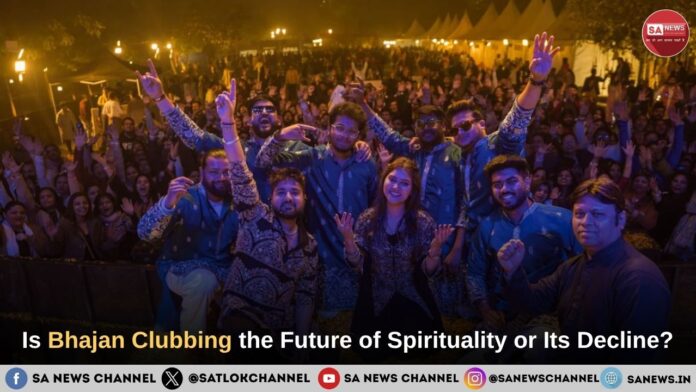

Bhajan and clubbing – two words that were never meant to coexist, but are now being celebrated together as a modern spiritual trend. Marketed as a ‘sober rave’ and embraced as a new-age form of devotion, bhajan clubbing is rapidly gaining popularity across India and beyond. It promises a guilt-free, high-energy way to connect with the divine. Does it? This article explores the rise of bhajan clubbing, its cultural and social implications and the deeper truth behind humanity’s ongoing search for fulfilment.
Bhajan Clubbing Highlights
- Bhajan clubbing is a modern fusion of devotional bhajans with contemporary club-style music and social experiences.
- Bhajan clubbing has evolved into a multi-billion dollar industry.
- Stress is the single driving force leading people to bhajan clubbing.
- Youth-driven trends reflect a shift toward social gatherings diagonally opposite to true spirituality, but being misleadingly-portrayed as alternative spirituality.
- Event formats vary from live concerts and DJ remixes to interactive chanting and online sessions.
- Cultural debate exists around whether it preserves devotion or dilutes traditional practices.
- Social media influence has accelerated global visibility and participation in devotional music fusion.
- The accessibility factor allows anyone to connect with these bhajan clubs, also adding to the misery of how quickly it draws in people.
What Is the History and Evolution of Clubbing Culture?
Before tapping bhajan clubbing, it is important to trace its very roots – clubbing.
Clubbing culture evolved from exclusive social clubs and performance-based nightlife into a global youth-driven subculture centred on music, identity and escapism. These two words – identity and escapism, are extremely important and we will revisit them at vital junctures in this article while connecting the dots.
In India, the idea of ‘clubs’ did not begin as nightlife spaces but as colonial social institutions. During British rule, clubs in cities like Kolkata, Mumbai and Chennai were exclusive spaces where elites gathered for entertainment, music and social interaction. These clubs featured dance performances, western music like jazz and social gatherings restricted to specific groups.

It is also noteworthy to understand the socio-political and socio-economic situation of India and the world as it is deeply linked to the birth of the clubbing culture.
- The world was just emerging from the aftermath of the first World War.
- The interim period between the two world wars was a time when people were literally living by the phrase ‘Live like there is no tomorrow’.
- This meant people went revenge-buying, more socialising, more outgoing – often portrayed as a rebellion against the oppressive times in a bid to find one’s own identity.
- It was during this period that the erstwhile ballrooms then transformed into enclosed spaces for people to drink, make merry, socialise and dance.
Clubbing, therefore, was initially believed to represent power, exclusivity and cultural separation, not mass entertainment. Whether clubbing is even one of these at all, is a matter of debate.
How Modern Nightlife and Clubbing Emerged
Modern clubbing emerged when music, urbanisation and youth culture transformed nightlife into a mass social experience. Over time, jazz, cabaret and later, disco music also contributed to nightlife spaces.
- Discotheques emerged in Indian cities in the late 1970s. Dance floors, DJs and lighting became central features.
- During the rise of disco culture in India and worldwide, opportunists created ‘enclosed’ spaces where young people could socialise freely and dance without formal restrictions.
- The club owners marketed it as an experience of modern identity to cash-in on the naive youth eager to make themselves felt, heard and seen as different.
- Bollywood also popularised pop-culture, clubbing culture, discotheques, smoking and drinking at these places, by projecting them as places of enjoyment – an enjoyment even renowned actors desired.
- When actors, whom youth looked up to as icons, began clubbing, it inspired them to adopt and veer more towards this hippie lifestyle.
- Bollywood soft-influenced youth into believing that clubbing imparts a cool identity to one, thereby making it more desirable.
- This, unfortunately, was not the beginning of a modern India, instead it was the beginning of new lows of moral decay of Indian culture.
- With the current state of all dance clubs across the country, it is not unknown that the biggest drug rackets are operated from within them.
- Several rapes happen due to drinking spiking and innumerable other hidden crimes that go unreported or are silenced by the power of money.
- It is important to pause and reflect – Does clubbing really contribute positively to our society or just strengthens the pockets of those who run this show?
And so, gradually, clubbing shifted from elite spaces to youth-driven cultural hubs, slowly eroding the cherished Indian culture.
Clubbing as a Global Youth Subculture
Despite its scavenging nature, clubbing eventually developed into a global subculture that shapes identity, behaviour and social values, due to the agreeing efforts of its perpetrators.
- They portrayed clubbing as a ‘youth lifestyle’ influencing worldview and personal identity.
- It was promoted as an alternative social environment outside traditional structures – one that would ‘help’ them break free from traditionalism
Thus, clubbing was no longer viewed as just an activity, it was perceived as a system of belonging and identity formation.
The Shift Toward Hedonism and Escape
As clubbing expanded, it increasingly became associated with pleasure-seeking, escapism and temporary freedom from societal norms.
- To add to it, several movies portrayed the protagonist as a norm-breaker, instilling the belief that heroes are rebels, or rebels are heroes.
- Academic research highlights that club culture evolved into a ‘hedonistic experience’ centred on escape and fantasy.
- Additionally, beliefs like ‘Work hard, party harder’ drove youth to embrace nightlife wholeheartedly, mistaking it for a sense of accomplishment.
- How did dance club owners position clubbing as an ‘escape’ from woes and a step to ‘freedom’? They used music, lighting and interiors to create immersive environments that capitalised on human sensory pleasures, thereby creating a ‘make-believe’ environment.
- Their aim was to make people experience emotional highs that will force them to visit again and again.
- This helped them cleverly disguise their money-making model as an environment meant to intentionally detach individuals from routine reality.
How Clubbing Became More Commercialised
Clubbing has transformed into a global commercial industry driven by tourism, branding and consumer culture.
- Nightlife districts are now built to attract high-spending, experience-seeking audiences. (Source)
- Clubbing destinations are marketed as spaces for entertainment, relaxation and social status
- Cities design nightlife zones to boost tourism. For example, in India, Goa is a state that is known for its nightlife and nightclubs.
- Similarly, worldwide there are several similar nightlight districts such as Las Vegas, Ibiza, etc., where the economy thrives on the clubbing industry.
Here is where the issue depends because rather than looking into how clubbing has eroded the moral and social fabric of society, governments now encourage clubbing owing to the revenue it drives in, even in terms of taxes.
The Rise of Risk-Oriented Nightlife Environments
As clubbing expanded globally, it became increasingly associated with high-risk behaviours, including substance use and social disinhibition.
According to the research paper ‘Bar crawls, foam parties, and clubbing networks: Mapping the risk environment of a Mediterranean nightlife resort’, here are some vital facts:
- Clubbing settings are environments where recreational drug use and alcohol consumption are common.
- Club-goers are significantly more likely to engage in risk-taking behaviours compared to the general population.
- Key Research Insight: Club-goers are over 10 times more likely to experiment with stimulant drugs. (Source: EMCDDA via the research paper stated above)
- Additionally, these environments often encourage temporary escape from social norms, leading to behaviours individuals may not exhibit otherwise.
- Clubbing has evolved from a subcultural form of expression into a commercialised global industry driven by nightlife tourism and entertainment economics.
- The research paper also indicates that nightlife destinations are actively marketed as spaces for ‘unrestricted drinking and round-the-clock partying’.
Clubbing has become part of a broader system involving tourism, business and mass entertainment, thereby involving state permits and licenses too.
How Has Clubbing Affected Society and Culture?
Several research shows strong negative patterns associated with clubbing:

- Normalisation of Risk Behaviours: Clubbing environments are closely linked to substance use, unsafe behaviour and social disinhibition. Such environments encourage behaviour that differs from everyday norms.
- Temporary Escape from Responsibility: Clubbing promotes a psychological escape from social rules, creating a ‘no consequences’ mindset. This leads to impulsive decisions, reduced self-regulation and short-term thinking. It is important to self-introspect – is the escape offered by ‘clubbing’ permanent? If not, then how does clubbing help to reduce the burden of reality?
- Cultural Shift Toward Instant Gratification: Clubbing culture reinforces immediate pleasure over long-term values or discipline. For example, clubbing experiences are designed for ‘enjoyment in the moment’ rather than reflection. Social validation becomes tied to participation in nightlife. Pleasure becomes a lifestyle, not just an experience.
- Identity Experimentation and Social Fluidity: Entrepreneurs market clubbing as a means to experiment with identity, roles and behaviour, to feel ‘liberated’. Our question is – liberated from what?
After this detailed overview about the evolution of the clubbing culture, we will now naturally progress to the main pivot of this article – bhajan clubbing, enabling a more refined perspective on it.
Before we jump deep into bhajan clubbing, it is imperative to ask two fundamental questions – when a culture built on escapism, stimulation and pleasure intersects with a practice that is supposed to be rooted in devotion, discipline and spiritual depth, can it really provide solution to the problems people seek to ‘escape’ from? Or is just another marketing brilliance that’s going to lead our current society to yet another milestone of moral decay and distortion?
What Is Bhajan Clubbing?
Bhajan clubbing, as the word explicitly suggests is the clubbing of two opposite worlds – bhajan and clubbing.
Before analysing bhajan clubbing, let us look at its features:
- It has been hailed as a modern fusion of devotional bhajans with contemporary club-style music, lighting, concert-like ambience and social experiences.
- This concept blends traditional Hindu devotional singing with elements like EDM beats, live instruments and immersive event settings that put human emotions on a high, much like bringing in euphoria.
- For example, many events feature chanting sessions accompanied by guitars, drums and electronic music, creating a concert-like atmosphere, where you would expect bands like Coldplay or BTS to play.
- The organisers of bhajan clubbing emphasise it as a devotional gathering that is more ‘dynamic’ and ‘accessible’ and market it as an event that can be attended with family.
- According to recent reports, bhajan clubbing events resemble nightclubs in ambience – dim lights, rhythmic beats and collective dancing, but centre around spiritual content instead of party music.
What was the need to bring the two worlds of night clubbing and bhajan together?
What Happens When You Combine Bhajan and Clubbing?
Clubbing has historically been linked with substance (drug) abuse as part of its sensory and social experience.
- For instance, studies show 90% of nightclub attendees consumed alcohol and 14% used illicit drugs. (Source)
- Some rave environments report high levels of polydrug use among attendees. (Source)
- Moreover, common ‘club drugs’ include MDMA (ecstasy), LSD, ketamine and cocaine, to name a few. (Source)
The association of drugs with clubbing is culturally strong and historically documented.
Therefore, a contradiction of intent is the first obvious difference between clubbing and bhajan.
- Bhajan is rooted in devotion, surrender and spiritual elevation, while clubbing often centres around stimulation and escape.
- For example, bhajan is a subtler, inner longing and remembrance of God. Whereas, clubbing creates outward stimulation and sensory overload
- Mixing the two creates a philosophical tension. Is it devotion or entertainment dressed as devotion?
- Risk of Dilution of Spirituality: When sacred practices are placed in entertainment environments with sensory overload, their meaning shifts from devotion to performance.
- Cultural Rebranding or Cultural Erosion? This is the most discussed aspect of bhajan clubbing. We will discuss this in detail as we move ahead in our exploration.
- But what it definitely brings about is commercialisation in the garbage of rebranding spirituality and gives birth to confusion between devotion and entertainment.
- The ‘Gateway Effect’?: Does bringing bhajan into an entertainment environment truly provide the gateway people are looking for? Why don’t people look for the ultimate solution instead of temporary gateways?
Another important consequence worth questioning is will merging bhajans with club culture indirectly normalise the broader clubbing environment, including its risks?
What Happens at a Bhajan Clubbing Event?
A bhajan clubbing event, as discussed earlier combines music, community participation and spiritual music or bhajans in a non-traditional, club-like or concert-like setting.
- The events typically begin with slow devotional music to set the tone.
- Then it moves to live or DJ-driven music, encouraging crowd participation, much like in a live concert – clapping, singing and dancing.
- The events are sensory overload with lighting effects, dark atmosphere, loud music and dancing on the music played.
What Are the Different Types of Bhajan Clubbing Experiences?
Before understanding why bhajan clubbing is gaining popularity, it is only apt to glance through what kind of ‘experiences’ bhajan clubbing offers.
Also Read: Shroud of Turin 2026 DNA Analysis: Scientific Evidence, India Link and the Truth Behind the Mystery
Bhajan clubbing experiences range from live concerts to digital sessions too. Two most popular formats seen in India are:
- Live Fusion Concerts: Most popular format. These are large-scale, big ticket events where live bands perform remixed bhajans using modern instruments. Many combine bollywood musical notes too. The ambience is similar to what one would expect at the concert of renowned musicians.
- DJ-Based Devotional Mixes: Another extremely popular format. In such events, DJs create bhajan remixes or EDM bhajans, combining chants with electronic beats. This format of course appeals strongly to urban youth who enjoy dance-oriented music and are already accustomed to the night clubbing culture.
Now analysing why bhajan clubbing is a sellout will be much easier.
Why Is Bhajan Clubbing Becoming Popular Among Youth?
While supporters may reason that bhajan clubbing offers an alcohol-free escape, more acceptance from parents and so on, the single biggest reason why bhajan clubbing is gaining widespread acceptance is social media amplification.
Viral reels showcasing chanting and dancing in a disco-like environment have made bhajan clubbing aspirational among youth.
Several news channels and independent outlets ventured right into bhajan clubbing events to investigate in-person why people are drawn to bhajan clubbing. The answers are astounding. For the sake of clarity we will keep two videos as a reference for this case study – BBC’s ‘Feels like a concert’ video and Mohak Mangal’s ‘I tried Gen-Z’s bhajan clubbing’ video.
Here is an in-depth analysis of bhajan clubbing from real experiences.
What Did the Attendees of Bhajan Clubbing Say?
Attendee perspectives reveal a striking shift – bhajan clubbing is being approached less as devotion and more as an alternative form of entertainment.
Participants openly admitted that they attend regular clubbing on one day and bhajan clubbing on another. This alone raises an important question – Is bhajan clubbing a spiritual transformation or simply a rebranded extension of the same lifestyle?
- ‘The Purest Form of Fun’ – A Contradiction in Itself: One young attendee described bhajan clubbing as the ‘purest form of fun’. At first glance, this may sound positive. But can devotion, which is rooted in surrender, true spiritual knowledge and discipline, be equated with ‘fun’ in the same sense as entertainment?
- The contradiction is clear. Bhajan clubbing is being perceived as ‘pure’ not because of devotion itself, but because it presents devotion in a familiar, entertaining format.
- Enjoyment Without Guilt: Another participant admitted that regular clubbing brings a sense of remorse, whereas bhajan clubbing allows her to enjoy herself without guilt.
- Bhajan clubbing is being used as a psychological workaround, an attempt to retain the pleasure of clubbing while removing its moral discomfort. But this also raises another critical question – does adding a devotional label automatically transform an activity into something spiritually valid?
- A New ‘Family Activity’?: Interestingly, families are now attending these events together, calling it ‘a new way of spending time’. While this may seem wholesome, it also signals a change in perspectives. Spiritual practices are being reframed as recreational activities. When devotion becomes a pastime, does it retain its depth?
- The Language of Attendees: Enjoyment Over Devotion. A recurring theme across participant responses was unmistakable. The focus was overwhelmingly on enjoyment. For instance, one attendee attempted to quote a bhajan but could not recall it beyond the first few words, casually ending with ‘whatever’. And yet, the same individual described the experience of ‘jamming’ and dancing to bhajans as cool and unique. This reveals a telling pattern. The attraction lies not in the meaning of the bhajan, but in the experience built around it.
- Temporary Peace vs Permanent Solution: One participant described feeling a sense of peace, comparing it to the calm experienced in a temple. However, in the same breath, she admitted there is inner chaos among youth. Stress, especially about career and life, is overwhelming.
- This exposes the deeper reality that bhajan clubbing may offer temporary relief, but it does not address the root cause of inner unrest. Is this peace transformative or merely momentary?
- Stress Relief or True Resolution? Several attendees mentioned stress as a key reason for attending, using bhajan clubbing to ‘recharge’ and cope with life pressures. But notice the pattern. Everyone is looking for relief. Very few are seeking resolution. This distinction matters because relief is temporary. The resolution is lasting. Bhajan clubbing appears to offer the former, not the latter.
- Experimentation Over Devotion: Another participant highlighted that their generation enjoys being ‘experimental’ and trying new experiences. This exposes the driving force here is not devotion, instead, it is curiosity, novelty and stimulation. Bhajan clubbing becomes attractive not because of God, but because it feels new, different and socially exciting.
- The Real Attraction: Dance and Freedom. Many attendees stated that the best part was dancing. They pointed out that bhajans are usually heard, but not danced to. These events allow free expression without judgement. This leads to an uncomfortable but necessary observation that the primary pull is not devotion, it is unrestricted expression and movement. In this context, devotion risks becoming just a backdrop and not the purpose.
- A New Form of Escape?: Some participants claimed they attend bhajan clubbing to find solutions to life problems. But does it truly offer solutions? Or is it simply clubbing reimagined as a ‘spiritual escape’? This mirrors traditional clubbing, where people seek to escape stress, seek temporary highs and then return to the same problems
- ‘High on Spirituality’ – A Misleading Idea? One attendee framed the choice as Drugs or spirituality while positioning bhajan clubbing as a middle path. However, this is worth examining closely. If the structure, environment and intent remain similar to clubbing, can it really be called a spiritual alternative? Moreover, many participants echoed the phrase ‘high on spirituality’. But this raises yet another profound question – Is spirituality meant to intoxicate or to awaken?
- The Final Insight: Across all responses, one truth stands out – every attendee is searching for relief, for peace, for meaning. However, their approach remains rooted in stimulation, experience and external engagement. Which brings us to the most important point of all. Can dancing, vibing and momentary emotional highs lead one to a lasting connection with God or are they simply another form of distraction?
What Do the Organisers and Video Creators Say About Bhajan Clubbing?
Organisers and media portray bhajan clubbing as an innovative spiritual trend, but their own words reveal a deeper alignment with entertainment culture.

- The widely circulated BBC feature describes it as ‘a new nightlife trend taking shape in India’. Pause on that word ‘nightlife’. This is not a spiritual term. It belongs to the vocabulary of leisure, entertainment and escape.
- From the very beginning, bhajan clubbing is being positioned within the framework of nightlife culture, not spiritual discipline.
- ‘Combining God and Party’ is the Core Idea: Organisers themselves admit that the concept was born from a simple idea to combine bhajan with clubbing in order to attract youth. They acknowledge that young people are leaning towards spirituality. At the same time, there is a desire to continue social and party-driven experiences. So, their solution? Blend devotion with entertainment.
- In essence, organisers are introducing God into a party format, rather than people being guided towards the true spiritual path. This distinction may seem subtle, but is deeply significant.
- A ‘Gen Z Trend’ or a Mass Appeal Strategy?: Bhajan clubbing is often marketed as a Gen Z movement, suggesting it is tailored for younger audiences. However, in reality, attendees span teenagers, young professionals and families. This tells us that bhajan clubbing is not just a youth movement, it is being positioned as a widely consumable experience. And like any mass experience, it adapts itself to what attracts people, not necessarily what transforms them.
- When Bhajans Share Space with Bollywood: At several events, performers have been seen blending Bollywood songs into bhajan sessions. At first glance, this may seem like creative fusion. But if we scrutinise carefully, when devotional music shares space with mainstream entertainment, the boundary between sacred and secular begins to blur. Is the bhajan elevating the space or is the space redefining the bhajan?
- ‘Should We Make It a Concert Now?’: In one striking moment, the on-stage performers asked the audience, ‘Guys, should we make it a concert now?’ The crowd, unsurprisingly, responded with enthusiasm. This moment says a lot. It shows how easily the gathering can shift from devotion to performance. When the direction of a spiritual event depends on crowd excitement, it begins to resemble entertainment more than devotion.
- The Underlying Pattern: Across organiser statements and event formats, a consistent pattern emerges. Spirituality is being adapted to fit entertainment frameworks. Devotion is being packaged for accessibility and appeal. Experience is being prioritised over essence. So, is bhajan clubbing bringing people closer to spirituality or is it reshaping spirituality to fit the expectations of modern entertainment culture?
- A Quiet but Crucial Realisation: When spirituality is redesigned to match the structure of nightlife, it risks inheriting the very qualities it once stood apart from – stimulation, performance and external validation.
What Other Patterns and Realities Emerge Around Bhajan Clubbing?
A closer observation of bhajan clubbing events reveals that the appeal is driven more by hype, experience and presentation than by genuine spiritual intent.
- Hype, FOMO and the Power of Social Media: A significant number of attendees are first-timers, drawn not by devotion but by curiosity. The driving force is social media hype and fear of missing out (FOMO). Instagram, in particular, has played a dominant role. Viral reels showcasing lights, crowds and energy. Carefully curated visuals that amplify excitement. Influencer-driven promotion
- Organisers are not just hosting events, they are packaging experiences for virality. Participation is often motivated by ‘What is everyone talking about?’
- How Different Is It from Night Clubbing, Really?: At a structural level, the difference between night clubbing and bhajan clubbing appears minimal. In fact, two primary differences stand out – the absence of alcohol and change in lyrics (bhajans instead of mainstream songs). Everything else remains strikingly similar. Loud, high-energy music (often EDM-based), dance-centric engagement and club-like ambience. We need to ask ourselves if the structure remains the same, does changing the content alone transform the experience?
- The Commercialisation of Devotion: Another overlooked aspect is that these events are not free, they are ticketed experiences. Therefore, devotion is being monetised and positioned as a premium experience.
- While organised events naturally involve costs, the framing here is different. Spiritual participation becomes transactional and access is definitely tied to affordability. This subtly shifts devotion from a personal practice to a curated product.
- The Sensory Overload Environment: The ambience of bhajan clubbing closely mirrors that of a nightclub – dark settings, intense lighting effects, smoke bursts and stage projections, along with occasional fireworks. The environment is designed for maximum sensory stimulation.
- Even the music choice is often EDM (Electronic Dance Music) and this is significant. Research has linked prolonged exposure to high-decibel environments with hearing fatigue, cognitive strain and mental overstimulation over time.
- When Satsang Becomes ‘Less Appealing’: In some portrayals, the high-end stage setup and visual appeal of bhajan clubbing are contrasted with a simple, local satsang. The true essence of a satsang done by a True Saint is to dispense the unparalleled spiritual knowledge of our sacred scriptures and show the true path of worship. Therefore, in essence, this comparison by the organisers and promoters of bhajan clubbing stands invalid.
- Devotion Meets Performance: At these events screens display images of deities on one hand, whereas crowds dance, cheer and groove to loud music on the other hand. Even senior citizens participate in high-energy dancing. The scene resembles a concert more than a contemplative gathering. Devotion has been confused with performance, energy and crowd behaviour.
- The ‘Safe Nightlife’ Narrative: One recurring narrative is ‘Where else can families, like a father and daughter, dance together at night without fear?’ This is presented as a positive shift in the videos while trying to reframe spirituality as a safe alternative to nightlife and socially acceptable form of entertainment. Is this spirituality?
- Same Purpose, New Packaging: Promotional content and creators often emphasise that the purpose is the same, only the medium has changed. But this statement also deserves scrutiny. If the purpose remains ‘escape from stress’, then the core intent has not evolved, only the packaging has.
- In all cases, people seek relief, distraction and temporary emotional uplift. Therefore, bhajan clubbing, then, risks becoming another format of escape, but with a spiritual label.
- The ‘No Alcohol’ Argument: A major point highlighted by organisers and attendees is there is no alcohol and this is undeniably positive. However, one cannot also ignore that there are more steps to true devotion beyond this. Plus, the abstinence from alcohol is at the venue, not from attendees’ lives. On the path of true devotion, alcohol and other intoxicants are completely forbidden altogether.
The Core Reality
Across all these observations, one truth becomes evident that bhajan clubbing is being driven by curiosity, experience and emotional stimulation, not by a deep search for real spiritual understanding.
Is bhajan clubbing a step towards true devotion or simply a more acceptable way to escape from the troubles of reality?
What Role Do Political Endorsements Play in the Rise of Bhajan Clubbing?
The most shocking endorsement of bhajan clubbing is by Prime Minister Narendra Modi. The growing promotion of bhajan clubbing by the highest political figure of India raises serious questions about intent, messaging and the future direction of spirituality in public life.
At multiple events, statements attributed to PM Modi are visibly quoted and projected on large screens, presenting bhajan clubbing as something aligned with national vision. This is not incidental. It signals active validation of the format at the highest level. And this is dangerous.
A few points to note about bhajan clubbing from PM Modi’s Mann Ki Baat program dated 26th January 2026:
- Prime Minister Modi lauded bhajan clubbing as a cultural milestone and at the same time admitted it feels like a concert.
- He also claimed bhajan clubbing events upheld the sanctity of bhajans and devotion. But, our question is, how? Though dancing on EDM beats?
- Sanctity has never been associated with stimulation, it has always been rooted in sincerity and true spiritual knowledge granted by a Tatvdarshi Sant (Complete Saint).
- Modi ji also emphasised that the youth was remoulding worship according to their own experience and sensibilities. Into what, we ask? This is deeply concerning. Should worship be moulded around convenience and entertainment? What about the role of our sacred scriptures that outline the path to true worship and devotion?
With political figures attending and endorsing such events, the scale and reach naturally expand. Why are political parties also funding bhajan clubbing events? Is this yet another attempt to please the youth vote bank and appear relatable, hip and cool?
When spirituality is entertainised and amplified for mass appeal, it doesn’t just reach more people, it also changes in meaning. Is this the beginning of a new industry?
Is This the Rise of a New ‘Spiritual Industry’?
Bhajan clubbing is ticketed, promoted, scaled and now politically amplified. This begins to resemble a new vertical of organised events and a commercial-spiritual hybrid model.
Events today are carefully designed experiences:
- Ticketed (approximately INR 300 – INR 1500 and beyond)
- Visually packaged for virality
- Scaled across cities
- Amplified through media and endorsements
The rise of this ‘sober rave of India’ or modernised kirtan, is now funnelling into a USD 70 billion industry. Can paying for a curated ‘spiritual experience’ solve the deeper problems of life?
Bhajan clubbing mirrors a familiar pattern. Stress builds up, an event provides temporary relief and the individual returns to the same unresolved reality. The mechanism remains unchanged, only the label is different. Escape is still escape, even when wrapped in devotion, it is not transformation.
Why Does Suffering Persist Despite Worship?
There have been several instances where even deeply devotional environments have witnessed tragedy, such as the recent Yamuna boat capsizing, where individuals engaged in bhajan and chanting lost their lives while singing and vibing to ‘Radhe radhe’. What could have gone wrong?
If people are sincerely engaged in worship, why do suffering and hardships continue? Is there a disconnect between what we believe is devotion and what true spiritual practice actually is?
Because if traditionally followed methods are unable to free individuals from stress, fear, suffering and not even able to protect devotees, then simply modernising them into concert-like formats cannot produce different outcomes.
What Are We Really Seeking and Where Are We Looking?
Across all observations through attendees, organisers, trends, one truth stands out clearly. People are searching not just for entertainment, temporary peace or emotional highs. But for a lasting solution to inner chaos, stress and uncertainty. However, most approaches today, including bhajan clubbing, focus on coping, not curing.
India is the land of enlightened saints, the Bhakti Revolution, Ayurveda and a culture deeply intertwined with spiritual quests. Is bhajan clubbing the highest expression of spirituality we can offer or a diluted version shaped for convenience, commerce and consumption?
What India Will Truly Offer
The highest spiritual gift India has ever offered the world has never been spectacle, it has always been truth. And according to prophecies across cultures, that truth is yet to be fully revealed on a global scale.
Renowned figures like Nostradamus spoke of a formidable guiding force – a figure who would rise to unify humanity under one authentic spiritual path. Not a broken, customised version of worship, but a clear, universal method firmly grounded in the truth of our sacred scriptures. .
The arrival of this Saviour is an expectation that echoes with striking similarity across multiple religions. Hindus mistake Him for Kalki. Christians believe Jesus will return. Jews anticipate their Messiah and Muslims speak of a divinely guided, knowledgeable figure, also known as the Baakhabar (ilm-wala). Different names. One expectation. A Saviour who does not offer temporary relief, but lasting resolution.
And here is where the contrast becomes impossible to ignore. Bhajan clubbing offers a superficial experience. The world, however, is searching for an answer.
As uncertainty, conflict and global tension steadily rise, humanity stands at a critical crossroads. The question is no longer about trends, formats or innovations.
The solution the world seeks does not lie in reinventing spirituality to suit comfort, but in rediscovering it in its purest, uncompromised form.
Who is that Saviour the world is waiting for?
Until that answer is understood, humanity will continue to seek peace in experiences, while the real solution quietly waits to be recognised.
The World Is Searching, But the Answer Is Already Here
The real solution to our problems has already arrived on earth. It is not bhajan clubbing, nor any other marketed adaptation of spirituality designed for temporary relief. The True Saviour of the world is Sant Rampal Ji Maharaj, the only Complete Saint (Tatvdarshi Sant) present on Earth today.
Before You Dismiss This, Pause and Reflect
Before rejecting this as just another claim, consider this. What if this is humanity’s singular opportunity to find a permanent solution to all problems, both spiritual and worldly? For it is indeed.
Renowned seer Nostradamus foretold the rise of a great spiritual leader from India, specifically from the land of five rivers, who would guide the entire world through true spiritual knowledge. And this is not an isolated prediction.
Across time, numerous astrologers and philosophers have pointed towards the emergence of one invincible spiritual guide who would unify humanity under the true path of worship. All such prophecies converge unquestionably on one figure – Jagatguru Tatvdarshi Sant Rampal Ji Maharaj.
A Living Proof, Not Just a Promise
The teachings of Sant Rampal Ji Maharaj are truly transformative. The changes visible in the lives of His disciples are aplenty to even illustrate. His followers lead lives free from vices, experience inner peace and clarity and excel in their professional and personal lives. This is not temporary relief. This is sustained transformation.
Because Sant Rampal Ji Maharaj’s teachings are rooted in the correct interpretation of holy scriptures of varied religions, offering a complete path to spiritual fulfilment and salvation.
Why Does Humanity Feel Incomplete?
Every human experiences inner chaos, restlessness and a constant search for ‘something more’. This is not accidental. Deep within, we are searching for our true self (our true identity).
The soul is searching for its true origin – for its Supreme Father, God Kabir (the Creator of all universes).
And this is why conventional practices fail to satisfy. Even modern adaptations like bhajan clubbing offer only temporary comfort. Because neither connects the soul to its true source.
Sant Rampal Ji Maharaj is the only saint in this world Who imparts the sacred spiritual knowledge hidden in revered texts across all religions and cultures. He is the manifestation of Supreme God Kabir, the True Creator of all universes, Who has come to lead us to true salvation in this golden period of worship. He reveals the original, authentic path that has been misunderstood or lost over time.
The Truth About God and Salvation
The Supreme Creator is Kabir Sahib, the origin of all universes, Who manifests on Earth as a Tatvdarshi Sant to guide souls back to their true home – Satlok. Only the Supreme God can reveal the true path of worship.
Today, as God Kabir is on Earth, in the form of Sant Rampal Ji Maharaj, fulfilling that role, this is the rarest of rare opportunities for humanity. It is not just another spiritual phase. This is a destined phase that offers a rare chance to be free from all suffering.
Discover how God Kabir is fulfilling His role as a Complete Saint in the form of Sant Rampal Ji Maharaj and the path to complete, everlasting happiness, in this enlightening video:
FAQs: Bhajan Clubbing
Answer: Bhajan clubbing refers to a contemporary format where devotional songs are presented in a club-like setting with music, lights and social interaction.
Answer: Bhajan clubbing can feel uplifting, but it typically offers short-term emotional relief rather than deep, lasting spiritual fulfilment.