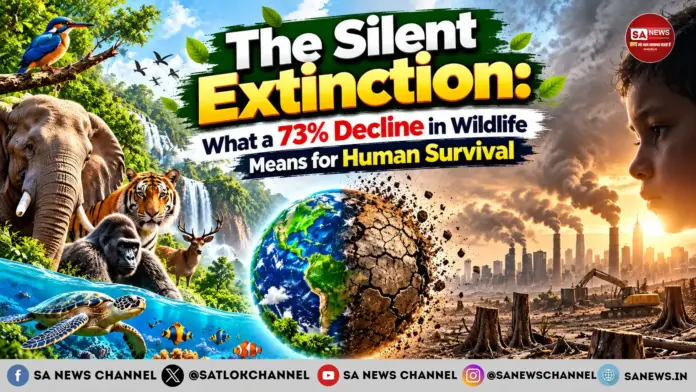

The natural world is undergoing an unprecedented crisis. According to the World Wildlife Fund’s (WWF) landmark Living Planet Report, global wildlife populations have suffered a catastrophic 73% decline over the past five decades. This staggering statistic is not merely an abstract environmental metric; it represents a fundamental breakdown of planet Earth’s life-support systems. From collapsed fisheries to degraded forests, biodiversity loss threatens our clean water, food security, and climate regulation. In this article, we examine what this “silent extinction” means for human survival.
The Alarm Bell: Unpacking the 73% Wildlife Collapse
Over the past half-century, human industrial expansion, habitat destruction, unregulated resource extraction, and climate change have destabilized ecosystems across the globe. Monitored populations of mammals, birds, amphibians, reptiles, and fish have contracted at an alarming rate.
The decline is not uniform across regions. Freshwater species have experienced the most severe losses, declining by over 80% globally. Tropical regions-particularly Latin America and the Caribbean-have recorded staggering drops exceeding 90% in monitored wildlife populations.
Key Factors Driving the Biodiversity Crisis
Habitat Degradation and Loss
Clearing forests for intensive agriculture, urbanization, and mining deprives animals of their natural habitats.
Overexploitation
Illegal wildlife trade, overfishing, and poaching decimate target populations faster than they can reproduce.
Climate Instability
Rising global temperatures, severe droughts, and erratic weather alter ecosystems faster than species can adapt.
Pollution
Chemical runoff, microplastics, and industrial waste poison rivers, soil, and marine environments.
How Biodiversity Loss Directly Threatens Human Survival
Many view wildlife conservation as an ethical or aesthetic concern-an effort to save emblematic species like tigers, whales, or pandas. However, ecological science emphasizes that human survival is inextricably linked to biodiversity.
Collapse of the Global Food System
Ecosystems rely on complex interdependencies. Pollinators-including bees, birds, and bats-are essential for more than 75% of the world’s food crop production. As wild pollinator populations drop due to pesticide overuse and habitat loss, agricultural yields face severe drops, threatening global food security.
Breakdown of Clean Water Systems
Freshwater ecosystems act as natural filtration plants. Wetlands, rivers, and forests filter pollutants, regulate water flows, and prevent flooding. With freshwater species declining by over 80%, river basins worldwide are losing their biological capacity to purify water, triggering severe water scarcity.
Accelerated Climate Catastrophe
Old-growth forests, coastal mangroves, and pristine oceans serve as vital carbon sinks, absorbing billions of tons of carbon dioxide annually. As these ecosystems degrade and lose their resident animal species-many of which play critical roles in seed dispersal and soil health-the planet’s capacity to regulate temperature diminishes rapidly.
Increased Risk of Zoonotic Pandemics
When wild habitats are fragmented, wild animals are forced into closer proximity with human settlements and livestock. This ecological disruption increases the risk of zoonotic spillover-where pathogens jump from animals to humans-raising the likelihood of future global health crises.
Deepening the Crisis: Invisible Ecosystem Collapse and Tipping Points
While a 73% drop in wildlife populations sounds severe, the structural damage underneath is even more dangerous. Ecosystems do not degrade linearly; they hold together until a critical threshold is breached, after which they collapse rapidly and unpredictably.
The Threat of Planetary Tipping Points
The Amazon Rainforest
Often referred to as the lungs of the Earth, massive deforestation combined with global warming is pushing the Amazon toward a “dieback” threshold. If crossed, vast stretches of tropical rainforest will transform into dry savanna, releasing billions of tons of stored carbon into the atmosphere.
Coral Reef Bleaching
Warmer ocean temperatures and acidifying waters have triggered widespread coral bleaching. Coral reefs support over 25% of all marine life despite covering less than 1% of the ocean floor. Their demise directly imperils coastal defense systems and the livelihoods of half a billion people.
Polar Ice and Permafrost Thaw
The disappearance of Arctic ice reduces the planet’s heat reflectivity (albedo effect), while melting permafrost releases ancient reservoirs of methane-a greenhouse gas significantly more potent than carbon dioxide.
The Invisible Soil and Microbiome Crisis
Discussions around wildlife often center on large mammals like tigers, elephants, or whales. However, the micro-world beneath our feet is suffering an equally catastrophic decline:
Soil Biodiversity Depletion
Chemical fertilizers, monoculture farming, and heavy tillage destroy beneficial fungi, soil bacteria, and earthworms. Healthy soil acts as a sponge for carbon and water; dead soil accelerates desertification and crop failure.
Insect Apocalypse
Global insect populations are declining at an unprecedented rate. Insects form the foundational base of terrestrial food webs-serving as key food sources for birds, reptiles, and freshwater fish while decomposing organic matter to cycle nutrients back into crops.
Actionable Solutions: A Blueprint for Global Recovery
Reversing half a century of environmental degradation requires systemic policy shifts combined with radical personal accountability.
Systemic Policy and Economic Realignment
Ending Perverse Subsidies: Governments globally award trillions of dollars in subsidies to fossil fuels, industrial agriculture, and destructive fishing practices. Diverting these funds toward regenerative farming, reforestation, and clean energy is vital.
Enforcing Protected Conservation Zones: Expanding marine protected areas and terrestrial sanctuaries ensures that critical ecosystems have space to regenerate naturally without commercial intrusion.
2. Transitioning to Regenerative Agriculture & Circular Economy
Organic and Regenerative Farming: Shifting away from synthetic chemical inputs to agroforestry, crop rotation, and natural composting restores soil health, conserves water, and protects pollinator species.
Eliminating Food Waste: Roughly one-third of all food produced globally is wasted. Reducing food waste lightens the agricultural pressure on wild land and cuts down greenhouse emissions.
Also Read:Why protecting Biodiversity is essential for Human Survival and Sustainable Development
Beyond Terrestrial Borders: The Unseen Crisis in Ocean Ecosystems
When discussing wildlife loss, attention often shifts to dense tropical forests or national parks. However, the crisis underwater is unfolding at a speed that directly threatens global nutritional security and weather stability.
1. Pelagic Fish Stocks and Apex Predator Collapse
Oceans cover over 70% of the Earth’s surface and absorb roughly 30% of human-generated carbon dioxide. Marine wildlife populations-ranging from open-ocean tuna to coastal pelagic fish-have faced relentless pressure from high-seas industrial trawling, longlining, and ocean acidification.
Loss of Oceanic Apex Predators: Top predators such as sharks, rays, and billfish have declined by more than 70% in abundance over the last half-century. When apex predators disappear, middle-tier species multiply unchecked, destroying kelp forests and seagrass beds that serve as critical marine nurseries.
Commercial Fishery Depletion: Millions of coastal communities across Africa, Asia, and small island nations rely on wild marine capture as their primary source of affordable animal protein. The destabilization of marine food webs threatens the protein security of over 3 billion people.
2. Acidification and Marine Ecosystem Dissolution
Excess atmospheric carbon dioxide dissolves into seawater, forming carbonic acid. This process reduces shell-building minerals for organisms like mollusks, plankton, and coral larvae:
The Base of the Food Web: Pteropods (sea butterflies) and microscopic zooplankton are developing weaker shells that dissolve in acidic waters. Because these micro-creatures form the foundational base of oceanic food webs, their loss triggers a cascade toward total fishery collapse.
The True Financial Cost: Valuing Ecosystem Services
Nature has long been treated by global accounting systems as an infinite resource with zero financial value. Economic research reveals that nature provides over $125 trillion annually in ecosystem services-far exceeding total global gross domestic product (GDP).
The Cost of Inaction vs. Conservation Investment
Invasive Species & Agricultural Damage: Invasive alien species-thriving in disrupted ecosystems-cause over $400 billion in global economic damage every year through crop destruction, infrastructure damage, and disease transmission.
Biodiversity Financing Deficit: Global biodiversity financing hovers between $75 billion and $92 billion annually. Investing in ecological restoration yields an estimated 7-to-1 return in economic value, demonstrating that protecting nature is a smart economic strategy.
Indigenous Wisdom & Nature Stewardship
Indigenous and traditional communities manage or hold custodianship over nearly 20% of the Earth’s landmass, which harbors approximately 80% of the world’s remaining biodiversity.
Key Takeaways from Traditional Stewardship
Reciprocity Over Extraction: Traditional cultures view nature through a lens of reciprocity-taking only what is necessary and actively restoring land through controlled burns, seasonal harvesting, and community protection.
Intergenerational Responsibility: Resource management decisions consider impacts on future generations rather than quarterly financial profits.
The Invisible Casualty: How Biodiversity Loss Breaks Human Health & Medicine
While habitat destruction and animal loss are frequently frame-based around conservation metrics, the human health consequences are immediate, profound, and expanding rapidly.
1. The Erosion of the Natural Pharmacy
A significant percentage of modern pharmaceuticals-including key oncology medications, antibiotics, and cardiovascular drugs-originate directly from wild plant, animal, and microbial species:
Unexplored Plant Molecules: Rain-forest and oceanic flora harbor millions of unstudied organic compounds. As endemic species vanish before scientists can catalogue them, humanity permanently loses potential cures for drug-resistant pathogens and chronic metabolic disorders.
Marine Biomedical Resources: Organisms like deep-sea sponges, cone snails, and horseshoe crabs yield vital diagnostic tools and pain-management proteins. The ocean floor’s thermal vents and coral reefs represent an irreplaceable library of natural bio-molecules under immediate risk from deep-sea mining and bottom trawling.
2. Microbial Diversity and Human Immunity
Human biological systems do not exist in isolation; they are deeply tied to environmental microflora:
The “Old Friends” Hypothesis: Exposure to diverse environmental bacteria, soil microbes, and natural outdoor ecosystems trains the human immune system during early development. Urban environments lacking natural microbial exposure are directly correlated with rising rates of severe childhood allergies, asthma, and inflammatory disorders.
Loss of Natural Vector Control: Healthy, predator-rich ecosystems regulate disease-carrying vectors naturally. When biological controls (such as bats, dragonflies, and predatory fish) suffer population collapse, disease-transmitting insects proliferate, leading to spikes in vector-borne illnesses like dengue, malaria, and Lyme disease.
The Spiritual Perspective on Nature & All Living Beings
While policy shifts and scientific warnings are crucial, the root cause of environmental destruction lies deeper-in human greed, ego, and ignorance of our connection to creation. Modern civilization treats nature merely as a resource to be exploited, disrupting the natural balance established by the Supreme Creator (Param Akshar Purush / Supreme God Kabir). Sant Rampal Ji Maharaj teaches that every soul-human, animal, or bird-originates from the same Divine Almighty. True spiritual devotion requires absolute non-violence (Jeev Daya) and deep compassion toward all living beings, as harming innocent creatures creates severe karmic consequences (Karma Bandhan). External environmental laws alone cannot heal the planet if inner human desires remain unchecked. By adopting true worship (SatBhakti), a vegetarian lifestyle, and vice-free living, followers naturally restore harmony with nature and protect God’s creation.
FAQs on Wildlife Decline
Q1: What does the 73% wildlife decline mean?
The 73% decline refers to the average drop in monitored wildlife population sizes (mammals, birds, amphibians, reptiles, and fish) between 1970 and 2020, as reported in WWF’s Living Planet Report.
Q2: Why is biodiversity loss dangerous for human health?
Loss of biodiversity disrupts ecosystems that filter our air and water, pollinate food crops, and regulate global weather patterns. Ecosystem degradation also increases human exposure to zoonotic diseases.
Q3: What are the main causes of wildlife decline?
The primary drivers include habitat destruction (deforestation for agriculture and urban development), overexploitation (overfishing, illegal hunting), climate change, pollution, and invasive species.
Q4: Can biodiversity loss be reversed?
Yes. By adopting sustainable agriculture, rapidly transitioning to clean energy, restoring degraded ecosystems, enforcing strong wildlife protection laws, and reducing resource consumption, nature can recover.
Q5: What is the single biggest driver of biodiversity loss?
The global food and agriculture system is the primary driver of habitat destruction, deforestation, soil degradation, and chemical pollution, consuming vast land areas at the expense of wild species.